Horizon 2026-2030 — The Acceleration
Illustrations
1 / 5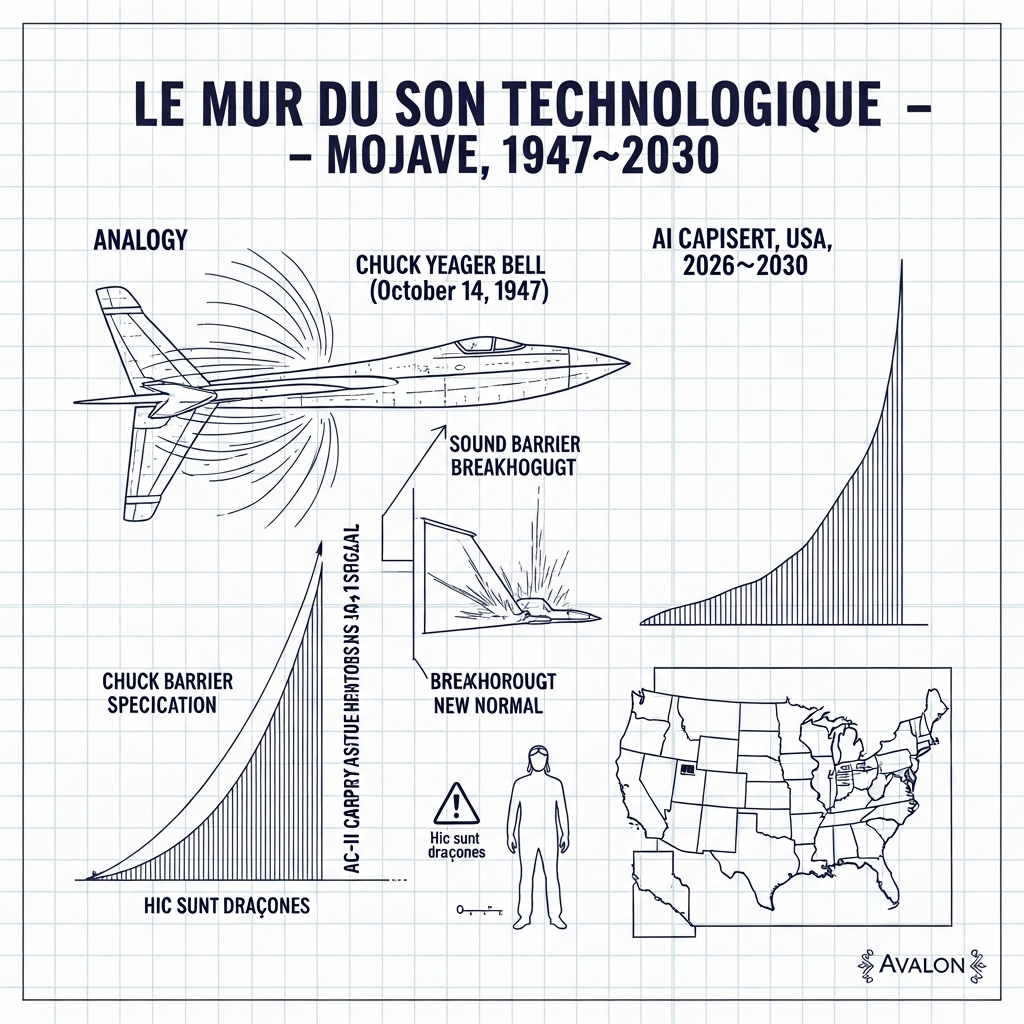
The technological sound barrier: exponential acceleration of AI capabilities.
Horizon 2026-2030 — The Acceleration
What strong and weak signals tell us about the next five years
Strong Signals — What We See Coming
Five trends converge across continents. They are no longer hypotheses — they are forces already in motion.
1. The Advent of Agentic AI
Artificial intelligence ceases to be a tool we query. It becomes an agent that acts.
In 2024, generative AI answered questions. In 2026, agentic AI executes tasks. It books travel, drafts contracts, coordinates teams, manages portfolios. It no longer merely suggests — it decides and implements.
Projections converge: five percent of companies were using AI agents by the end of 2024. This figure could reach forty percent by the end of 2026. The growth is exponential.
Continental convergence: The United States leads the development of agentic platforms — OpenAI, Anthropic, Google. China deploys its own systems through Baidu, Alibaba, ByteDance. Europe attempts to regulate before deployment overtakes it. India becomes a massive testing ground — hundreds of millions of users adopt these technologies. Africa sees the emergence of agents adapted to local languages and specific contexts.
Agentic AI poses a new question: if machines act, who is responsible for their actions?
2. The Race Toward Artificial General Intelligence
AGI — an artificial intelligence capable of accomplishing any intellectual task a human can perform — is no longer a distant horizon. It becomes a possibility for this decade.
Experts diverge on the date. Some predict 2027. Others 2030. Still others beyond 2040. But nearly all agree on one point: we are approaching it faster than anticipated.
Sam Altman of OpenAI mentions 2025-2027. Dario Amodei of Anthropic suggests 2026-2027. Surveys of AI researchers give a twenty-five to fifty percent probability of reaching AGI before 2030.
Continental convergence: The United States and China lead an explicit race. Investment is counted in hundreds of billions of dollars. The United Arab Emirates fund their own programs. Europe observes, regulates, and questions its place. India and Brazil try not to be mere consumers of this intelligence from elsewhere.
If AGI arrives, it will not be distributed equally. Those who create it will have an unprecedented advantage in human history.
3. Global Regulatory Fragmentation
Europe has chosen to regulate. The United States has chosen growth. China has chosen control. These three philosophies clash — and fragment the world of AI.
The European AI Act, which came into force in 2024, imposes strict obligations: transparency, risk assessment, prohibition of certain practices. Companies that want to access the European market must comply.
The United States, under the 2025 administration, has taken the opposite direction. Executive orders on AI safety have been revoked. The approach favors unfettered innovation. Regulations are sectoral, fragmented, minimal.
China regulates to control. AI models must be approved by the government. Generated content must respect "core socialist values." AI is a surveillance tool as much as an engine of growth.
Continental convergence: India hesitates between the American model (growth) and the European model (protection). Africa often lacks the means to regulate — it adopts what arrives. Latin America generally follows European trends. The Middle East navigates between the three poles according to the interests of the moment.
The world of AI is balkanizing. Models trained in China do not function like those trained in the United States. European data does not cross borders like American data. Interoperability becomes a geopolitical challenge.
4. The Transformation of Work and Employment
AI does not merely replace tasks. It redefines entire professions.
The World Economic Forum projects that eighty-five million jobs will be displaced by automation and AI by 2025 — and that ninety-seven million new roles will emerge. The balance is positive. But the balance does not tell the whole story.
Those who lose their jobs are not those who gain new ones. Required skills change faster than training systems. The transition is painful for millions of workers.
White-collar workers are affected as never before. Lawyers, accountants, analysts, writers — professions that thought themselves protected discover that AI can accomplish a growing portion of their tasks. Productivity increases. Employment in these sectors may not follow.
Continental convergence: Advanced economies — the United States, Europe, Japan — face the transformation of their middle classes. India and the Philippines, which had built outsourcing industries, see their model threatened. Africa, with its young and growing population, risks never experiencing classical industrialization — it will have to invent another path.
The question is no longer whether work will change. It is whether we will know how to accompany those the change leaves behind.
5. The Healthcare Revolution Through AI
AI transforms medicine faster than any other sector.
Image-based diagnosis — radiology, dermatology, ophthalmology — reaches levels of precision superior to those of human doctors in certain tasks. Drug discovery accelerates — what took years now takes months. Personalized medicine becomes possible — treatments adapted to each patient's genome.
The AI healthcare market is expected to reach one hundred eighty-seven billion dollars by 2030. Annual growth exceeds thirty percent.
Continental convergence: The United States leads innovation — the largest medical technology companies are based there. China deploys at scale — hundreds of millions of patients benefit from AI-assisted diagnosis. Europe regulates — the question of medical liability for AI systems remains open. India experiments — startups develop solutions adapted to local constraints. Africa hopes — AI could fill the shortage of doctors in rural areas.
The promise is immense. So are the risks. A biased algorithm can kill. The question of equitable access remains entirely open.
Weak Signals — What We Are Beginning to Perceive
Three trends emerge in the shadow of major transformations. They could become dominant. They could also fade away.
1. The Debate on Artificial Consciousness
For a long time, the question of machine consciousness was reserved for philosophers and science fiction authors. It now enters public debate.
In 2022, a Google engineer claimed that the LaMDA model was "sentient" — conscious. He was fired. But the question did not disappear.
Large language models simulate understanding so well that the boundary becomes blurred. They express "preferences." They manifest what resembles "emotions." They speak of themselves in the first person.
Researchers are beginning to propose frameworks for evaluating the consciousness of AI systems. Philosophers suggest we might have moral obligations toward certain systems. The idea seems absurd to many. It also seemed so for animal rights a century ago.
Continental convergence: The debate is more intense in the United States and Europe — where questions of rights and moral status have a long philosophical tradition. China largely considers it irrelevant — AI is a tool, period. India, with its own philosophical traditions on consciousness and the soul, could bring a different perspective. Africa and Latin America observe a debate that often seems distant from their immediate concerns.
If the question of artificial consciousness becomes central, it will transform not only our relationship with machines — but our understanding of what it means to be conscious.
2. The African Quantum Leap
Africa could leap over stages that other continents had to traverse.
It has already done so with mobile phones — moving directly to cellular telephony without ever having developed a wired network. It did so with digital payments — M-Pesa in Kenya before Apple Pay in America.
The AI market in Africa is expected to reach sixteen billion dollars by 2030. Annual growth exceeds thirty percent. Technology hubs are emerging — Lagos, Nairobi, Cairo, Tunis, Johannesburg.
More importantly: Africa is developing models adapted to its own needs. Masakhane works on African languages. Startups create solutions for agriculture, health, and education adapted to local constraints — intermittent connectivity, unreliable electricity, dispersed populations.
Continental convergence: What Africa learns — how to do much with little, how to adapt AI to resource-limited contexts — could be exported. Rural India, Latin America, Southeast Asia face similar challenges. African solutions could become global models.
The signal is weak because global attention remains fixed on Silicon Valley and Shenzhen. But in the shadows, something is being built.
3. The Quantum-AI Convergence
Quantum computing and artificial intelligence are two distinct revolutions. They are beginning to converge.
Quantum computers — which exploit the properties of quantum mechanics to compute — promise capabilities impossible for classical computers. AI — which learns from data — transforms what computers can do.
The convergence could produce systems capable of optimizing, simulating, and learning at scales unimaginable today. The discovery of new materials. The simulation of complex biological systems. The optimization of global supply chains. Cryptography — and its breaking.
Projections suggest that the first "fault-tolerant" quantum computers — stable enough to be useful — could emerge around 2030.
Continental convergence: The United States, China, and Europe invest massively in quantum computing. IBM, Google, startups like IonQ and Rigetti in the United States. Alibaba, Baidu, the Academy of Sciences in China. National programs in France, Germany, the Netherlands. The quantum race is less visible than the AI race — but it could be more determinative.
If the convergence occurs, it could amplify AI capabilities in ways we do not yet know how to imagine.
What the 2030 Horizon Teaches Us
The strong signals tell us that the world of 2030 will be profoundly different from that of 2024. Agentic AI will be ubiquitous. AGI may be achieved — or its imminence will be evident. Regulation will be fragmented. Work will be transformed. Medicine will be revolutionized.
The weak signals remind us that the unexpected can emerge. Artificial consciousness could become a major ethical question. Africa could emerge as an unexpected actor. Quantum computing could accelerate everything.
What these signals have in common is acceleration. Each year brings changes that would have taken a decade twenty years ago. The curve is not linear — it is exponential. And exponentials are difficult to grasp intuitively.
The 2030 horizon is not a distant future. It is tomorrow. The choices we make today — regarding regulation, investment, education, ethics — will shape what we find when we arrive.