Introduction
Illustrations
1 / 7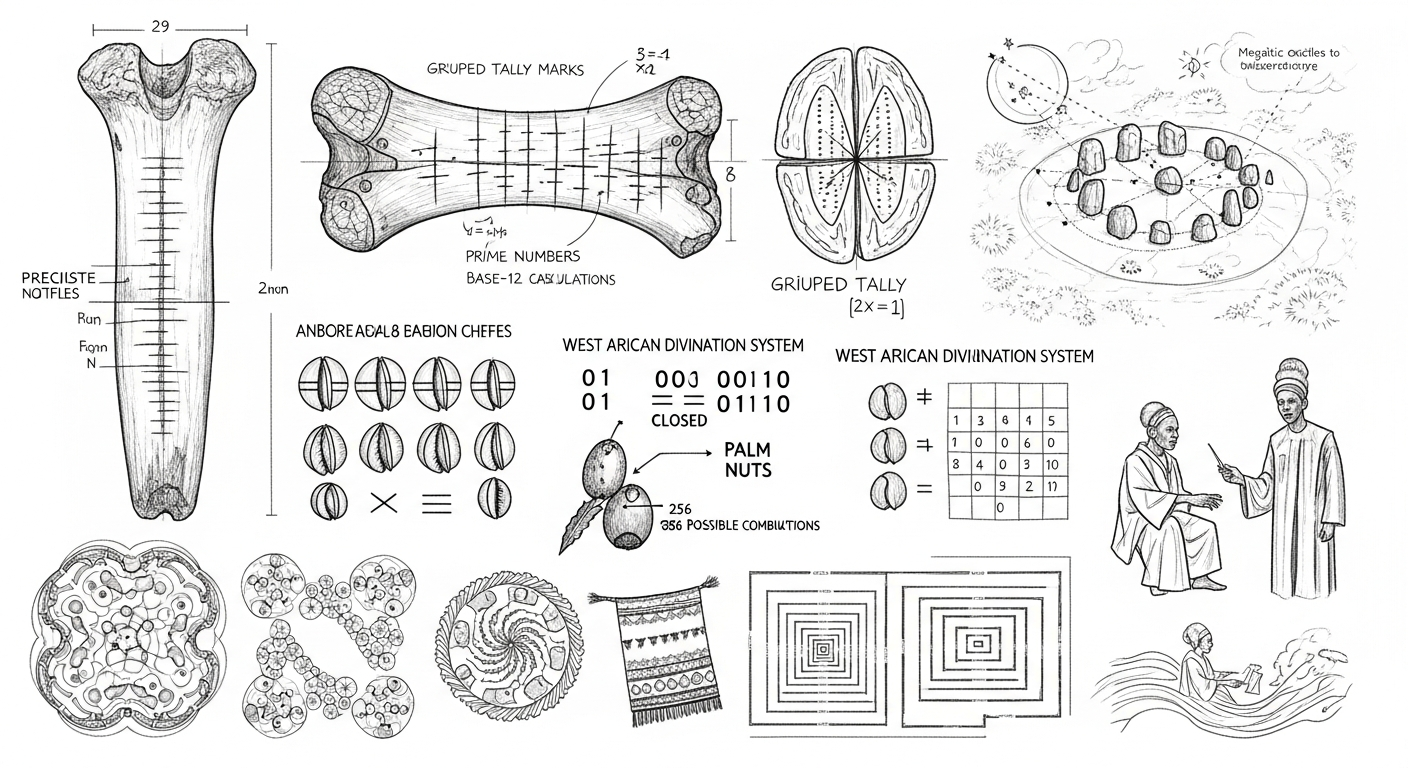
African traditions and their contributions to computational thinking.
Intelligence Before Machines: Introduction
The history of artificial intelligence, as it is usually told, begins in 1956, in a conference room at Dartmouth College, when a handful of American researchers coined the term and founded the discipline. This story is true. It is also radically incomplete.
For the dream of creating artificial beings capable of thinking, deciding, and acting on their own—this dream did not wait for electricity to be born. It has traversed humanity since we first learned to forge tools and formalize our thoughts. From the African savannas to the tropical forests of Mesoamerica, from the temples of the Nile to the peat bogs of Denmark, from Yoruba sanctuaries to the workshops of imperial China, every civilization has laid, in its own way, the foundations of what we now call artificial intelligence.
This first part explores these forgotten roots. It brings together seven tales, seven journeys across continents and millennia, to show that the newest questions are sometimes the oldest in the world.
Africa — Notches and Stars
This article covers an extended period, from Prehistory to Antiquity, to demonstrate the continuity of knowledge.
The Lebombo bone, discovered at the border of South Africa, bears twenty-nine notches dated to forty-three thousand years ago—the oldest evidence of numerical thought ever discovered. Twenty thousand years later, the Ishango bone reveals a base-twelve numeration system and perhaps the first prime numbers. Seven thousand years before our era, the stone circle of Nabta Playa, in the Nubian desert, predates Stonehenge by two millennia.
But it is the Ifá system of the Yoruba that offers the most startling discovery: a divination system using two hundred fifty-six configurations obtained through binary combination—an eight-bit coding structurally identical to the EBCDIC code of the first IBM computers, developed two millennia before Leibniz. The babalawo does not divine randomly: he calculates. Ethnomathematician Ron Eglash recognized in it "a pseudo-random number generator" and "a digital feedback loop." Binary is not a Western invention. It is an African heritage.
Americas — Zero and the Stars
The Olmecs, then the Maya, invented positional zero more than a millennium before it reached Europe—that concept without which no computer could function. Their vigesimal system allowed them to calculate planetary trajectories and write dates spanning millions of years. The Long Count calendar integrated multiple temporal cycles into a coherent system that foreshadows our modern data structures.
Maya priest-astronomers observed the sky from observatories like Uaxactún, where aligned temples allowed them to mark equinoxes and solstices with precision. At Copán, stelae recorded the cycles of the moon and planets with remarkable accuracy. Astronomy, here as elsewhere, was the mother of computation. Zero was not born in Silicon Valley laboratories. It was born in the tropical forests of Mesoamerica.
Asia
China — The Empire of Automata
Three thousand years before the word "robot" was invented, the craftsman Yan Shi presented to King Mu of Zhou a life-sized android capable of singing, dancing, and seducing—to the point of provoking the sovereign's jealousy. This scene, reported in the Taoist text Liezi, inaugurates a tradition of mechanical innovation that would span more than a millennium of Chinese history, from the Warring States period to the final centuries of Antiquity.
The article traces this lineage: Lu Ban and his wooden bird capable of gliding for three days; Mozi and his school of engineers who developed a formal logic rivaling that of the Greeks; and above all Ma Jun's south-pointing chariot, with its differential gear system—ancestor of the GPS, invented fifteen centuries before the automobile industry. For the ancient Chinese, the concept of qi, the vital breath, could animate a body of flesh as well as a machine of wood and bronze.
India — The Bronze Guardians
Hindu epics abound with artificial beings. Vishwakarma, the divine architect, forges the Pushpaka Vimana, that celestial vehicle capable of traveling "at the speed of thought." Maya, the engineer of demons, builds palaces whose crystal floors deceive visitors.
But the most extraordinary story comes from a Buddhist legend: mechanical warriors called bhuta vahana yanta—"machines with spiritual movement"—guarded the Buddha's relics in an underground chamber at Pataliputra. Legend tells that their plans came from the Greco-Roman world, transported in the flesh of a murdered engineer. Emperor Ashoka himself had to confront these robots before gaining access to the relics. This story testifies to a circulation of technical knowledge between civilizations from Antiquity—and raises the ever-relevant question of controlling autonomous systems.
Europe
Ancient Europe — Arcs and Stars
Before the Greek philosophers, peoples without writing observed the sky with a patience we can barely imagine. The Nebra sky disk, dated to 1600 BCE, is the oldest concrete astronomical representation ever discovered. The Trundholm sun chariot perhaps encodes the Metonic cycle—the relationship between solar years and lunar months—more than a millennium before the Greeks gave it a name.
Celtic druids transmitted their knowledge exclusively through oral tradition, during twenty years of training. The Coligny calendar, engraved to resist the imposition of the Julian calendar, predicted lunar positions to within a day over five centuries. The Etruscans invented the arch and vault, taught the Romans the alphabet and numerals. Roman surveyors with their groma executed spatial calculation algorithms. The Roman abacus, the first portable calculator, gave its name to the word "calculate." Caesar's automaton, showing its twenty-three wounds to the crowd, triggered a riot that changed history.
Greece — The Forges of the Mind
In Homer's tales, the blacksmith god Hephaestus creates bronze automata: Talos, the giant who patrols the coasts of Crete, detecting enemy ships and hurling rocks at invaders; golden tripods mounted on wheels that serve the gods without human intervention; guard dogs of precious metals watching over palace gates. These mythological creatures already embody the fundamental components of any robot: sensors, processor, effectors, power source.
Meanwhile, Aristotle formalized the syllogism—that reasoning machine that transforms thought into reproducible procedure. The founding intuition of artificial intelligence takes shape: if reasoning follows rules, then perhaps a machine could think. Today's expert systems, inference engines, and reasoning chains of large language models descend directly from this Aristotelian logic.
Middle East — Temples of Illusion
It was in the fertile crescent of the Middle East that humanity invented the first algorithms. Babylonian cuneiform tablets contain systematic procedures for solving mathematical problems—a "machine language" of formulas, according to computer scientist Donald Knuth. The sexagesimal system, the Plimpton 322 tablet with its Pythagorean triples, the calculation of Jupiter's trajectory using the area of a trapezoid: the Babylonians wielded a mathematics of abstraction fourteen centuries before Europe.
In Egypt, as early as 2500 BCE, temples housed speaking statues. Hidden systems of levers and tubes allowed priests to make idols move and speak. The interface mattered as much as the mechanism. In Alexandria, Ctesibius, Philo, and Hero brought this art to its peak: water clocks, hydraulic organs, mechanical servants pouring wine, coin-operated holy water dispensers, fully programmed mechanical theater. The priest had become a programmer—not of code, but of belief.
These seven tales sketch a geography of intelligence that extends far beyond the borders of the modern West. They reveal that the fundamental questions of artificial intelligence—autonomy, decision-making, formal reasoning, information storage and transmission—were posed and partially solved by civilizations that had neither electricity nor silicon.
The story we are about to tell is not one of sudden invention. It is that of a millennial, universal quest, as old as our capacity to shape matter and ask ourselves what distinguishes the living from the inert. It will continue, in the second part of this work, through the Middle Ages—the golden age of Islamic automata, European clocks, and the first logic machines.
But before crossing that threshold, we must measure what Antiquity has bequeathed us. Not machines, but something more precious still: the questions that would one day make them possible.