Introduction
Illustrations
1 / 6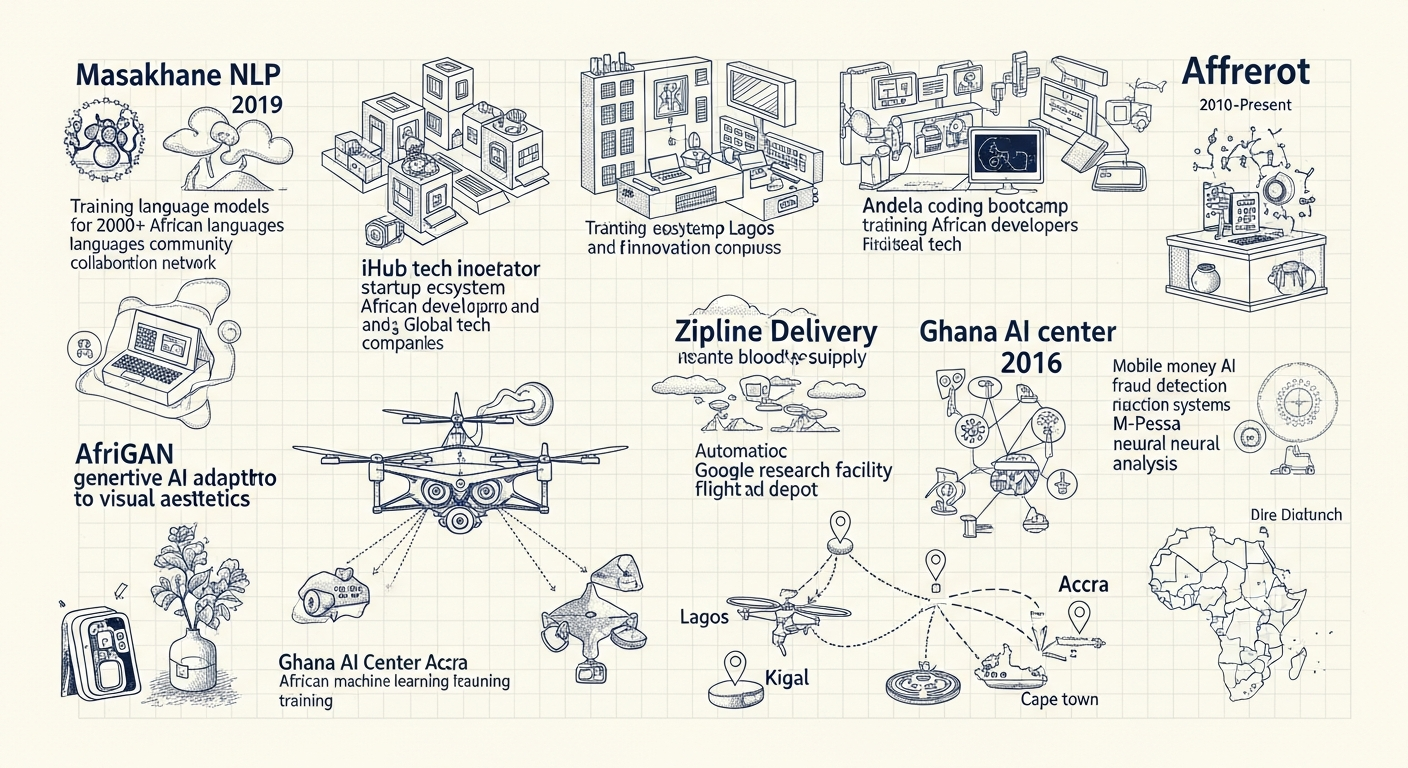
Africa: emergence of an African AI ecosystem and sovereignty challenges.
The Deep Learning Revolution: Introduction
On September 30, 2012, in a bedroom at his parents' house, a Canadian doctoral student named Alex Krizhevsky trained a neural network on two video game graphics cards. Eight days later, his system — AlexNet — won the ImageNet challenge with an error rate of 15.3%, shattering the previous record by ten points. The world of artificial intelligence shifted.
This moment encapsulates the period we are now traversing. Between 2010 and today, humanity witnessed the most spectacular acceleration in the history of AI. Neural networks, abandoned during the previous winters, returned with force. Machines learned to see, to speak, to write. On November 30, 2022, ChatGPT reached one million users in five days — the fastest-growing application in the history of the Internet. In March 2023, GPT-4 passed bar examinations. In October 2024, Demis Hassabis and John Jumper received the Nobel Prize in Chemistry for AlphaFold, which had predicted the structure of two hundred million proteins.
But this revolution did not have just one epicenter. Across the planet, new players emerged, sometimes where least expected. Africa saw the birth of more than two thousand four hundred artificial intelligence companies. The United Arab Emirates appointed the world's first AI minister and created the first university entirely dedicated to this field. France brought forth Mistral AI, the only credible European competitor to OpenAI, valued at fourteen billion dollars in less than two years. China produced four times more AI patents than the United States. India became the world leader in AI skills penetration according to the Stanford index.
This sixth part completes the journey begun in Antiquity, continued through the Middle Ages, the Early Modern period, the Age of Revolutions, and the Information Age. Six continents, fifteen years of dizzying acceleration — and everywhere the same question: who shapes artificial intelligence, and according to what values?
Africa — The Quantum Leap
Africa did not wait to be invited to the AI table. It took its seat.
In 2024, more than two thousand four hundred African companies are building artificial intelligence infrastructure. South Africa leads, followed by Kenya and Nigeria. InstaDeep, founded in Tunis in 2015, was acquired by BioNTech for six hundred eighty-two million dollars — the largest acquisition of an African AI startup in history.
But it is in adapting to local realities that Africa innovates most. Intron Health, in Nigeria, develops voice recognition for African accents with ninety-two percent accuracy — where Western systems fail. The CDIAL platform integrates one hundred eighty African languages. Awarri is building the first Nigerian large language model. Africa teaches us that universal AI does not exist — and that inclusion comes through creation, not just adoption.
Americas — Godfathers and Giants
In 2018, three researchers received the Turing Award: Geoffrey Hinton, Yoshua Bengio, and Yann LeCun. They were nicknamed the "godfathers of deep learning." Two of them worked in Canada.
Canada had become, almost by accident, the epicenter of the revolution. During the AI winters, when no one believed in it, Hinton in Toronto and Bengio in Montreal had persisted. In 2017, Canada became the first country to establish a national artificial intelligence strategy. In 2024, it invested two billion four hundred million dollars in the field. Yoshua Bengio is today the most cited scientist in the world, across all disciplines.
But it was in the United States that the giants emerged. OpenAI launched ChatGPT. Anthropic created Claude. Google deployed Gemini. Meta released Llama as open source. The race for large language models became the new space race — with training costs reaching hundreds of millions of dollars.
Further south, Latin America leapt forward. The AI adoption rate there jumped from twenty-two to forty percent in one year. Brazil has more than one thousand seven hundred agricultural technology companies, ninety percent of which use AI. Argentina has developed smart irrigation solutions that saved seventy-two billion liters of water. The Americas teach us that AI is built at multiple scales — from university laboratories to tech giants, from agricultural startups to national strategies.
Asia — The New Center of Gravity
In May 2023, a Chinese company named DeepSeek was founded. Less than two years later, its models rivaled those of OpenAI — at a fraction of the cost. China then had one million six hundred seventy thousand AI-related companies and was filing four times more patents than the United States.
But Asia is not just a Chinese story. India, according to the 2024 Stanford index, holds first place in the world for AI skills penetration. Its talent pool has grown by two hundred sixty-three percent since 2016. The IndiaAI mission, launched in March 2024, plans to quadruple the country's computing capacity. Anthropic, Google, and OpenAI are opening offices there.
Taiwan remains the world's "silicon shield." TSMC manufactures sixty-four percent of global semiconductors. Without Taiwan, neither NVIDIA, nor AMD, nor Apple could produce their most advanced chips. The geopolitics of AI runs through the Taiwan Strait.
Fei-Fei Li, born in China, had created ImageNet in 2009 — the database that made AlexNet possible. Kai-Fu Lee, who led Google China, became one of the most influential investors in global AI. Asia teaches us that the center of technological gravity can shift — and perhaps it already is.
Europe — Rule and Exception
On July 12, 2024, the European Union published the AI Act — the world's first comprehensive regulation of artificial intelligence. Fines of up to thirty-five million euros or seven percent of global revenue. Prohibitions on systems posing "unacceptable risk." Europe chose to regulate what it did not dominate.
But the exception emerged where no one expected it. In April 2023, three former DeepMind and Meta employees founded Mistral AI in Paris. Their initial funding — one hundred thirteen million euros — was the largest in European history for a nascent company. Eighteen months later, Mistral was valued at fourteen billion dollars. Europe's only credible competitor to the American giants had been born.
DeepMind, founded in London in 2010, had already proved that Europe could produce excellence. AlphaGo defeated the world champion of Go in 2016. AlphaFold solved a fifty-year-old problem — protein structure prediction — and earned its creators the Nobel Prize. More than three million researchers in one hundred ninety countries use AlphaFold today.
But Europe also lost battles. Aleph Alpha, the German startup that was supposed to rival OpenAI, abandoned its large language model ambitions in 2024. Europe teaches us that regulation can precede innovation — and that the exception sometimes proves the rule.
Middle East — Silicon Gardens
In 2017, the United Arab Emirates appointed Omar Al Olama as Minister of Artificial Intelligence — the first in the world. Two years later, they created MBZUAI, the first university entirely dedicated to AI. In 2022, they launched Falcon, their own large language model. In 2024, Microsoft invested one and a half billion dollars in G42, the Emirati AI champion.
The Emirates have invested one hundred forty-seven billion dollars in artificial intelligence since 2024. Their AI workforce has quadrupled since 2001 to reach one hundred twenty thousand people. The desert has been transformed into a silicon garden.
Israel, for its part, remains the "startup nation." Its artificial intelligence ecosystem, heir to Unit 8200 and cybersecurity pioneers, continues to produce innovations in computer vision, autonomous driving, and medical technologies. The Middle East teaches us that political will can create ecosystems — and that oil resources can fund the transition to the knowledge economy.
Oceania — Archipelago of Innovation
Australia has nearly quadrupled its artificial intelligence patents between 2015 and 2024 — from one hundred seventy to six hundred twenty-nine. Its AI publications have grown from five to nearly twelve percent of the national scientific total. CSIRO Data61 has become a world leader in agent systems and privacy-preserving AI.
In December 2024, CSIRO and the University of Adelaide launched the RAIR Centre — a new research hub for responsible artificial intelligence. Venture capital funding for Australian AI has reached one billion three hundred million Australian dollars.
But Oceania faces a paradox: it produces one point six percent of global AI research, but only zero point two percent of patents. Research is not being transformed into industry quickly enough. Oceania teaches us that scientific excellence does not guarantee technological sovereignty — and that innovation must find its way to market.
These six narratives map a geography of acceleration where old hierarchies are wavering. They reveal that the 2010-present period was both the moment when artificial intelligence became ubiquitous — from laboratories to smartphones, from hospitals to classrooms — and the moment when new players entered the race.
North America gave us the godfathers of deep learning and the tech giants. Africa gave us innovation adapted to local realities and the question of linguistic inclusion. Asia gave us the new center of gravity — China, India, Taiwan — and proof that dominance can shift continents. Europe gave us the first global regulation and the Mistral exception. The Middle East gave us proof that political will can create ecosystems. Oceania gave us scientific excellence and the question of its transformation into industry.
The period ends — if indeed it has ended — on an open question. Artificial intelligence is already transforming work, creation, research, war, politics. It will do so even more. But according to what rules? For whose benefit? With what guarantees?
Geoffrey Hinton, one of the godfathers, resigned from Google in 2023 to sound the alarm about risks. Yoshua Bengio, the other Canadian godfather, advocates for global governance. Timnit Gebru, African pioneer of algorithmic bias research, continues to ask the questions others prefer to ignore. Technology advances. Ethics runs behind.
Understanding this acceleration — including what it promises and what it threatens — may be the condition for shaping it rather than simply enduring it.