Rule and Exception
Illustrations
1 / 5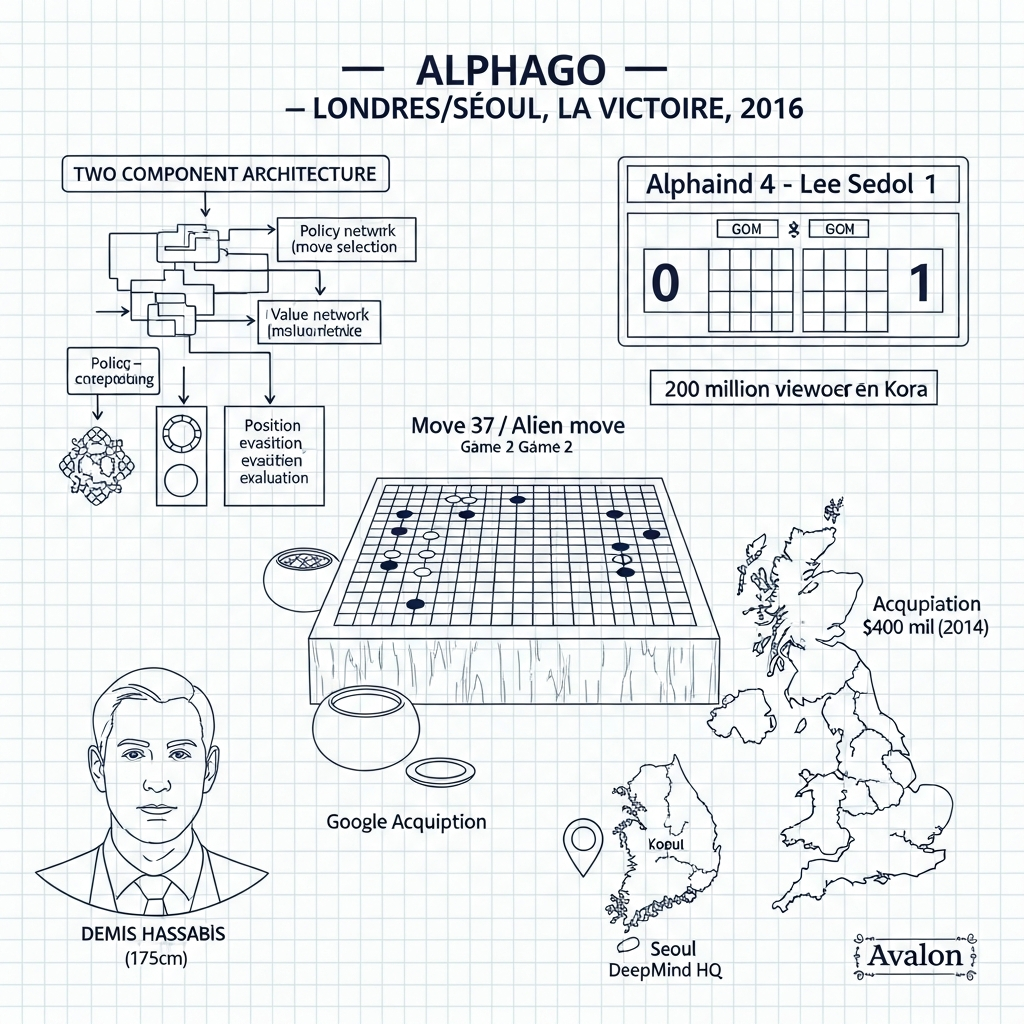
AlphaGo defeats Lee Sedol (2016): historic moment for AI.
Yesterday — The Heirs of Bletchley Park
There exists a particular form of European genius: one that is born in adversity, flourishes in discretion, and receives recognition only after the fact.
In 2010, three men founded a company in London. Demis Hassabis, Shane Legg, Mustafa Suleyman. Their ambition: to create artificial general intelligence — a machine capable of learning any intellectual task that a human can accomplish. They called it DeepMind.
Demis Hassabis was a prodigy. Chess champion at thirteen, video game designer at seventeen, neuroscientist at twenty-nine. He had grown up in London, studied at Cambridge and University College London. He embodied a European tradition of transdisciplinary thinking — a bridge between neuroscience and computer science, between theory and application.
In 2014, Google bought DeepMind for four hundred million pounds sterling. Europe had just produced one of the most promising AI startups in the world — and sold it to an American giant.
But DeepMind, even under the Google flag, remained in London. And it transformed the world.
In March 2016, AlphaGo defeated Lee Sedol, one of the greatest Go players in history, four games to one. Go — a Chinese strategy game more than two thousand five hundred years old — had been considered a "holy grail" of artificial intelligence. The number of possible positions on a Go board exceeds the number of atoms in the observable universe. Traditional programming techniques had failed for decades. AlphaGo succeeded by combining deep learning with tree search — a synthesis of brute force and learned intuition.
The victory traveled around the world. In South Korea, where Go is a national sport, two hundred million people watched the matches live. AI had just crossed a symbolic threshold. What humans considered the supreme expression of their strategic intelligence could now be surpassed by a machine.
Then came AlphaFold.
Protein folding — the way a chain of amino acids folds to form a three-dimensional structure — was one of the most difficult problems in biology. For fifty years, researchers around the world had been trying to solve it. Structure determines function; understanding how proteins fold would allow us to understand diseases, design drugs, transform medicine.
In 2020, AlphaFold2 solved the problem. The system could predict the structure of a protein with accuracy comparable to experimental methods — but in minutes rather than months or years. DeepMind published predictions for two hundred million known proteins, making them freely available to all researchers in the world.
More than two million scientists in one hundred ninety countries use AlphaFold today. Science magazine named AlphaFold2 "Breakthrough of the Year" in 2021.
In October 2024, Demis Hassabis and John Jumper received the Nobel Prize in Chemistry — sharing the distinction with David Baker for his work on computational protein design. Artificial intelligence had just won a Nobel. Europe, via DeepMind, had contributed to this revolution.
Today — The Rule
While DeepMind was transforming biology, Europe was doing something no one else dared to do: it was regulating.
On July 12, 2024, the Artificial Intelligence Regulation — the AI Act — was published in the Official Journal of the European Union. It was the world's first comprehensive legislation governing AI. It entered into force on August 1, 2024.
Europe had chosen to regulate what it did not dominate.
The approach was based on risk. The more damage an AI system could cause, the stricter the rules. Four categories were defined.
Systems posing "unacceptable risk" were banned. Mass facial recognition. Social scoring. Behavioral manipulation exploiting vulnerabilities. Predictive policing based solely on profiling. Europe was drawing red lines that others dared not draw.
"High-risk" systems — those used in employment, justice, access to essential services — were subjected to strict obligations. Risk management. Human oversight. Transparency. Regular audits. Technical documentation. Companies deploying these systems had to prove they were safe and fair.
"Limited risk" systems — such as conversational agents — were subject to transparency obligations. Users had to know they were interacting with a machine.
"Minimal risk" systems — the vast majority of AI applications — remained unregulated.
Penalties were severe: up to thirty-five million euros or seven percent of global turnover, whichever was higher. Europe was showing that it took regulation seriously.
General-purpose AI models — like GPT-4 or Claude — were subject to transparency requirements: respect for copyright, publication of detailed summaries of training content. The most powerful models, likely to pose systemic risks, had to additionally conduct evaluations, mitigate identified risks, and report incidents.
The AI Act set a global precedent. Just as the General Data Protection Regulation (GDPR) had influenced privacy laws around the world, the AI Act could become a model for AI regulation on a planetary scale. Europe was exporting its standards — since it could not export its technologies.
Criticisms were plentiful. Some argued that Europe was regulating an industry where it had no champions. That constraints would discourage innovation. That European companies would be disadvantaged against less restricted American or Chinese competitors. That Europe was becoming a technology museum — a place preserving the values of the past rather than building the future.
Others responded that regulation was not the enemy of innovation — that it could instead create a framework of trust enabling massive AI deployment. That companies respecting European standards would gain a competitive advantage in ethics-conscious markets. That Europe was choosing to defend a vision of AI compatible with fundamental rights.
The debate remained open. But Europe had made a choice — and that choice would shape the next decade.
The Exception
Then the improbable occurred.
In April 2023, three Frenchmen founded a company in Paris. Arthur Mensch, thirty-two, formerly of Google DeepMind. Guillaume Lample and Timothee Lacroix, in their thirties, formerly of Meta. All three had met at the Ecole Polytechnique. They created Mistral AI.
Two months later, in June 2023, Mistral raised one hundred five million euros — the largest initial funding ever for a European AI startup. In December, a second round of three hundred eighty-five million followed, bringing the valuation to more than two billion dollars. Europe had its champion.
Mistral was not seeking to copy OpenAI. It proposed a different approach. Its models were open — the source code and network weights were published, allowing anyone to use, modify, and adapt them. This strategy, inspired by free software, aimed to create an ecosystem where innovation would be collective rather than concentrated.
Mistral's models rivaled those of the American giants on many performance benchmarks — while being lighter, faster, and less costly to run. European efficiency against American brute force.
In June 2024, Mistral raised six hundred million euros, bringing its valuation to nearly six billion dollars. It had become the fourth AI company in the world by valuation — and the first outside the San Francisco Bay Area.
In September 2025, ASML, the Dutch giant of semiconductor manufacturing equipment, led a funding round of one billion seven hundred million euros, valuing Mistral at nearly fourteen billion dollars. The three founders became the first French AI billionaires.
Mistral was proving that Europe could produce champions — not just sell them to Americans as it had done with DeepMind. The exception existed.
But the exception remained precarious.
Aleph Alpha, the German startup that was supposed to be Germany's Mistral, abandoned its large language model ambitions in 2024. Europe remained fragmented — each country wanting its national champion rather than building continental-scale ecosystems.
The United Kingdom, having left the European Union, retained DeepMind but had not produced a comparable successor. France had Mistral. Germany had research centers but few first-tier startups. Small European countries often had nothing.
European investment in AI remained a fraction of that in the United States or China. Talent trained in Europe often left for Silicon Valley, attracted by higher salaries and more dynamic ecosystems. The brain drain continued.
Europe produced world-class researchers — Yann LeCun, one of the godfathers of AI, was French before becoming American. It trained excellent engineers. But it struggled to transform this excellence into dominant companies.
Beyond — The European Choice
The Europe of AI is the site of a fundamental tension: between rule and exception, between regulation and innovation, between values and power.
It first teaches us that regulation can precede domination. Europe chose to define the rules of the global AI game — even if it was not the dominant player. The AI Act is a wager: that European standards will become global standards, that companies around the world will have to comply to access the European market of five hundred million consumers. This is the "Brussels Effect" — Europe's ability to project its standards beyond its borders.
It then teaches us that scientific excellence does not guarantee economic domination. Europe invented the World Wide Web (Tim Berners-Lee at CERN), Linux (Linus Torvalds in Finland), convolutional neural networks (Yann LeCun in France). It produced DeepMind, which won a Nobel Prize. But the giants of global AI — OpenAI, Google, Anthropic, Meta — are American. The transition from research to industry remains Europe's weak link.
It finally teaches us that exceptions can become models. Mistral proved that a European startup could compete with American giants in less than two years. DeepMind proved that Europe could produce major scientific breakthroughs in AI. These exceptions show that Europe has the potential — the challenge is to systematize it.
The European choice is a civilizational choice.
Europe has decided that AI must respect fundamental rights. That mass facial recognition is incompatible with a free society. That behavioral manipulation is unacceptable. That humans must maintain control over machines. That transparency is non-negotiable.
These choices have a cost. They can slow innovation. They can disadvantage European companies against less scrupulous competitors. They can make Europe a spectator rather than an actor in the AI revolution.
But they also have value. They define what Europe refuses to sacrifice — even for technological power. They offer an alternative model to that of Silicon Valley (innovation at all costs) and that of Beijing (innovation under state control). They propose a third way: innovation framed by rights.
Is this path viable? Mistral and DeepMind suggest yes — that Europe can innovate while respecting its values. The AI Act suggests yes — that regulation can coexist with creation. But history is not written.
Europe has forged the rule. It has made the exception emerge. The question that remains open is whether the exception will become the norm — or whether it will remain a glimmer in a landscape dominated by others.