Asia — The New Center of Gravity
Illustrations
1 / 5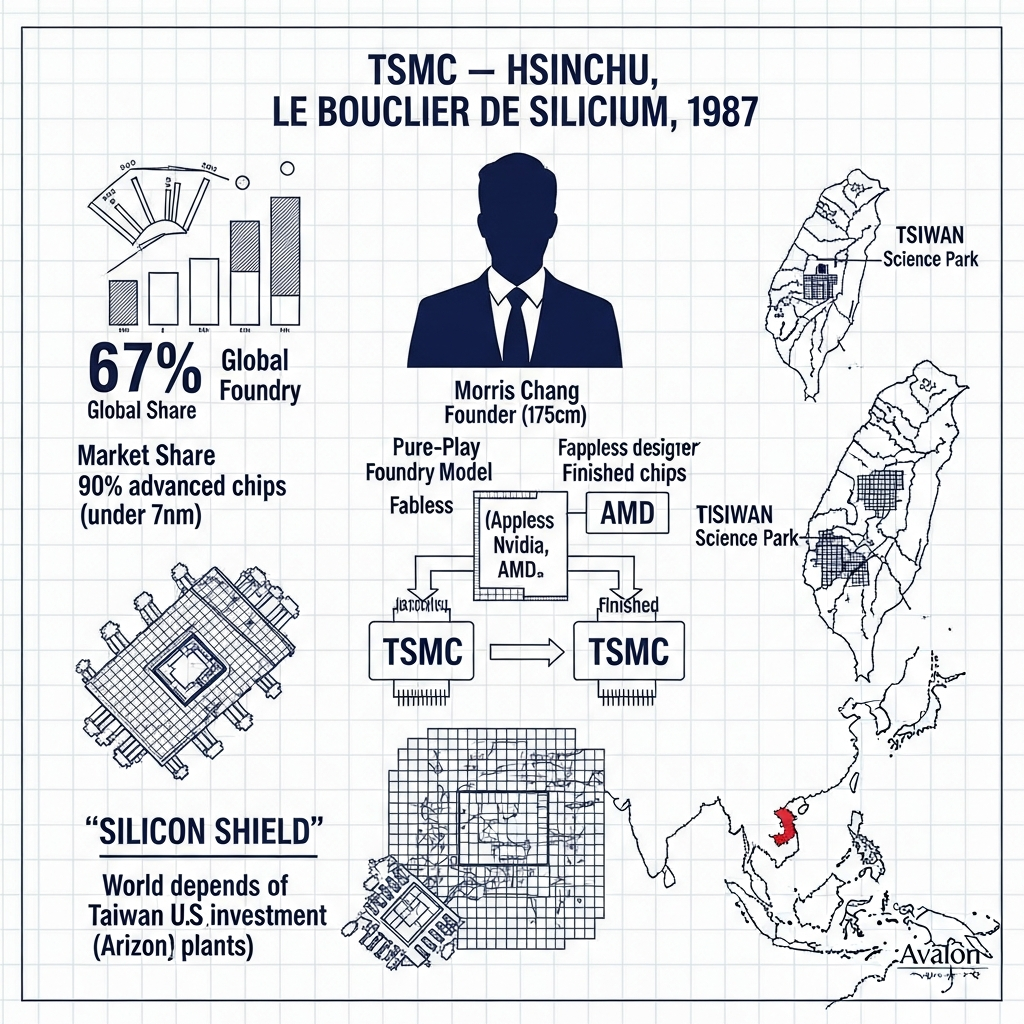
TSMC: Taiwan's 'silicon shield', 90% of world's advanced chips.
Asia — The New Center of Gravity
How Asia became the beating heart of global artificial intelligence
Yesterday — The Invisible Foundations
There exists a type of revolution that makes no noise. It unfolds in factories, in laboratories, in classrooms — while the world looks elsewhere.
When AlexNet triumphed at the ImageNet challenge in 2012, the world celebrated the victory of deep learning. But few noticed that this victory rested on Asian foundations.
ImageNet itself — the database of fourteen million images that had made training AlexNet possible — had been created by Fei-Fei Li. Born in Beijing in 1976, she emigrated to the United States at sixteen with her family, growing up between two worlds. At Princeton, then at Stanford, she had an insight that would change everything: the best algorithm was useless without the right data. In 2006, she began assembling millions of images, having them labeled by workers around the world via Amazon Mechanical Turk. In 2009, she published ImageNet — to relative indifference. The CVPR conference did not even grant her an oral presentation, only a poster.
Three years later, AlexNet proved she was right. Massive, well-labeled data was the fuel of deep learning. Fei-Fei Li became the "godmother of AI" — belated recognition for an early vision.
She was not alone. Kai-Fu Lee, born in Taiwan, trained at Carnegie Mellon, had developed pioneering speech recognition systems before leading Microsoft Research China, then Google China. He would become one of the most influential investors in the Chinese AI ecosystem, with Sinovation Ventures.
Asia had not only supplied individual talents. It had built an invisible infrastructure — the factories that manufactured the chips, the engineers who designed them, the data that fed the models. This infrastructure would become the beating heart of global AI.
Morris Chang was fifty-four years old when Texas Instruments "put him out to pasture." After twenty-five years at the company, he found himself in a role without power, without influence, without a future. In 1985, he left the United States for Taiwan, at the invitation of a government seeking to develop its technology industry.
What followed transformed the world.
In 1987, Chang founded TSMC — Taiwan Semiconductor Manufacturing Company. His innovation was not technological but commercial: the "pure-play foundry" model. TSMC would not design its own chips. It would manufacture those of others. Any company could now design processors without owning factories — they simply had to entrust the manufacturing to TSMC.
This model enabled the emergence of "fabless" giants — NVIDIA, AMD, Qualcomm, Apple. These companies could focus on design, leaving manufacturing to Taiwan. The semiconductor industry was revolutionized.
By 2024, TSMC controlled sixty-seven percent of the global semiconductor foundry market. The company manufactured more than half of the planet's advanced chips — and ninety percent of the most sophisticated ones. The chips that ran ChatGPT, Claude, Gemini, Tesla cars, iPhones: all came out of Taiwanese factories.
This dominance created what analysts call Taiwan's "silicon shield." The island, claimed by China, had become so essential to the global economy that any disruption — war, blockade, natural disaster — would have planetary consequences. Taiwan was no longer protecting itself solely through military alliances, but through its technological indispensability.
The Biden administration pledged up to six billion six hundred million dollars in incentives for TSMC to build factories in Arizona. In 2024, TSMC announced a total investment of sixty-five billion dollars in the United States — six manufacturing plants, two advanced packaging centers, a research center. But the most advanced chips — the two-nanometer ones — would not be produced in the United States until 2028 at the earliest. Taiwan maintained its lead.
The world was discovering, with a mixture of admiration and unease, how much it depended on an island of twenty-four million people.
Today — The Race of the Dragons
Meanwhile, in mainland China, another revolution was accelerating.
In May 2023, a company named DeepSeek was founded. Less than two years later, its DeepSeek-V3 model was outperforming Meta's Llama 3.1 and Anthropic's Claude 3.5 Sonnet on language and reasoning tests — at a fraction of the training cost. The DeepSeek-R1 model, specialized in reasoning, demonstrated that China could compete with the American giants.
The world was surprised. It should not have been.
China had one million six hundred seventy thousand companies related to artificial intelligence. More than two hundred thirty-seven thousand had been created in the first half of 2024 alone. The country was filing approximately three hundred thousand AI patent applications per year — representing seventy percent of global AI patents. From 2014 to 2023, China had filed more than thirty-eight thousand generative AI patents — six times more than the United States.
The Chinese tech giants — Baidu, Alibaba, Tencent, ByteDance — had all entered the race for large language models. After the launch of DeepSeek-R1, each announced models claiming to surpass its capabilities. Internal competition was as intense as the rivalry with the West.
But China was making a different choice from America. It was embracing open source. DeepSeek, Alibaba, and Tencent were releasing their models, allowing anyone to use and modify them. This strategy, inspired by free software, aimed to create an ecosystem where innovation would be collective rather than concentrated.
Baidu, Alibaba, and Tencent were offering services cheaper than OpenAI and Google. Chinese AI was targeting the entire world — not just the domestic market.
Yet China remained vulnerable. American sanctions on advanced chips — prohibiting the export of the most powerful processors to China — created a bottleneck. NVIDIA could no longer sell its most powerful GPUs to Chinese companies. TSMC could no longer manufacture the most advanced chips for Huawei.
DeepSeek had demonstrated that one could do a lot with less. But "less" remained a constraint. The AI race was also a semiconductor race — and on that front, China still depended on technologies it did not master.
India was taking a different path.
In March 2024, the Indian cabinet approved the IndiaAI mission — a budget of ten thousand three hundred crore rupees (approximately one billion three hundred million dollars) over five years. The objective: to build a complete AI ecosystem, from computing infrastructure to talent training, from sovereign models to public-interest applications.
India started from a paradoxical position. According to the 2024 Stanford index, it held first place in the world for AI skills penetration — ahead of the United States and Germany. AI talent concentration there had increased by two hundred sixty-three percent since 2016. India also led in AI skills penetration among women.
But this abundance of talent did not come with an abundance of infrastructure. India lacked computing power, data centers, sovereign models adapted to its languages.
The IndiaAI mission was tackling these gaps. It planned the construction of computing infrastructure equipped with eighteen thousand six hundred ninety-three GPUs — one of the largest in the world. It was funding the creation of language models adapted to Indian languages. It was establishing data and AI laboratories in second- and third-tier cities, decentralizing innovation beyond Bangalore and Mumbai.
Sarvam AI, a Bangalore startup, was selected from among sixty-seven candidates to build the first sovereign Indian large language model. It would receive four thousand GPUs for six months to train a seventy-billion-parameter model, designed to reason and speak Indian languages fluently. This model would not be open to the public — it was aimed at population-scale deployment, for government services, education, and healthcare.
India now had more than one hundred fifty native AI startups, having collectively raised more than one and a half billion dollars since 2020. OpenAI, Anthropic, and Google were opening offices there — attracted by the talent pool and the potential market of one billion four hundred million people.
India was not seeking to compete with China or the United States on raw power. It was seeking to build AI for India — in its languages, for its problems, according to its priorities.
The Asian Fabric
Japan, South Korea, Singapore, Vietnam, Indonesia: each Asian country was weaving its own thread into the fabric of global AI.
Japan remained the world leader in industrial robotics — forty-five percent of global production. FANUC, Kawasaki, Honda with its humanoid robot ASIMO: the heirs of the Japanese robotics tradition from the 1980s continued to innovate. But in large language models, Japan lagged behind — handicapped perhaps by the same caution that had caused the fifth-generation project to fail in the 1980s.
South Korea dominated memory. Samsung, the world's largest memory chip manufacturer, supplied essential components for AI systems. Without high-bandwidth memory, the most powerful GPUs were useless. Korea, like Taiwan, occupied an indispensable link in the chain.
Singapore positioned itself as a bridge. Its strategy — evolving from labor to skills, from skills to capital, from capital to technology, from technology to innovation — allowed it to attract talent and investment from across the region. The city-state had become a crossroads where West and Asia met.
Vietnam and Indonesia were emerging as new software development hubs, benefiting from the relocation of companies seeking alternatives to China. "Derisking" — reducing dependence on China — was redistributing the cards in Southeast Asia.
Asia was not a uniform bloc. It was an archipelago of strategies, specializations, rivalries. But these islands were linked by flows of talent, capital, data, chips. The center of gravity of global AI was shifting inexorably eastward.
Beyond — The Tipping Point
There exists a moment in the history of civilizations when the center of gravity tips. Europe dominated the Industrial Revolution. America dominated the computing revolution. Asia could dominate the artificial intelligence revolution.
The numbers tell a story. Seventy percent of global AI patents filed in China. Ninety percent of advanced chips manufactured in Taiwan. First place in the world for AI skills penetration held by India. Chinese models rivaling American ones at a fraction of the cost.
But the numbers do not tell everything.
Asia first teaches us the diversity of paths. China chose mass — millions of companies, hundreds of thousands of patents, open-source models flooding the market. Taiwan chose indispensability — specialization so advanced that the entire world depends on its factories. India chose sovereignty — models in its languages, for its problems, according to its priorities. There is not a single path to AI power.
It then teaches us the vulnerability of dependencies. American chip sanctions revealed how much China remained dependent on technologies it did not master. But this dependence is reciprocal. The United States depends on Taiwan for its chips. Europe depends on Asia for its supply chain. Interdependence creates both stability — no one has an interest in disrupting the system — and fragility — a disruption affects everyone.
It finally teaches us the power of invisible foundations. Fei-Fei Li created ImageNet in relative indifference before AlexNet proved its importance. Morris Chang invented the pure-play foundry model in obscurity before the world realized its dependence on TSMC. Technological revolutions are often built on foundations that no one notices — until everything collapses if they are missing.
The center of gravity continues to shift.
In 2025, China has more AI companies than any other country. India trains more AI talent than any other country. Taiwan manufactures more advanced chips than any other country.
The godfathers of deep learning — Hinton, Bengio, LeCun — are Western. But the foundations on which they built — ImageNet data, TSMC chips, engineers trained in Asia — are largely Asian.
This asymmetry — conceptual innovation in the West, material infrastructure in the East — may not last. DeepSeek has shown that China can innovate at the model level, not just manufacture chips. Sarvam AI shows that India can create sovereign models, not just export programmers.
The question is no longer whether Asia will play a major role in AI. It already does. The question is whether the West will be able to adapt to a world where it is no longer the center.
Parallel paths are converging. The center of gravity is tipping. Asia is no longer the periphery of global innovation.
It is becoming its heart.