Introduction
Illustrations
1 / 6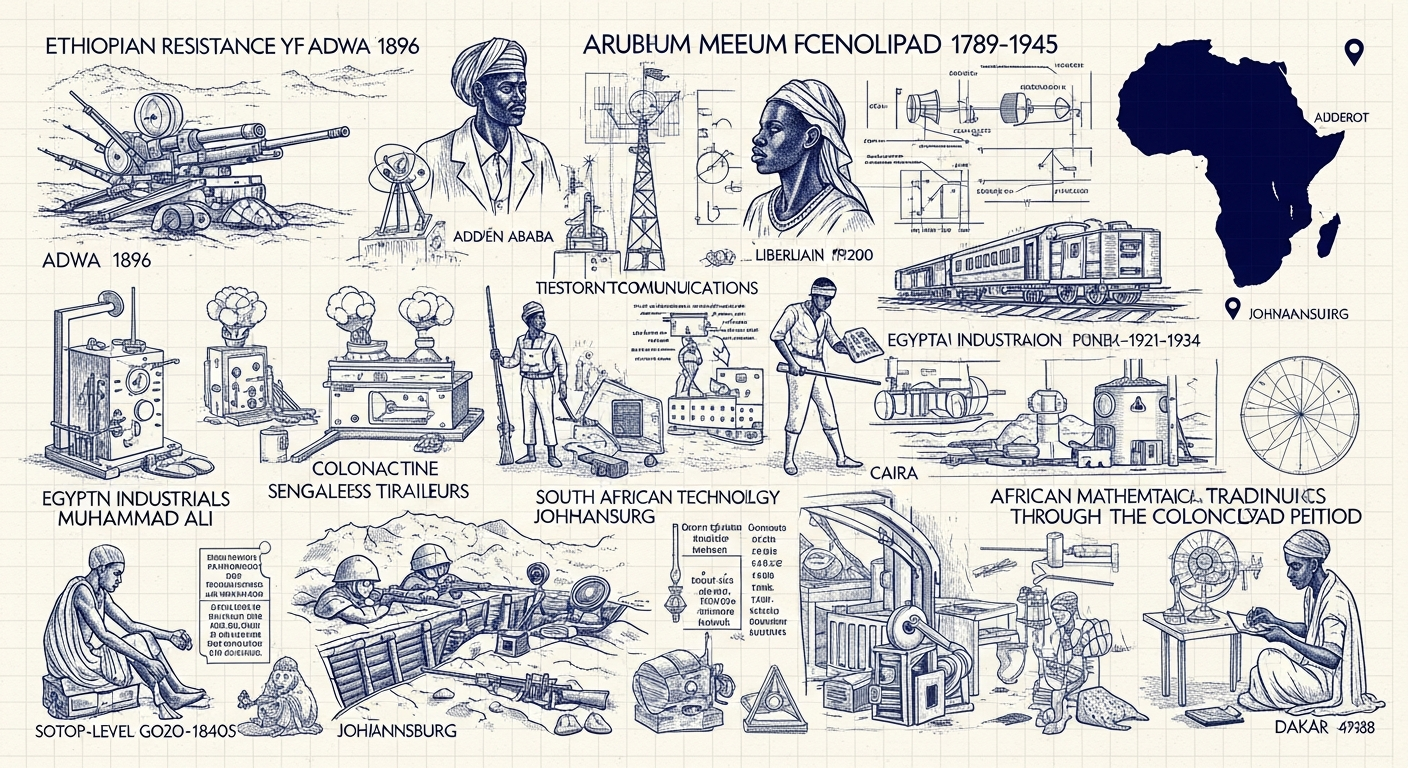
Africa: colonization and resistance of traditional knowledge.
The Age of the Forge and the Inferno
Between 1789 and 1945, humanity traversed an age of revolutions—industrial, political, and intellectual—that laid the conceptual foundations for artificial intelligence. Yet this same period unleashed cataclysms that destroyed millions and scattered the communities of thinkers who might have developed these ideas further.
This chapter traces the dual dynamic that characterizes this era: the forging of fundamental concepts and the destruction of the human networks that created them.
Six Continental Journeys
Europe: The Forge and the Inferno
From Jacquard's loom to Turing's theoretical machine, from Babbage's dreams to Bletchley Park's secrets, Europe produced the core concepts of computation. Yet the same continent generated the wars and persecutions that killed or exiled many of its greatest minds.
Africa: Invisible Threads
While colonization disrupted indigenous knowledge systems, African intellectual traditions continued—in different forms, in diaspora, in resistance. The continent that gave humanity some of its oldest mathematical artifacts was excluded from the new computational order being built.
The Americas: Lost Memories
Indigenous computational traditions were erased as North America became the destination for Europe's exiled geniuses. The Americas emerged from this period positioned to dominate the next—but at the cost of what was forgotten and who was excluded.
Asia: Parallel Paths
Japan's intentional modernization, China's century of humiliation, India's colonial subjugation—each Asian nation developed differently under Western pressure. Yet parallel intellectual traditions persisted, and some would re-emerge to challenge Western technological hegemony.
Middle East: Dried Springs
The homeland of al-Khwarizmi—the very origin of the word "algorithm"—found itself marginalized from the computational developments its medieval scholars had made possible. Colonial mandates and political instability suppressed what the Nahda had attempted to revive.
Oceania: Forgotten Stars
Aboriginal Australian songlines encoded continental databases; Polynesian navigation systems processed information across oceanic distances. Yet colonial science dismissed these achievements, establishing institutions that excluded indigenous knowledge and knowledge-keepers.
The Threads That Bind
Across all six continents, common patterns emerge:
1. Epistemicide: The systematic destruction or marginalization of non-European knowledge systems
2. Exile: Political upheaval scattering minds that might have collaborated
3. Invisibilization: The erasure of women's contributions at every turn
4. Parallel Discovery: Similar concepts emerging independently, suggesting human cognitive universals
5. War as Accelerator: Military needs driving—and distorting—computational development
By 1945, the theoretical foundations of computing had been laid. But who laid them, who was excluded from the building, and what alternative paths were foreclosed—these questions matter for understanding what artificial intelligence became, and what it might yet become.
The following sections explore each continent's story during this age of forge and inferno.