Oceania
Illustrations
1 / 5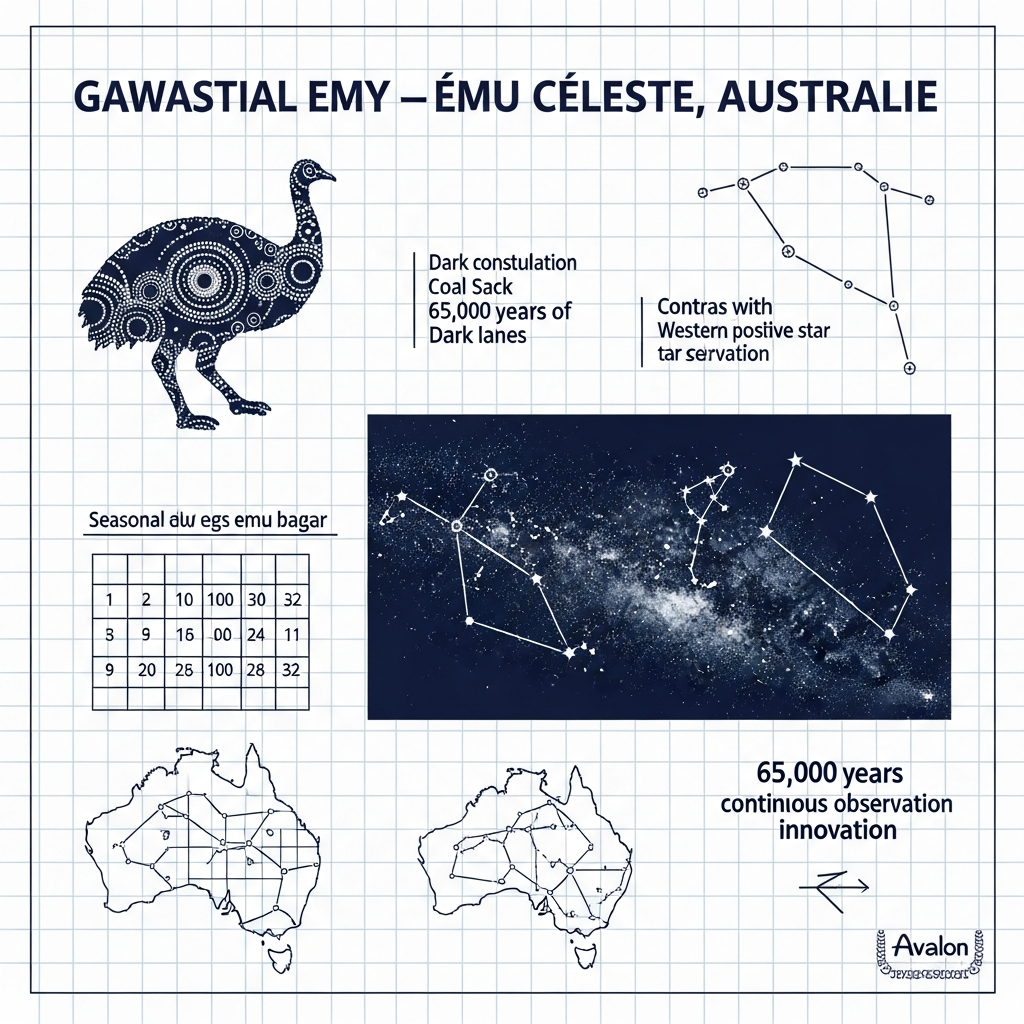
The Gawarrgay (celestial emu): millennia-old Aboriginal astronomy.
Forgotten Stars
Oceania and the Foundations of Artificial Intelligence (1789-1945)
Yesterday — The World's First Astronomers
There is an emu that crosses the southern sky. You cannot see it by looking at the bright stars, but by observing the darkness between them. The Gawarrgay, the celestial emu, is drawn in the dark spaces of the Milky Way, its long neck stretching where we see only emptiness. For the Gamilaraay people of Australia, this inverted constellation — made of absence rather than presence — tells the story of the terrestrial emus, their migrations, their breeding cycle, the right time to gather their eggs.
This way of reading the sky in negative, of finding meaning in what others consider nothingness, perhaps summarizes what Oceania has contributed most precious to the history of human thought. And what colonization made it lose.
When the first British ships dropped anchor in Sydney Bay in 1788, they were landing on a continent inhabited for at least sixty-five thousand years. The Aboriginal peoples of Australia had developed what contemporary researchers do not hesitate to call humanity's first astronomy — predating the Babylonians, the Egyptians, the Greeks. These astronomers before writing had mapped the movement of celestial bodies with remarkable precision, created seasonal calendars based on the stars, identified variable stars like Betelgeuse whose brightness fluctuates over the months.
Their science was functional, embodied in daily life. The Yolngu of northern Australia had understood the relationship between lunar cycles and ocean tides long before Newton explained gravitation. Their elders could predict the time and height of the next tide simply by observing the Moon's position and phase. This knowledge was not recorded in treatises: it was transmitted through speech, through song, through stories that wove together observation of the sky and the imperatives of survival.
More remarkable still was their approach to counting. A persistent myth, spread by early colonial observers, claimed that Aboriginal people could not count beyond four or five. Alfred Howitt, who studied the peoples of southeastern Australia in the late nineteenth century, methodically refuted this legend. He discovered body-counting systems — body-tallying — where numbers took the name of body parts: the index finger, the wrist, the forearm, the elbow, each corresponding to a value. The number seven, for example, was expressed by pointing to the forearm and was called "boibun," evoking the slight swelling of that part of the arm.
These mathematical systems, developed over tens of millennia, served to organize kinship structures of dizzying complexity. The combinatorics necessary to manage marriages, ceremonial obligations, and hunting rights between clans assumed a logical sophistication that Western mathematicians would only recognize much later. Message sticks bearing numerical notches circulated between neighboring groups to announce ceremonies, ritual gatherings, and sporting competitions — a communication network based on numerical abstraction.
On the other side of the Tasman Sea, the Polynesian peoples had pushed the art of reading the stars even further. Maori navigators used the kapehu whetu — the star compass — a system dividing the horizon into thirty-two "houses" of 11.25 degrees each, oriented by the rising and setting points of the sun, moon, and key stars. These navigators memorized the position of at least two hundred and twenty stars, remembering the exact place where each rose and set on the horizon.
With this knowledge, they crossed the Pacific in outrigger canoes, without compass, without sextant, without maps, navigating thousands of kilometers to discover and populate islands scattered across the ocean's immensity. Their method combined stellar observation with reading swells, winds, cloud formations, and bird behavior. Distance was calculated through an intuitive geometry based on navigation time between known points. Through Polynesian wisdom was even transmitted the understanding that the Earth was round — deduced from the circumnavigation of stars in the night sky.
These forms of knowledge represented computational systems in the deepest sense of the term: methods for processing information, recognizing patterns, predicting events, optimizing routes. Algorithms before the word existed, encoded in songs, dances, stories, and ritual practices. The astronomer who predicted the tides, the navigator who calculated his position by the stars, the sage who determined permitted marriages by kinship rules — all performed logical operations of a sophistication comparable to what European mathematicians would formalize much later.
But these stars were soon to be extinguished.
Today — The Bridge That Never Existed
British colonization of Australia rested on a legal fiction of absolute violence: terra nullius, land belonging to no one. This concept made it possible to declare the continent empty of legitimate inhabitants, their presence of sixty-five millennia reduced to nothing by a stroke of the pen. Between 1788 and 1900, the Aboriginal population collapsed by ninety percent. Disease, territorial dispossession, systematic massacres — what contemporary historians call colonial terrorism — decimated entire peoples.
With the bodies disappeared the knowledge. Aboriginal astronomy was transmitted through oral tradition, from generation to generation, during ceremonies that colonizers set about prohibiting. When the elders died without having been able to train their successors, millennia of accumulated knowledge vanished in a few decades. Sacred sites where astronomical rituals were practiced were destroyed, transformed into pastures or mining zones. The languages that carried the names of the stars, the stories that explained their movements, the songs that encoded the calendars — all of this was systematically eradicated.
What the early times of colonization had not finished, a deliberate policy would complete. Between 1910 and the 1970s, the Australian government implemented the forced removal of Aboriginal children from their families. These children — known today as the Stolen Generations — were torn from their communities, placed in institutions or white families, forbidden to speak their traditional languages, to participate in any cultural practice. They were told that their parents had abandoned them, or that they were dead. In some regions, one child in three was taken in this way.
The Bringing Them Home report, published in 1997 by a Royal Commission, called these policies genocide. Not genocide by weapons, but cultural and spiritual genocide — the deliberate destruction of knowledge transfer between generations. The astronomy that had survived the massacres of the nineteenth century could not withstand this methodical rupture of transmission. Children raised in colonial institutions never knew the celestial emu, never learned to read the tides in the moon, never memorized the two hundred and twenty stars of the Polynesian compass.
And while this ancient knowledge was being extinguished, other stars were beginning to shine on the same territory.
In 1850, the University of Sydney opened its doors — Australia's first institution of higher education. Melbourne followed in 1853, Adelaide in 1874. On the other side of the Tasman Sea, the University of Otago was founded in 1869, Canterbury in 1873. These institutions, modeled on the British system, trained a colonial elite that would produce first-rate scientists. By 1920, one hundred and fifteen women had already obtained science degrees from Sydney — pioneers in an academic world still largely male. Edith Dornwell, Australia's first female science graduate in 1885, Fanny Hunt in 1889, Leonora Little at Melbourne in 1893: these names testify to a real intellectual effervescence, even if it remained confined to the population of European origin.
The most brilliant figure of this colonial science was born in Nelson, New Zealand, in 1871. Ernest Rutherford was the fourth of twelve children of a Scottish wheelwright father and an English schoolteacher mother. A brilliant student, he obtained a double distinction in mathematics and physical sciences at Canterbury College, then left New Zealand in 1895 never truly to return. In 1908, he received the Nobel Prize in Chemistry — the first awarded to an Oceanian scientist — for his work on the disintegration of radioactive elements. Three years later, he made his most decisive contribution: the theorization of the atomic nucleus.
Rutherford had discovered that the atom was not a solid, homogeneous sphere, as was then believed, but an essentially empty space at the center of which was concentrated a tiny, dense mass. His experiments of 1911, where alpha particles passed through gold foil only to be occasionally deflected by these invisible nuclei, revealed a structure of the infinitely small that no one had suspected. The Aboriginal stars mapped the macrocosm; Rutherford mapped the microcosm. But between these two enterprises of knowledge, no bridge was ever built.
Einstein called him a "second Newton." His peers considered him the greatest experimentalist since Faraday. He trained a generation of future Nobel Prize winners — James Chadwick, Niels Bohr, Otto Hahn — and was knighted, then raised to the rank of baron with a coat of arms including a kiwi and a Maori warrior. This last symbolic irony — the emblem of a colonized people adorning the arms of a colonial scientist — summarizes all the ambiguity of scientific Oceania: an aesthetic recognition of Indigenous cultures emptied of all epistemic recognition.
Lawrence Hargrave, born in Greenwich in 1850 and immigrated to Australia as a teenager, embodies another facet of this colonial science. An engineer, explorer, and inventor, he developed the box kite — an aerodynamic structure that became the basis for the first biplanes. On November 12, 1894, attached to a train of his kites, he rose into the air and became the first Australian to fly. His discoveries — notably that a curved wing surface produced twice as much lift as a flat surface — directly influenced the Wright brothers through their correspondence with Octave Chanute.
The Council for Scientific and Industrial Research, forerunner of CSIRO, was created in 1926 under the direction of David Rivett. Australia was finally acquiring a national research infrastructure. But this institutional science completely ignored the knowledge it had supplanted. The mathematics of Aboriginal kinship systems, the Polynesian navigation algorithms, the astronomy of the Gawarrgay — none of this existed for it. Two traditions of knowledge occupied the same territory without ever meeting, like two superimposed skies that no gaze could embrace together.
Alexander Aitken, an Otago mathematician born in 1895, developed mental calculation abilities that stunned his contemporaries. Traumatized by his experience in the trenches of Gallipoli and the Somme, he spent most of his career in Edinburgh. Roy Kerr, from Canterbury, found in 1963 the solutions to Einstein's equations describing rotating black holes. These brilliant minds born in Oceania all had to, like Rutherford, expatriate themselves to accomplish their work. The territory that had produced humanity's first astronomers was now exporting its scientists to imperial centers, unable to retain them for lack of infrastructure, funding, and critical mass.
The Oceanian paradox lies entirely in this junction-less parallelism. On one side, Indigenous knowledge of remarkable sophistication, accumulated over tens of millennia, destroyed in less than two centuries. On the other, a colonial science producing world-class figures, but transplanted from Europe, ignorant of what it had replaced, exporting its best talents to the Northern Hemisphere. Two worlds on the same soil, but no bridge between them. Not even the awareness that a bridge could have existed.
Beyond — What We Have Lost
Contemporary artificial intelligence systems function, in many respects, like the knowledge traditions that colonial Oceania erased. They recognize patterns in massive data, predict events from accumulated observations, optimize trajectories in complex spaces. The Polynesian navigator who calculated his position by stars and swells was performing an operation analogous to what a navigation system does today: integrating multiple signals to determine a location and an optimal course.
The essential difference lies in transmission. Aboriginal and Polynesian knowledge was embodied — it existed only in the minds that carried it, was transmitted through example and speech, died with its holders if it had not been taught. This fragility made it vulnerable to interruption. When the Stolen Generations were torn from their families, when ceremonies were forbidden, when elders died without successors, millennia of knowledge vanished in a few decades. Artificial intelligence, by contrast, encodes its knowledge in numerical parameters, weight matrices, replicable architectures. It can be copied, backed up, distributed. It does not die with its creators.
But this technical permanence conceals another form of vulnerability. Current artificial intelligence systems depend on concentrated data centers, fragile supply chains, and rare expertise. A few companies, a few countries, a few teams hold the keys to this technology. If these structures were to collapse — through war, economic crisis, or exhaustion of necessary resources — some of this knowledge could disappear as suddenly as the astronomy of the Gawarrgay.
Oceania's history reminds us that sophistication is not a guarantee of survival. The peoples who had developed humanity's first astronomies and the mathematics of kinship systems were not primitive — they were differently advanced, along axes that Western science did not recognize. Their erasure does not testify to their inferiority, but to the violence of those who supplanted them. The colonial science that produced Rutherford and Hargrave was not intrinsically superior to the knowledge it replaced; it was simply backed by a military and economic power that Indigenous peoples did not possess.
This lesson resonates strangely at a time when a few nations and a few companies concentrate most of the capacity in artificial intelligence. Would history repeat itself? Could knowledge traditions again be erased, no longer by guns and diseases, but by economic obsolescence, technological dependence, and inability to participate in a revolution monopolized by others?
We do not yet know. But Oceania offers us a warning and a regret. The warning: that knowledge, even millennia old, can vanish in a single generation if the conditions for its transmission are destroyed. The regret: that two knowledge traditions could have coexisted on the same territory without ever dialoguing, without colonial science deigning to enrich itself from what Indigenous peoples had discovered.
Let us imagine for a moment what another history might have been. Mathematicians trained in Sydney or Melbourne studying Aboriginal kinship systems and discovering novel combinatorial structures there. Canterbury astronomers learning from Maori to read the stars differently, to see constellations in shadow rather than light. Aeronautical engineers drawing inspiration from Polynesian navigation techniques to design guidance systems. This history did not happen. The bridge was never built. The two skies remained separate.
Ernest Rutherford appears on the New Zealand hundred-dollar bill, recognized as the greatest scientist that nation has produced. His coat of arms bears a kiwi and a Maori warrior. But in his work, his writings, his discoveries, there is no trace of Polynesian knowledge. The Maori warrior on his blazon is an ornament, not a source. A trophy, not a teacher.
Contemporary artificial intelligence sometimes reproduces this pattern. It trains on predominantly Western data, in predominantly English languages, according to paradigms predominantly from a few American and European universities. Knowledge from the rest of the world — when it has not been destroyed — remains largely ignored, at most mentioned as ethnographic curiosities rather than integrated as epistemic contributions. The Polynesian star compass appears in no navigation algorithm. The mathematics of Aboriginal kinship systems inspires no expert system.
Perhaps it is too late to rebuild what was lost. The Stolen Generations are aging; their children and grandchildren are trying to recover fragments of languages, ceremonies, and knowledge that their grandparents were never able to transmit to them. Linguists and anthropologists are working to document what remains, to preserve pieces of Aboriginal astronomy, to reconstruct Polynesian navigation techniques. But documenting is not transmitting. Knowledge recorded in a book is not the same as knowledge alive in practice.
What Oceania teaches us, finally, is that the history of intelligence — artificial or human — is not a linear progress toward ever-greater sophistication. It is a rugged landscape where peaks rise and collapse, where promising paths are abruptly interrupted, where precious knowledge disappears while other knowledge emerges. The Gawarrgay, the celestial emu, continues to cross the southern sky. But those who knew how to read its message become fewer each year.
Two hundred and twenty stars memorized by Polynesian navigators. Ninety percent of a population disappeared in a century. A Nobel Prize for a man born in Nelson. Sixty-five thousand years of human presence reduced to silence by a legal fiction. These figures sketch a geometry of loss that artificial intelligence would do well to contemplate.
For true intelligence, perhaps, consists not only in accumulating knowledge. It also consists in recognizing what has been lost, in honoring the forgotten stars, in building bridges that never existed. Oceania still awaits that bridge. The celestial emu still crosses the sky, drawn in the shadow between the bright stars. We need only look up. We need only learn to see differently.