Middle East
Illustrations
1 / 5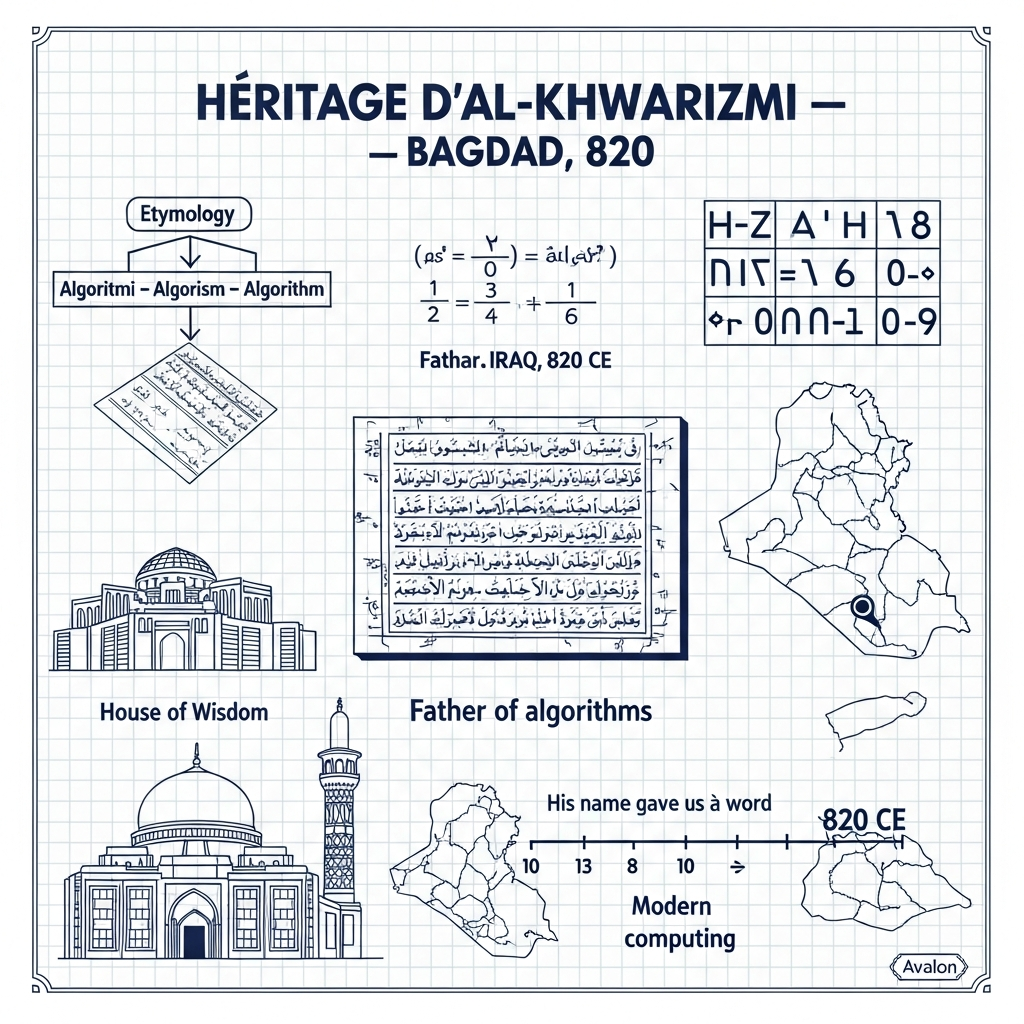
Al-Khwarizmi's legacy: the algorithm at the heart of modern computing.
Dried Springs
The Middle East's Contributions to the Foundations of Artificial Intelligence (1789-1945)
Every time a computer executes an operation, it performs an algorithm. Every time a machine solves an equation, it does algebra. Every time a system processes data, it manipulates numerals — those ten symbols we call, often without thinking about it, Arabic numerals. The very vocabulary of computing carries the memory of the Middle East. The words "algorithm" and "algebra" come from Arabic. The first derives from the name of a ninth-century Persian mathematician, Muhammad ibn Musa al-Khwarizmi. The second comes from the title of his most famous treatise, Al-Jabr.
This etymology is not a linguistic curiosity. It is the trace of a spring — an intellectual spring from which the fundamental concepts of modern computation flowed. This spring flowed in Baghdad, in the time of the Abbasid caliphs, when the House of Wisdom gathered the greatest minds of the known world. It still flowed when Greek, Persian, and Indian manuscripts were translated into Arabic, preserved, enriched, then transmitted to medieval Europe. It was the bridge by which ancient civilizations reached the West.
Then the spring ran dry. In 1258, the Mongols sacked Baghdad. Thousands of manuscripts were burned or thrown into the Tigris. The House of Wisdom vanished. The following centuries saw the gradual decline of the Arab-Islamic scientific tradition, while Europe, irrigated by Latin translations of Arabic texts, began its own Renaissance.
The history of the Middle East between 1789 and 1945 is that of an attempt to make these springs flow again. The Nahda — the Arab Renaissance — tried to awaken the dormant intellectual heritage. Reformers sought to reconcile modern science and Islamic tradition. Translators strove to transpose European advances into Arabic. But colonialism, fragmentation, and wars interrupted these efforts. The springs, briefly revived, ran dry again.
Yesterday — The Memory in Words
What the World Has Forgotten
There is something vertiginous in realizing that the beating heart of the digital age — the algorithm — bears the name of a man born more than twelve hundred years ago, in a region that was then called Khwarezm, on the borders of Persia and Central Asia. Al-Khwarizmi worked in Baghdad around 820, under the reign of Caliph al-Ma'mun, in an institution whose name alone evokes its ambition: Bayt al-Hikma, the House of Wisdom.
This institution was the largest repository of books in the world in the mid-ninth century. Mathematicians, astronomers, physicians, and philosophers rubbed shoulders there. Teams of translators converted into Arabic the Greek texts of Euclid and Archimedes, the Persian treatises on astronomy, the Indian works on mathematics. Al-Ma'mun had the first Baghdad observatory built to verify Ptolemy's observations. He commissioned the creation of one of the most detailed world maps of the era. The House of Wisdom was not merely a place of preservation — it was a center of creation.
It was there that al-Khwarizmi wrote his two foundational works. The first, Al-Jabr, offered the first systematic solution of linear and quadratic equations. The second described the Indian numeration system — those ten symbols including zero that would transform calculation. When these texts were translated into Latin in the twelfth century, Europeans began speaking of "algorism" to designate the art of calculating with the new numerals. Al-Khwarizmi's name, Latinized as "Algoritmi," became synonymous with a calculation procedure.
Some historians call him the "father of algebra." Others, more boldly, call him the "grandfather of computing." These titles are not exaggerated. To solve an equation, al-Khwarizmi proceeded methodically, step by step, following a precise sequence of rules. This is exactly what we today call an algorithm: a procedure for solving a problem in a finite number of steps. The concept existed before him, but it was his work that gave it its name and modern form.
History's irony is that this fundamental contribution is so little known in the countries that benefit from it most. Every search engine, every artificial intelligence system, every application on our phones relies on algorithms. And yet, how many know where this word comes from? How many remember Baghdad in the time of the Abbasids?
The Destruction and the Silence
In 1258, the Mongol armies of Hulagu Khan swept down on Baghdad. The siege lasted two weeks. When the city fell, the massacre began. Historians estimate that several hundred thousand people perished. The last Abbasid caliph was executed. Palaces were pillaged, mosques desecrated, libraries destroyed.
The House of Wisdom, that beacon of medieval knowledge, vanished in the turmoil. Thousands of irreplaceable manuscripts — texts on mathematics, astronomy, medicine, philosophy — were burned or thrown into the Tigris. According to legend, the river waters ran black with ink for days. We will never know exactly what was lost that day. Centuries of intellectual work, discoveries that may never have been remade, research paths forever closed.
The destruction of 1258 did not mark the immediate end of Arab-Islamic science. Centers of knowledge survived in Egypt, Persia, and Andalusian Spain. But something had been broken. The network that had allowed the circulation of ideas between Baghdad, Cairo, Cordoba, and Samarkand no longer functioned in the same way. The creative momentum slowed. Translations into Arabic became rarer while translations from Arabic into Latin multiplied. The flow of knowledge had changed direction.
Five centuries later, when Napoleon's armies landed in Egypt in 1798, the Middle East had become peripheral in the global geography of knowledge. Europe had taken over. It had developed, on foundations transmitted by medieval translators, a new science that propelled it toward world domination. Al-Khwarizmi's mathematics had engendered European descendants — Newton, Leibniz, Euler — and these descendants had caused the ancestor to be forgotten.
Today — Attempts at Renaissance
The Shock of the Egyptian Expedition
On July 1, 1798, thirty-five thousand French soldiers landed near Alexandria. Napoleon Bonaparte, then twenty-eight years old, had come to conquer Egypt to cut the British route to India. But the expedition was not merely military. It also included one hundred and sixty-seven scholars — mathematicians, engineers, naturalists, archaeologists — charged with studying the country in all its dimensions.
The French occupation lasted barely three years. It was militarily a failure. But its intellectual impact was immense. For the first time in centuries, Egyptian elites found themselves confronted with a European power on their own soil. They discovered the gap that had opened between their civilization and that of the invader — in military techniques, certainly, but also in sciences, administrative organization, and technology.
This shock engendered a question that would haunt the Middle East throughout the nineteenth century: how to catch up with Europe? How to regain lost power and prestige? Different answers were proposed. Some advocated pure and simple imitation of the West. Others defended a return to the sources of Islam. Still others sought a synthesis, a modernization that would preserve cultural identity while adopting Europe's technical advances.
The Nahda: The Arab Awakening
The movement that attempted this synthesis was called the Nahda — an Arabic word meaning "awakening" or "renaissance." It flourished mainly in Egypt, Lebanon, and Syria during the second half of the nineteenth century and the early twentieth. Its actors were intellectuals, translators, religious reformers, and newspaper editors. Their ambition was to revitalize Arab culture, reform education, and promote modern science while remaining faithful to the Islamic heritage.
One of the pioneers of this movement was named Rifa'a al-Tahtawi. Born in 1801 in the Nile Delta, he was sent to Paris in 1826 by Muhammad Ali, the governor of Egypt, to accompany a mission of military cadets. He was to serve as imam, as chaplain for these young soldiers. But once in Paris, Tahtawi transformed. He learned French, studied philosophy, mathematics, and geography. He read Voltaire, Rousseau, and Montesquieu. He witnessed the July Revolution of 1830.
Upon his return to Egypt in 1831, Tahtawi published a book that would transform Arab thought: Takhlis al-ibriz fi talkhis Bariz — "The Extraction of Gold in Summarizing Paris." It was the first modern description in Arabic of a European country. Tahtawi described French institutions, customs, and sciences, with a mixture of admiration and critical distance. He suggested that Egypt and the Muslim world had much to learn from Europe, but that reforms should be adapted to the values of Islamic culture.
In 1835, Tahtawi founded the School of Languages in Cairo. This institution trained the first modern Egyptian intelligentsia. With Muhammad Ali's encouragement, Tahtawi and his students translated approximately two thousand European works into Arabic — scientific manuals, legal treatises, literary works. Tahtawi himself translated the Napoleonic Code. A century after the Mongol destruction of the House of Wisdom, a new bridge was being built between civilizations — but in the other direction this time. It was European texts that were flowing toward the Arab world.
The Press and Knowledge
Muhammad Ali, the master of Egypt, understood that modernization required the dissemination of knowledge. In 1815, he sent a mission to Milan to learn the art of printing. In 1820, the Bulaq Press — named for the Cairo district where it was located — began operations. It was the first government press on the African continent, the first indigenous Arab press established by Muslims.
Between 1822 and 1842, the Bulaq Press published two hundred and forty-three titles. Forty-eight military and naval works, twenty-six poetry collections in Turkish, Persian, and Arabic, twenty-one grammar manuals, sixteen treatises on mathematics and mechanics, fifteen medical books. European scientific works were translated and disseminated. A class of educated readers began to form. The Arabic language itself was transformed, enriching itself with new terms to designate modern concepts.
The Nahda was not limited to Egypt. In Lebanon, Christian intellectuals like Butrus al-Bustani founded learned societies and journals. In Syria, discussion circles debated the paths of modernization. A free Arab press emerged, carrying new ideas about education, politics, and the condition of women. For a few decades, it seemed that the Arab world was going to succeed in its renaissance.
Al-Azhar and Reconciliation
Al-Azhar University, founded in Cairo in 970, was the oldest and most prestigious institution of Islamic education. For centuries, it had trained the jurists, theologians, and scholars of the Muslim world. But in the nineteenth century, it seemed frozen in its traditions, closed to modern sciences, hostile to reform.
One man attempted to transform it. Muhammad Abduh, born in 1849, was a product of al-Azhar — he had studied there and taught there. But he had also been influenced by Jamal al-Din al-Afghani, a Persian thinker who argued that modern science was not incompatible with Islam. Abduh came to believe that the decline of the Muslim world came not from religion itself, but from a misinterpretation of it.
In 1886, after a political exile, Abduh returned to Egypt as a national hero. He threw himself into reforming al-Azhar. In 1895, he created an administrative committee dominated by reformists. Professors' salaries were increased according to a merit system. Student allowances were doubled. New dormitories with running water were built. The academic year was lengthened and organized according to European standards. Mathematics and science courses were introduced alongside traditional religious studies.
In 1899, Abduh was appointed Mufti of Egypt — the country's highest religious authority. Until his death in 1905, he worked to reconcile Islam and modernity, to show that science and faith were not enemies. His legacy is contested — some see him as the father of Islamic reformism, others as an agent of Westernization. But no one disputes that he tried to revive Islam's intellectual tradition, the tradition that had produced al-Khwarizmi a thousand years earlier.
The Exiled Genius
In the small town of Nabatieh, in southern Lebanon, a statue stands in a public square. It represents a man in Western dress, his gaze turned toward the horizon. This man was named Hassan Kamel Al-Sabbah. Few people outside Lebanon know his name. Yet his inventions shaped the twentieth century.
Al-Sabbah was born in 1895, in a Lebanon still under Ottoman rule. A brilliant student, he dreamed of becoming an engineer. But the Middle East of his time offered few opportunities for young technical geniuses. In 1921, he set sail for the United States. He studied for a year at the Massachusetts Institute of Technology, obtained his master's degree at the University of Illinois in 1923, then joined General Electric's laboratories in Schenectady, New York.
What followed is the stuff of prodigy. In twelve years, Al-Sabbah filed more than seventy patents — forty-three in the United States, more than thirty internationally. His inventions touched on television, cathode ray tubes, electrical conversion systems, and solar energy. In 1930, he invented and tested the first solar cell — those devices that today power satellites and spacecraft. The same year, his work allowed General Electric to present the first fully electronic television system.
But Al-Sabbah had signed a contract that made all his inventions the property of General Electric. For each patent, he received the symbolic sum of one dollar. His genius enriched an American company, not his native country. He embodied a paradox that would become familiar: Middle Eastern talents, to flourish, often had to go into exile.
On March 31, 1935, Al-Sabbah died in a car accident near Elizabethtown, New York. He was thirty-nine years old. A General Electric director declared: "It is truly unfortunate that his inventive mind came to such an untimely end. His death is a great loss to the world of invention." In Lebanon, a statue was erected. But the patents remained American.
Beyond — Borders and Silence
The Dismemberment
While Al-Sabbah was filing his patents in Schenectady, the Middle East was suffering the consequences of a secret agreement signed twenty years earlier. In May 1916, in the midst of World War I, two diplomats — the British Mark Sykes and the French Francois Georges-Picot — had drawn lines on a map. These lines divided the Ottoman Empire into French and British zones of influence.
The Sykes-Picot agreement was negotiated in the strictest secrecy. At the same time, the British were promising the Arabs — through the Hussein-McMahon correspondence — independence in exchange for their revolt against the Ottomans. The Arabs rose up. Lawrence of Arabia became a legend. And when the war was won, the promises were betrayed.
In November 1917, the newly arrived Soviet government published the Sykes-Picot agreement found in the Tsarist archives. The Arab world discovered with stupefaction that it had been sold. In April 1920, the San Remo Conference confirmed the partition. France obtained Syria and Lebanon. Britain obtained Iraq, Jordan, and Palestine. Borders were drawn with a ruler, with no regard for populations, tribes, or religious communities.
These artificial borders divided united peoples and united divided peoples. The Kurds found themselves scattered among four countries. The Druze were cut in two. Projects of Arab unity — the dream of a state that might have developed its own scientific institutions — were shattered. In their place, a mosaic of small states dependent on colonial powers, incapable of pursuing autonomous policies.
The Impossible Development
How can one build research universities when your country is a colonial mandate? How can one fund laboratories when your economy is oriented toward the export of raw materials? How can one train engineers when the educational system is controlled by a foreign power? These questions would haunt the Middle East throughout the twentieth century.
The Nahda had laid the foundations for an intellectual renaissance. Tahtawi had translated thousands of books. Abduh had reformed al-Azhar. The Bulaq Press had disseminated scientific knowledge. But these efforts assumed continuity, gradual development, stable institutions. Colonialism broke this continuity. Egypt under British occupation, the Levant under French and British mandates, Iraq under British trusteeship — all these countries lost control of their educational and scientific destiny.
The best minds, like Al-Sabbah, had to go into exile to develop their potential. Those who remained encountered structural obstacles: lack of funding, absence of laboratories, intellectual isolation. Scientific research requires a critical mass of researchers, constant exchanges, long-term investments. None of this was possible in the fragmented Middle East of the interwar period.
What Remains
What remains today of the Middle Eastern heritage in the foundations of artificial intelligence? The words, first. Every time someone speaks of an algorithm, they invoke — without knowing it — the name of al-Khwarizmi. Every time they do algebra, they use an Arabic term. The numerals our computers manipulate still bear the name "Arabic numerals," even though their origin is Indian and their transmission Middle Eastern.
These linguistic traces are the vestige of an immense contribution. The medieval Middle East did not merely transmit Greek and Indian knowledge to Europe. It transformed, enriched, and systematized them. Algebra as we practice it is not Greek — it is Arabic. The very notion of the algorithm, this methodical sequence of operations, was formalized in Baghdad before being developed in Cambridge or Princeton.
But the institutions that had produced these innovations no longer exist. The House of Wisdom was destroyed. Al-Azhar, despite Abduh's reforms, never became a scientific research center comparable to MIT or the Ecole Polytechnique. Modern Middle Eastern universities were created during or after the colonial period, often on imported models, rarely connected to local intellectual traditions.
The paradox is complete. The Middle East gave the world the fundamental concepts of calculation — and was prevented from continuing what it had begun. It named the algorithm — and hardly participated in the algorithmic revolution of the twentieth century. It transmitted the numerals — and watched computing develop elsewhere. The springs that had irrigated medieval science ran dry, and when the Nahda tried to make them flow again, colonialism dried them up once more.
The heritage survives in words. Algorithm. Algebra. Numeral. These terms carry the memory of an era when Baghdad was the center of the scholarly world. But words alone are not enough to make a living tradition. Can the dried springs ever flow again?