The Age of Foundations: Introduction
Illustrations
1 / 6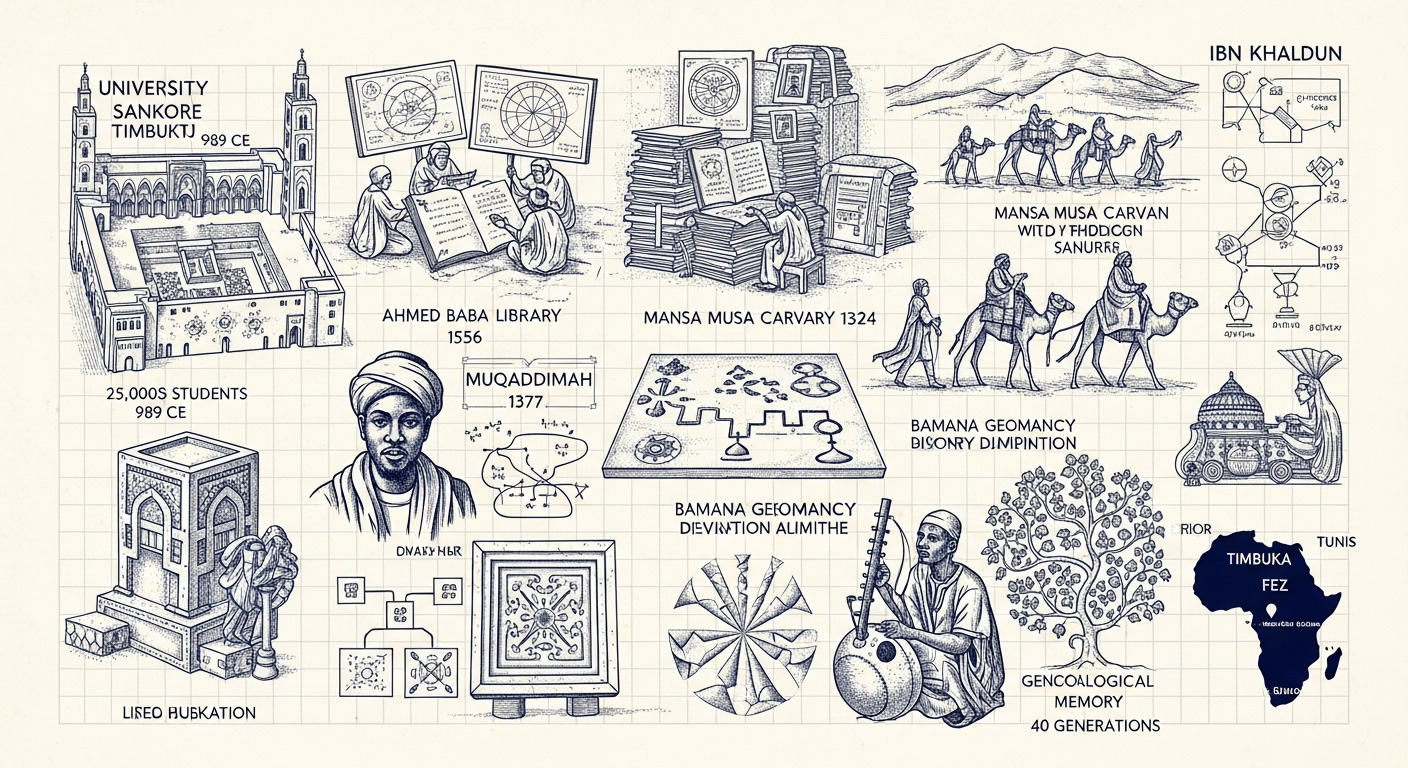
Medieval African centers of learning: Timbuktu, Sankoré, and knowledge transmission.
The Age of Foundations: Introduction
We have been told a story. The story of a lost millennium, of a dark parenthesis between the glory of Antiquity and the brilliance of the Renaissance. A thousand years of obscurantism, stagnation, oblivion. Textbooks still sometimes call it the "Dark Ages." This story is a lie by omission.
For while medieval Europe searched for light in its monasteries, the rest of the world was building. In Baghdad, a mathematician invented the algorithm—the word itself still bears his name. In Timbuktu, scholars compiled hundreds of thousands of manuscripts in libraries rivaling Alexandria. In China, clockmakers erected twelve-meter-tall mechanical towers, peopled with automata that struck the hours without human intervention. In the Yucatán, astronomers calculated eclipses with a precision Europe would not achieve for centuries. And across the vastness of the Pacific, navigators crossed thousands of kilometers of ocean with no instrument but their bodies and the stars.
The Middle Ages were not a dark age. They were the age when humanity laid the foundations of what we now call artificial intelligence.
This second part continues the journey begun in Antiquity. Six continents, a thousand years of history—from the fall of Rome in 476 to the voyages of Columbus in 1492. And everywhere, the same stubborn quest: to give form to thought, to delegate calculation to matter, to preserve knowledge against oblivion and time.
Africa — Libraries of Sand
There are libraries the wind cannot erase. In 1324, Mansa Musa, emperor of Mali, crossed the Sahara with a caravan so sumptuous it destabilized Egypt's economy. The true wealth he brought back from his pilgrimage was not gold: it was scholars, architects, books. On his return, Timbuktu became what Alexandria had been—the intellectual center of the known world.
The University of Sankore welcomed twenty-five thousand students. Between four hundred thousand and seven hundred thousand manuscripts were produced there—treatises on algebra, star charts, algorithms for dividing inheritances according to combinatorial rules of formidable complexity. In Tunis, Ibn Khaldun invented the social sciences, proposing a rational methodology for understanding history as a system of causes and effects. North Africa was not content with calculation. It theorized the very conditions of knowledge.
But it was perhaps in sand that Africa developed its most troubling innovations. Bamana geomancy, which ethnomathematician Ron Eglash described as "the most complex example of a fractal algorithm" he had encountered, transmitted its generative procedures from generation to generation. And the griots—those hereditary historians, musicians, and genealogists—constituted living libraries, memorizing genealogies spanning forty generations. When a griot dies, says the Mandinka proverb, it is as if a library has burned. This is not a metaphor.
Americas — Knots of Time
A knot can be an obstacle or a memory. In the Andes, it was both—and much more.
Around the year 1100, a Maya scribe finished painting the Dresden Codex, one of only four Maya manuscripts to survive the conquistadors' book burnings. Sixty-five percent of its pages contain astronomical tables. Among them, an eclipse prediction algorithm valid for more than five centuries, with an accuracy of 0.0002 days per year—superior to the Julian calendar Europe was using at the time. At Chichén Itzá, the El Caracol observatory offered twenty astronomical sight lines. The Maya had understood that time could be calculated.
Further south, the Incas invented the quipu—a system of knotted cords that constituted the nervous system of their empire. The largest contained up to fifteen hundred cords, each capable of carrying more than fifteen hundred distinct units of information. The quipu stored; the yupana calculated. One was memory, the other processor. This architecture—separating calculation from storage—is precisely that of modern computers. Cusco's ceque system went further still: forty-one imaginary lines radiated from the Temple of the Sun to three hundred twenty-eight sanctuaries. Space itself had become a database.
Asia — Clocks of Heaven
A clock is not merely a measuring instrument. It is a promise: that the world obeys rules, that the future can be predicted.
In 725, the Buddhist monk Yi Xing completed what no one had ever achieved: a machine capable of measuring time by itself. Its secret lay in the escapement—that mechanism which transforms continuous movement into regular pulses. Europe would not invent its own for another two centuries. Three hundred fifty years after Yi Xing, Su Song brought this tradition to its peak. His clock tower, built in Kaifeng, housed one hundred thirty-three coordinated mechanical figurines, the oldest known chain transmission, and a mechanism so complex that the conquerors who dismantled it never managed to reassemble it.
In 1040, the craftsman Bi Sheng invented movable type printing—four hundred years before Gutenberg. In Kerala, India, Madhava of Sangamagrama developed around 1380 the first infinite series for calculating trigonometric functions—the beginnings of infinitesimal calculus, two to three centuries before Newton and Leibniz. In Samarkand, Ulugh Beg's observatory measured stellar positions with a precision Europe would not achieve until Tycho Brahe. Medieval Asia was not imitating European machines. It was anticipating them.
Europe — Wheels of Reason
A wheel can transmit movement. It can also, if conceived with enough ingenuity, reproduce the workings of thought.
On the island of Majorca, around 1275, Ramon Llull conceived a strange machine: concentric disks bearing letters and symbols, which could be rotated to generate combinations of concepts. Llull had invented a thinking machine—the first in Western history. Four centuries later, Leibniz would draw inspiration from it for his logical calculus. Across Europe circulated legends of brazen heads—bronze automata capable of answering any question. Albertus Magnus allegedly spent thirty years building one, before his student Thomas Aquinas destroyed it with a blow from his staff, exasperated by its constant chatter.
In workshops, clockmakers built marvels. Giovanni Dondi's astrarium, completed in Padua around 1364, had seven faces, one hundred seven gear wheels, and reproduced planetary positions with a precision that astonished Leonardo da Vinci himself. William of Ockham formulated his razor—"do not multiply entities beyond necessity"—that principle of parsimony which today guides the design of machine learning algorithms. Medieval Europe sought to formalize thought, to make it reproducible, transmissible. The wheels of the cosmos and the wheels of reason turned together.
Middle East — Architects of Mechanical Thought
Every technological revolution has its forgotten ancestors. Artificial intelligence was born in Baghdad, in the ninth century.
In 813, Caliph Al-Ma'mun founded the House of Wisdom, where astronomers, mathematicians, and translators from Persia, India, Greece, and China crossed paths. It was there that Al-Khwarizmi worked, whose Latinized name would give us the word "algorithm," and whose treatise al-Jabr would give us the word "algebra." What he invented was not just another formula: it was a method, a series of step-by-step instructions that could be executed by someone who did not understand what they were doing. The fundamental principle of every computer program.
The Banu Musa brothers built in 850 an automatic flute capable of playing different melodies according to the configuration of interchangeable cylinders—the first programmable machine in history. Al-Jazari created in 1206 automata of stunning sophistication, including a boat carrying four mechanical musicians. Ibn al-Haytham invented the experimental scientific method. Al-Kindi developed frequency analysis—the first automated information processing. In 1258, the Mongols destroyed the House of Wisdom. But the ideas had already traveled—to Toledo, Palermo, Paris—where they waited to germinate anew.
Oceania — Navigators of the Invisible
There are technologies you cannot hold in your hand.
Between 800 and 1200, Polynesians reached Hawaii, Easter Island, and New Zealand. They navigated thousands of kilometers of open ocean, without compass, without sextant, without written charts. In the Marshall Islands, navigators developed rebbelib—stick charts representing not the contours of lands, but the patterns of ocean swells. These charts were never consulted during the voyage: the navigator memorized them, then left them on shore. At sea, he felt the waves with his body. The first cognitive cartography in history.
In Australia, songlines—those itineraries encoded in song—have preserved precise information for fifty thousand years. The Māori whakapapa constituted a taxonomic framework linking all phenomena—human, animal, plant, mountain, star—in a structure that today's computer scientists would recognize as a relational database. In 1976, Mau Piailug, one of the last six master navigators of Micronesia, guided the Hōkūle'a from Hawaii to Tahiti without any modern instrument, triggering a cultural renaissance across the Pacific. Intelligence, Oceania tells us, is not only a matter of calculation. It is a matter of relationship—with body, landscape, ancestors.
These six tales sketch a geography of intelligence that extends beyond the borders of the West and the limits of what is usually called "progress." They reveal that the foundations of artificial intelligence—the algorithm, the automaton, the logic machine, the database, distributed memory—were laid during this millennium we thought was dark.
The Middle East gave us the algorithm. Asia gave us mechanical precision. Europe gave us logical formalization. The Americas gave us the architecture separating calculation from storage. Africa gave us distributed memory. Oceania gave us embodied intelligence.
These foundations now await the Renaissance to flourish—and the industrial revolution to become mechanized. But the questions had already been posed. The answers, already sketched. The Middle Ages were not a parenthesis. They were a germination.
The seeds planted in Antiquity matured slowly there, sheltered from view, in libraries of sand and clock towers, in knotted cords and stick charts, in combinatorial wheels and navigation songs.
The flowering will come. But it will only be possible because others, before us, knew how to patiently till the soil.