The Americas
Illustrations
1 / 5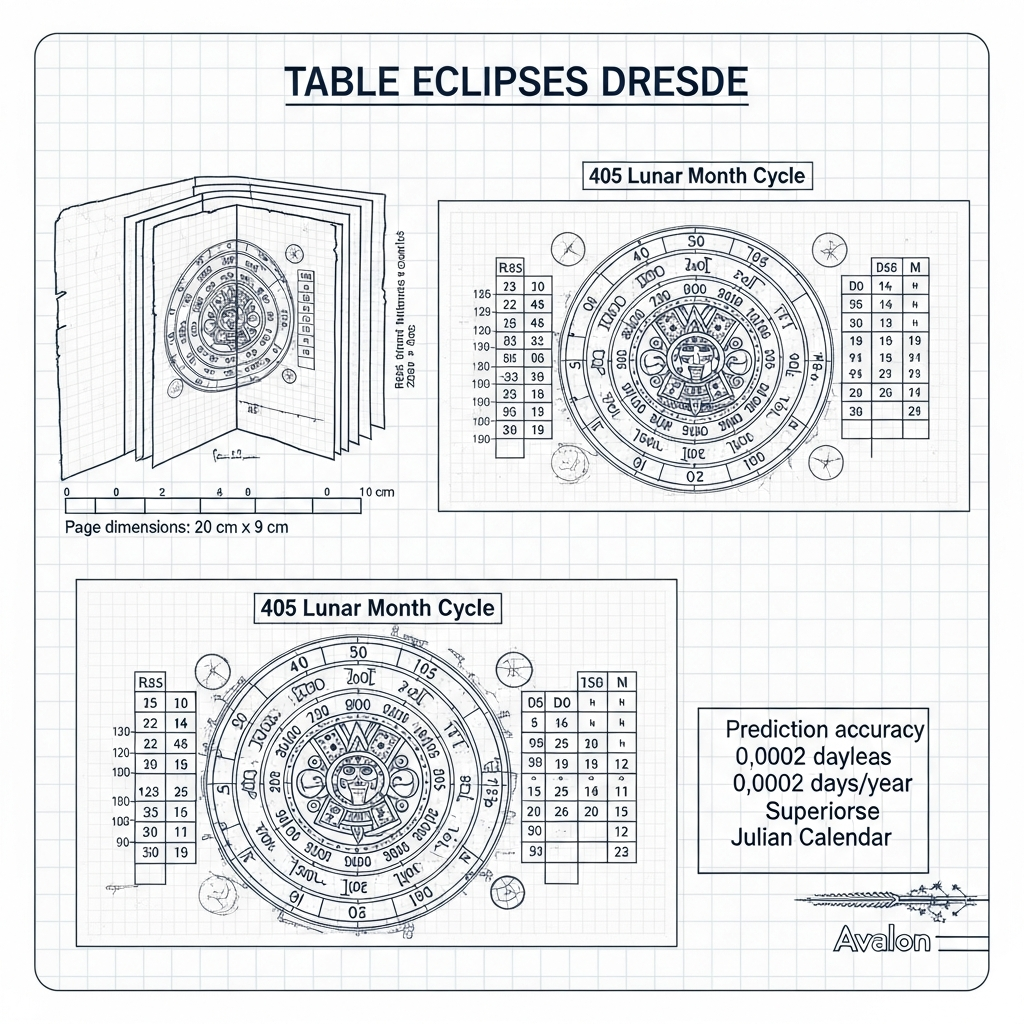
The eclipse table from the Dresden Codex: astronomical predictions of remarkable precision.
Knots of Time: How Medieval Americas Wove the Future into Their Calculations
A knot can be an obstacle or a memory. In the medieval Andes, it was both—and much more. While medieval Europe laboriously copied its manuscripts in monasteries, the civilizations of the Americas had invented information systems of a sophistication we are only beginning to measure. From knotted cords to eclipse tables, from circles of posts to stone observatories, the American continent wove the future into its calculations—laying, without knowing it, the foundations of what we would one day call artificial intelligence.
Yesterday — The Empire of Algorithms
Somewhere in the Yucatán, around the year 1100, a Maya scribe finished painting on a long strip of fig bark what would become the Dresden Codex—one of only four Maya manuscripts to survive the conquistadors' book burnings. Sixty-five percent of its pages contain astronomical tables. And among them, a computational masterpiece: an eclipse prediction algorithm valid for more than five centuries.
The eclipse table covers four hundred five lunar months, or thirty-two years and nine months. It probably begins in 1083 or 1116 CE. But its true ingenuity lies in its "reset" method: when the cycle ended, Maya astronomers recalibrated their calculations to intervals of two hundred twenty-three or three hundred fifty-eight months—known eclipse cycles—thus correcting accumulated errors. The result: an accuracy of 0.0002 days per year, superior to the Julian calendar Europe was using at the time. The Maya had understood, without telescope or measuring instruments, that the ritual calendar of two hundred sixty days harmonized perfectly with lunar cycles after forty-six repetitions. This discovery allowed them to predict every eclipse visible from their territory.
At Chichén Itzá, the El Caracol observatory—the "snail shell," named for its spiral staircase—materialized this science in stone. Built around 906, it offered twenty astronomical sight lines on twenty-nine possible celestial events. Its narrow windows framed the setting sun at the equinoxes. Its alignments made it possible to track Venus throughout the year. The Venus table of the Dresden Codex covers thirty-seven thousand nine hundred sixty days—exactly one hundred four years—integrating the planet's synodic cycles with the sacred calendar.
Further north, in the alluvial plains of the Mississippi, another civilization was building its own celestial calculation instrument. Cahokia's Woodhenge, erected between 900 and 1100, consisted of a circle of forty-eight red cedar posts spaced seven and a half degrees apart, with a diameter of one hundred twenty meters. The central post was offset one and a half meters to the east—a deliberate correction to compensate for the site's latitude. At the equinoxes, the sun seemed to emerge directly from Monks Mound, the largest pre-Columbian structure north of Mexico. At the winter solstice, it aligned with Fox Mound. Geometry served the calendar. Calculation served the sacred.
These observatories and tables were not isolated curiosities. They testified to an intellectual tradition transmitted over centuries. Maya scribes trained for years in observing the night sky. Their codices were copied from generation to generation, some almanacs dating back to the Classic period, five centuries earlier. In central Mexico, the calmecac—elite Aztec schools—trained the temalpouhqueh, the "counters of the heavens," from age five. Mathematics, astronomy, calendars, geometry: the curriculum would have done honor to any medieval European university.
We thought the algorithm was born in Mesopotamia with Al-Khwarizmi. We had forgotten the scribes of the Yucatán.
Today — Cords and Stars
If the Maya excelled at astronomical prediction, the Incas invented something equally remarkable: a portable database, capable of storing thousands of pieces of information in a skein of knotted cords.
The quipu—from the Quechua for "knot"—was the nervous system of the Inca empire. Between 1200 and 1532, the khipukamayuq, those hereditary cord experts, administered a territory of ten million inhabitants with what looked like a simple assembly of colored threads. But the simplicity was deceptive. The largest quipus had up to fifteen hundred cords. Each cord could carry, according to anthropologist Gary Urton, more than fifteen hundred distinct units of information—by combining twist direction, knot type, attachment method, and color. The numerical system was decimal and positional, identical to ours. Some researchers even see a binary coding superimposed on the decimal system.
"They were like primitive computers," notes historian Kim MacQuarrie. The comparison is not exaggerated. The quipu was not a calculator—it was a storage device. To calculate, the Incas used the yupana, a stone or clay tablet with compartments corresponding to decimal units. Corn or quinoa grains served as counters. Peruvian researcher Andrés Chirinos deciphered it in 2010 as a "pre-Hispanic calculator" capable of addition, subtraction, multiplication, and division. The yupana calculated; the quipu recorded. One was the processor, the other memory.
This architecture—separating calculation from storage—is precisely that of modern computers.
But the Incas went further still. Cusco's ceque system organized space itself as an information system. Forty-one imaginary lines radiated from the Qurikancha, the Temple of the Sun, toward three hundred twenty-eight huacas—sanctuaries distributed throughout the landscape. Each line was entrusted to a specific social group. It carried calendrical, astronomical, ritual, and territorial information. Archaeologists speak of "materialized ideology": the entire geography of Cusco was a map of the sociopolitical system, a database inscribed in the territory.
In Mexico, the nepohualtzintzin—the Aztec abacus—embodied another form of computational thinking. Thirteen rows of seven beads, totaling ninety-one. This number was not arbitrary: ninety-one days constitute a season; twice ninety-one, the cycle of corn from seed to harvest; three times, the duration of human gestation; four times, almost a complete year. The calculation instrument was also a calendar. Time and number merged in the same object.
These systems foreshadow what computer scientists today call distributed information systems. Knowledge was not concentrated in a single place. It was distributed among experts trained over decades, inscribed in portable objects, materialized in city architecture. When the Inca empire collapsed under the conquistadors' blows, the khipukamayuq continued to transmit their art. When Spanish monks burned the Maya codices, the astronomical tables had already been copied for centuries.
Redundancy ensured survival. The network survived its nodes.
Beyond — What Knots Teach Circuits
Our modern computers rigorously separate hardware from software, calculation from storage, code from data. This architecture, which we take for natural, was not the only possibility. Pre-Columbian civilizations had imagined others.
The quipu was both physical medium and language. The ceque was both territory and calendar. The nepohualtzintzin was both calculator and representation of time. These systems did not distinguish information from its material embodiment. They did not separate the sacred from the computational. For the Maya, calculating eclipses was a religious act—predicting the moment when the gods would darken the sun. For the Incas, tying a quipu was administering the empire and honoring the ancestors who had transmitted this art.
This fusion troubles us. We have learned to think of intelligence as something abstract, disembodied, transferable from one medium to another. Our algorithms run indifferently on servers in California or Finland. Our data travels through undersea cables, indifferent to geography. We invented artificial intelligence by separating it from all context.
Medieval Americas remind us that another path existed. An intelligence inscribed in bodies, in places, in objects. An intelligence that did not distinguish calculation from ritual, storage from transmission, information from the community that carried it. The khipukamayuq were not interchangeable. Each expert carried part of the total knowledge. The death of one impoverished the entire system—but did not destroy it, because other nodes in the network preserved partial copies.
The history of artificial intelligence, as usually told, begins with Turing machines and Dartmouth conferences. It forgets the eclipse tables of the Dresden Codex, which predicted the future with precision superior to Ptolemy. It forgets the quipus, those portable databases capable of storing thousands of pieces of information in a few grams of cotton. It forgets the calmecac, where five-year-old children learned to count the heavens.
These omissions are not merely historical injustices. They are conceptual impoverishments. For to imagine what artificial intelligence could become, we must first understand all the forms intelligence has taken in human history. Medieval Americas invented several—some in cords, others in stone, still others in cedar posts aligned with the stars.
The conquistadors burned the codices. But the algorithms they contained had already crossed the centuries—knotted in the memory of those who knew how to read the sky.