Oceania
Illustrations
1 / 5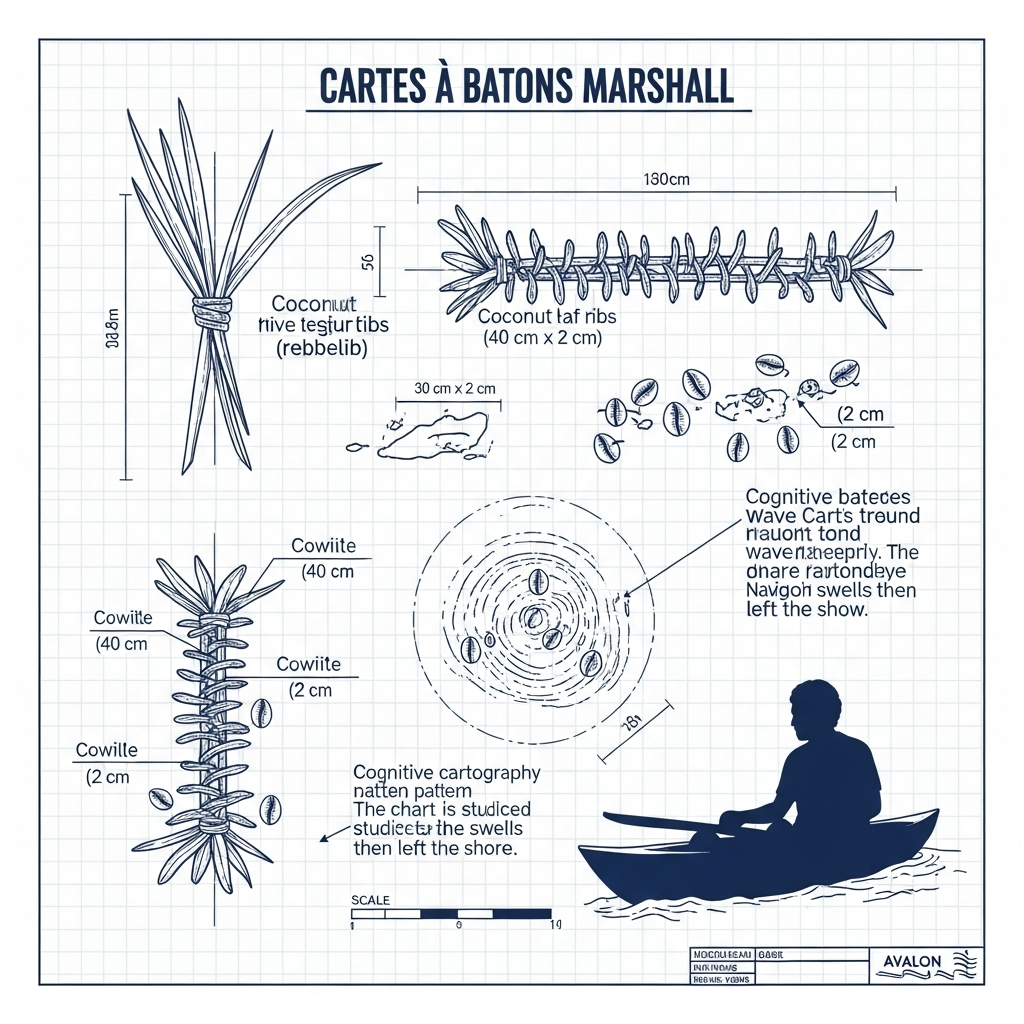
The rebbelib: stick navigation charts encoding currents and waves.
Navigators of the Invisible: How Medieval Oceania Invented Technologies of the Mind
There are technologies you cannot hold in your hand. While medieval Europe built cathedrals of stone and the Middle East forged algorithms on parchment, the peoples of the Pacific were building something more subtle still: cathedrals of memory, algorithms inscribed in the stars, maps traced not on paper but in the mind. These navigators of the invisible developed, without alphabetic writing or measuring instruments, information processing systems of a sophistication we are only beginning to understand.
This is the story of another path to intelligence. A path that does not pass through ink and metal, but through body, voice, waves, and stars. A path that reminds us that the foundations of what we now call artificial intelligence are not found only in the libraries of Baghdad or European monasteries, but also on the canoes that crisscrossed the vastest ocean in the world.
Yesterday — Architects of the Invisible
The Ocean House
Between 1100 and 800 BCE, a people archaeologists call the Lapita accomplished something extraordinary. Setting out from the Bismarck Archipelago, near New Guinea, they colonized in a few generations one-tenth of the Earth's circumference. From Fiji to Tonga, Samoa to the Marquesas, they crossed thousands of kilometers of open ocean, without compass, without sextant, without written chart. Their expansion was not a random drift on currents: it was a systematic, methodical colonization, testifying to a stunning mastery of navigation.
This expansion continued throughout the Middle Ages. Between 800 and 1200 CE, Polynesians reached Hawaii, Easter Island, and finally New Zealand around 1250-1300. They navigated on double-hulled canoes—Tongan kalia could reach thirty-five meters in length and carry more than a hundred people. The peak development of this naval technology coincided with the Great Pacific Migrations, an era when naval architects perfected V-shaped hulls that improved windward performance, when carpenters assembled composite planks without a single metal nail.
But the real feat was not in the wood. It was in the mind.
Maps You Don't Look At
In the Marshall Islands, navigators developed a cartography system unique in human history: the rebbelib, or stick charts. Made from coconut leaf ribs tied together, dotted with shells representing islands, these charts resemble nothing known. They do not represent the contours of lands, but something far more subtle: the patterns of ocean swells and how islands disturb them.
The most astonishing thing is not their fabrication. It is their use. Unlike European charts, rebbelib were never consulted during the voyage. The navigator studied them before departure, memorized the wave patterns, then left the chart on shore. At sea, crouching at the bow of his canoe, he literally "felt" the waves with his body, comparing tactile sensations to the mental map he carried within him.
We have just described the first cognitive cartography in history. Information externalized on a physical medium, internalized through memorization, then used in real time by comparison with sensory data. This is, in essence, the functioning of any intelligence system: learn a model of the world, then use it to interpret experience.
Walking Libraries
How do you transmit knowledge when you have no writing? Polynesians solved this problem by inventing what might be called "living libraries." In each community, specialized memory keepers—sometimes called "walking libraries" by anthropologists—memorized genealogies, historical narratives, navigation instructions.
Polynesian genealogies often go back dozens of generations. Paradoxically, Polynesians without writing could trace their ancestors further back in time than Europeans with their parish registers. The eldest son learned the names of all the family's ancestors. If the eldest was not capable of fulfilling this function, the most gifted was chosen. Memory was too precious to be left to chance.
The techniques were sophisticated: rhythmic repetition, rhymes, mnemonic formulas, gestures associated with each passage. Navigation itself was transmitted from master to apprentice in the form of songs. Sea routes were encoded in poems learned by heart. The geography of the Pacific was described as a giant octopus—the Taumata-Fe'e-Fa'atupu-Hau—whose head was on the island of Ra'iātea and whose tentacles extended to all the islands of the ocean.
These systems had an essential characteristic: flexibility. Unlike a written text, fixed once and for all, the oral narrative could adapt to context, audience, circumstances. There was no "correct" version of a story, but variations around a stable structure. This adaptability is, again, a property we seek today in artificial intelligence systems.
Today — Sensing, Singing, Dancing: Bodies That Calculate
Songlines: Fifty Thousand Years Before the Memory Palace
On the Australian continent, Aboriginal peoples developed an even older and perhaps even more sophisticated system. Songlines, or dreaming tracks, are itineraries that cross the landscape linking sacred sites. Each site is associated with a narrative, a song, a piece of knowledge. By singing the songs in the right order, a traveler can navigate hundreds of kilometers through unknown territories.
Europeans long attributed the invention of spatial memory techniques to the ancient Greeks, with the famous "method of loci" or "memory palace." An orator would imagine a familiar building and mentally place elements of his speech in each room. By mentally walking through the building, he would recover his speech.
Songlines work on a similar principle, but with a fundamental difference: the "palace" is not imaginary, it is the real landscape. And this system predates Greece by at least fifty thousand years.
Recent research has shown that a twenty-minute session with the Aboriginal memory method improves recall performance as much as the classic memory palace. But songlines do more than store information. They activate knowledge integrated into natural systems, using ritual, history, and song. "To know," in this tradition, is not simply to represent—it is to be in a rhythmic relationship with the world.
Terrestrial songlines are doubled by celestial songlines. The same narratives that describe the terrestrial landscape also describe the constellations. The sky becomes a mnemonic map for remembering paths on the ground. This redundancy—information encoded simultaneously in sky and earth, in song and movement—ensures remarkable system resilience.
Maramataka: Astronomy as Calculation
The Māori of New Zealand developed what might be called "computational astronomy": the maramataka, a lunar-stellar system used to predict harvests, plan voyages, and organize social life.
At the heart of the system is Matariki, the Māori name for the Pleiades. The appearance of this constellation just before dawn marks the Māori New Year and the beginning of winter. But Matariki is not merely a temporal marker. It is also a prediction tool. The clarity and brightness of the stars in the cluster allowed prediction of the quality of the coming season. Bright, distinct stars announced a good harvest; hazy, pale stars, a difficult season.
The tohunga kōkōrangi—literally "expert of the heavens"—was a revered figure who observed the stars for his clan and drew predictions about harvests, weather, omens. The star compass, or kāpehu whetū, required memorizing more than two hundred twenty stars and their positions on the horizon at different hours of the night and different seasons of the year.
This knowledge—tātai arorangi—was used to navigate the ocean, plant crops, harvest seafood, and measure time. It represents a form of analog calculation, where the regularities of the cosmos are internalized and used to make inferences about the terrestrial world.
Hula: The Body as Archive
In Hawaii, before the arrival of missionaries in the early nineteenth century, there was no written language. Hula—traditional Hawaiian dance—was not entertainment: it was the primary means of preserving and transmitting knowledge.
The mele, the chants that accompany hula, are described as "containers" of 'ike—a word meaning knowledge, wisdom, and understanding. These containers hold family genealogies, land histories, attributes of gods, agricultural and maritime techniques. Each gesture of the dance corresponds to a word or idea in the chant. The entire body becomes an information storage system.
More subtle still: kaona, the hidden meaning. Hawaiian chants often function on multiple levels of meaning. The literal level tells a simple story—a flower opening, a wave crashing. But beneath this surface, hidden meanings evoke historical events, political figures, spiritual teachings. The same chant can be understood differently depending on the listener's level of initiation.
Many of these hidden meanings have been lost over time, victims of colonization and cultural suppression. But hula's resilience is remarkable. Despite decades of prohibition, the dance survived underground and is experiencing a renaissance today.
Beyond — The Network of Ancestors
Whakapapa: The Relational Database Before Its Time
The Māori concept of whakapapa is perhaps Oceania's most profound contribution to what we would today call information science. The word literally means "to place layer upon layer," like geological strata. It is the Māori term for genealogy, but its scope infinitely exceeds a simple list of ancestors.
Whakapapa has been described as "the skeletal structure of Māori epistemology." It is a taxonomic framework linking all phenomena—animate and inanimate, known and unknown, terrestrial and spiritual. It links not only humans to each other, but humans to animals, plants, mountains, rivers, stars. Everything has a genealogy. Everything is connected.
This structure organizes, preserves, and transmits mythology, legend, history, knowledge, customs, philosophies, and spiritualities from one generation to the next. It delimits membership in social groups. It explains historical causality. It serves as a political tool. And—perhaps most striking—it functions as a research methodology.
Anthropologist Charles Te Ahukaramu Royal described whakapapa as a tool capable of "analyzing natural phenomena, origins, connections and relationships, and even predicting the future." In other words: a relational database, an analysis tool, and a prediction system—all without writing, without computers, with nothing but the human mind and oral tradition.
Rongorongo: Writing from Nowhere
On Easter Island, isolated in the middle of the Pacific, inhabitants developed something unique in all of Oceania: a writing system. Rongorongo—"to recite, declaim, sing" in the Rapanui language—remains largely undeciphered today. Only twenty-seven wooden objects inscribed with these mysterious signs have survived, none on the island itself.
The system has about one hundred twenty symbols representing birds, fish, gods, plants, geometric shapes. The forms resemble no other known writing system. Recent research suggests that at least one tablet dates from between 1493 and 1509—before the arrival of Europeans on the island.
If this dating is confirmed, rongorongo would be one of the rare cases of independent invention of writing in human history, alongside Mesopotamia, Egypt, China, and Mesoamerica. An isolated community, on a bit of volcanic land lost in the middle of the ocean, would have invented from scratch a system of symbolic representation.
The dominant opinion is that rongorongo is not writing in the strict sense, but a mnemonic device—a support for reciting genealogies, calendars, choreographies, agricultural or astronomical instructions. A portion of one tablet has been identified as a lunar calendar. The rest remains silent, keeping its secrets in a code we have not yet managed to break.
Transmission: From Mau Piailug to Nainoa Thompson
In 1970, only six master navigators—pwo—remained in all of Micronesia. All lived on the island of Satawal or neighboring Puluwat. The millennial tradition of navigation without instruments was on the verge of extinction.
One of these six masters was named Pius "Mau" Piailug. Chosen at birth by his grandfather to become a navigator, he had earned the title of palu—master—at eighteen. His navigation system relied on the sun and stars, winds and clouds, seas and swells, birds and fish. All his knowledge had been transmitted orally, through apprenticeship with his grandfather Raangipi.
In 1976, Mau Piailug did something extraordinary. He navigated the Hōkūle'a, a double-hulled Hawaiian canoe, from Hawaii to Tahiti—more than four thousand kilometers—without any modern instrument. When the canoe arrived in Tahiti, seventeen thousand people were waiting on the shore.
This voyage triggered a cultural renaissance across Polynesia. From Hawaiians to Māori, Tahitians to Rarotongans, the peoples of the Pacific rediscovered their navigating heritage. Nainoa Thompson, a Hawaiian who had learned wayfinding from Mau, became the first modern Polynesian to master the art of traditional navigation.
In 2007, Mau presided over the first pwo ceremony in fifty-six years. Five Hawaiians and eleven others were initiated as master navigators. Before his death in 2010, Mau had established the Mau Piailug Society, an organization that continues to transmit Micronesian navigation traditions.
Intelligence, Oceania tells us, is not only a matter of calculation. It is a matter of relationship. Relationship with the body, which feels the waves and dances the stories. Relationship with the landscape, which carries within it paths and narratives. Relationship with the sky, which offers its stars as landmarks. Relationship with ancestors, whose memory lives in genealogies and songs.
The navigators of the invisible did not build machines. They built systems—systems of memory, prediction, navigation, knowledge. These systems were carried not by silicon, but by human bodies, oral traditions, ritual practices. They were, in a sense, technologies of the mind.
We who build artificial intelligences today have much to learn from these traditions. The resilience of distributed memory. The power of multimodal encoding—song, gesture, star, wave. The importance of relationship as the foundation of knowledge. The adaptability of systems that have no "correct" version fixed forever.
The Pacific Ocean covers one-third of the Earth's surface. Its islands are tiny points lost in the blue immensity. Yet men and women learned to cross this space, to trace invisible routes through it, to build civilizations there. They did so without writing, without metal, without optical instruments. They did so with their bodies, their memories, their intelligence.
True intelligence, perhaps, is not the one that calculates fastest. It is the one that knows how to navigate the invisible.