Introduction — Mapping the Uncharted
Illustrations
1 / 4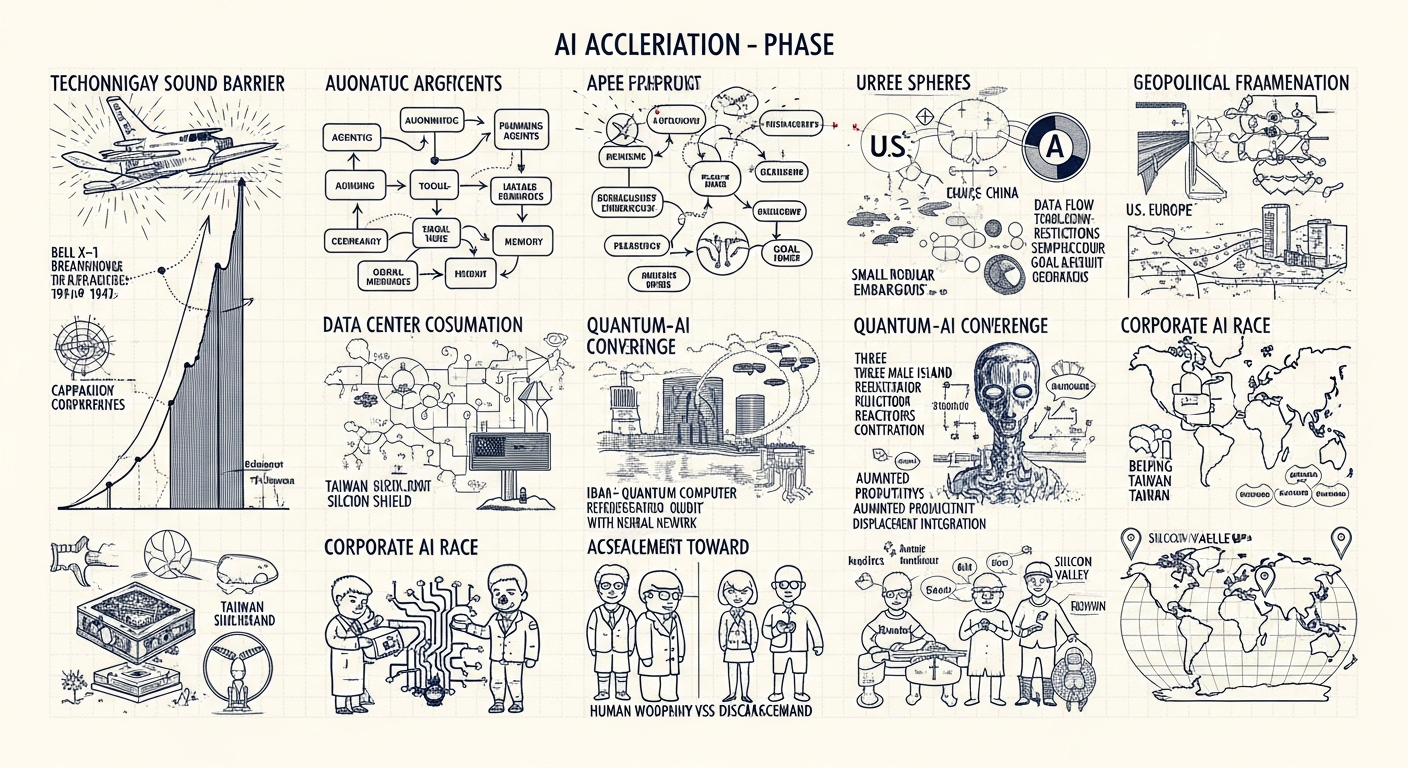
2026-2030: Technological acceleration and breaking the AI sound barrier.
Introduction — Mapping the Uncharted
Why we look ahead, and how
The ancient cartographers drew what they knew — the familiar coastlines, the traveled routes, the ports where their ships had anchored. Beyond the edges of the known, they sometimes inscribed a phrase: Hic sunt dracones. Here be dragons. Not because they believed in monsters, but because they understood that the unknown demands respect.
We are about to embark on a similar journey — not across space, but through time. The essays that follow attempt to map what lies ahead: the next five years, the following decade, the quarter-century to come. This is a peculiar undertaking. The future, by definition, does not yet exist. It cannot be observed, measured, or verified. And yet, it can be explored.
Foresight is not prophecy. It does not claim to reveal what will happen. Instead, it traces the forces already in motion, follows their trajectories, imagines where they might lead. It identifies signals — some strong, some weak — and asks what they suggest about the world that is taking shape around us.
The approach we take here rests on a simple observation: the future does not arrive all at once. It unfolds in layers. What will happen in the next five years is largely determined by decisions already made, investments already committed, technologies already developed. The curves are drawn; we are merely following them forward. But as we look further ahead, uncertainty grows. The ten-year horizon is hazier. The twenty-five-year horizon dissolves into possibility rather than probability.
This is why we organize our exploration around three horizons.
The first horizon — 2026 to 2030 — is the horizon of acceleration.
The signals are strong. Artificial intelligence is no longer a laboratory curiosity; it is a force reshaping economies, societies, and geopolitics. We can see the trajectories clearly: the rise of agentic systems that act rather than merely respond, the race toward artificial general intelligence, the fragmentation of global regulation into competing philosophies, the transformation of work and medicine. These are not speculations. They are extrapolations of what is already underway.
The second horizon — 2031 to 2036 — is the horizon of transformation.
The contours begin to blur. If artificial general intelligence arrives — and many experts now believe it will — the period that follows will be unlike anything we have experienced. Humanoid robots may walk among us. Science may accelerate by an order of magnitude. The world may split into distinct technological spheres, each with its own artificial intelligence, its own values, its own vision of the future. The signals remain strong, but their implications are harder to trace.
The third horizon — 2036 to 2050 — is the horizon of metamorphosis.
We enter the realm of the uncertain. Superintelligence may become a real possibility — or a real threat. The economy of work may give way to something we do not yet have words for. The boundary between biology and computation may dissolve. Space may become the domain of artificial minds that need no return. We cannot see clearly at this distance. We can only sketch possibilities, identify the questions that will need answers.
At each horizon, we distinguish between strong signals and weak ones.
Strong signals are the trends that appear robust across multiple sources, multiple regions, multiple analyses. They are the currents that carry us whether we swim with them or against them.
Weak signals are different. They emerge at the margins — tentative, uncertain, easy to dismiss. But weak signals can become strong. The smartphone was a weak signal in 2000. Climate change was a weak signal in 1970. What seems marginal today may define tomorrow.
We also trace what we call continental convergence: the ways different regions of the world face the same technological forces with different resources, different histories, different choices. The future will not arrive uniformly.
The United States and China race ahead, locked in competition.
Europe regulates and questions its place.
India and Africa seek paths that do not merely follow those already traveled.
The Middle East invests its resource wealth in technological ambition.
Each region will experience a different version of the transformation to come.
What is the purpose of this exercise?
Not to predict — for prediction is impossible.
Not to prescribe — for the choices belong to all of us.
The purpose is to prepare. To understand the forces in motion. To recognize the choices that remain open. To imagine what we might want before what arrives is already upon us.
The cartographers of old drew their maps not to constrain the voyagers but to help them navigate. Here be dragons, they wrote — not as a warning to stay away, but as a reminder to proceed with awareness.
The dragons are out there. The question is whether we meet them prepared.