Introduction
Illustrations
1 / 6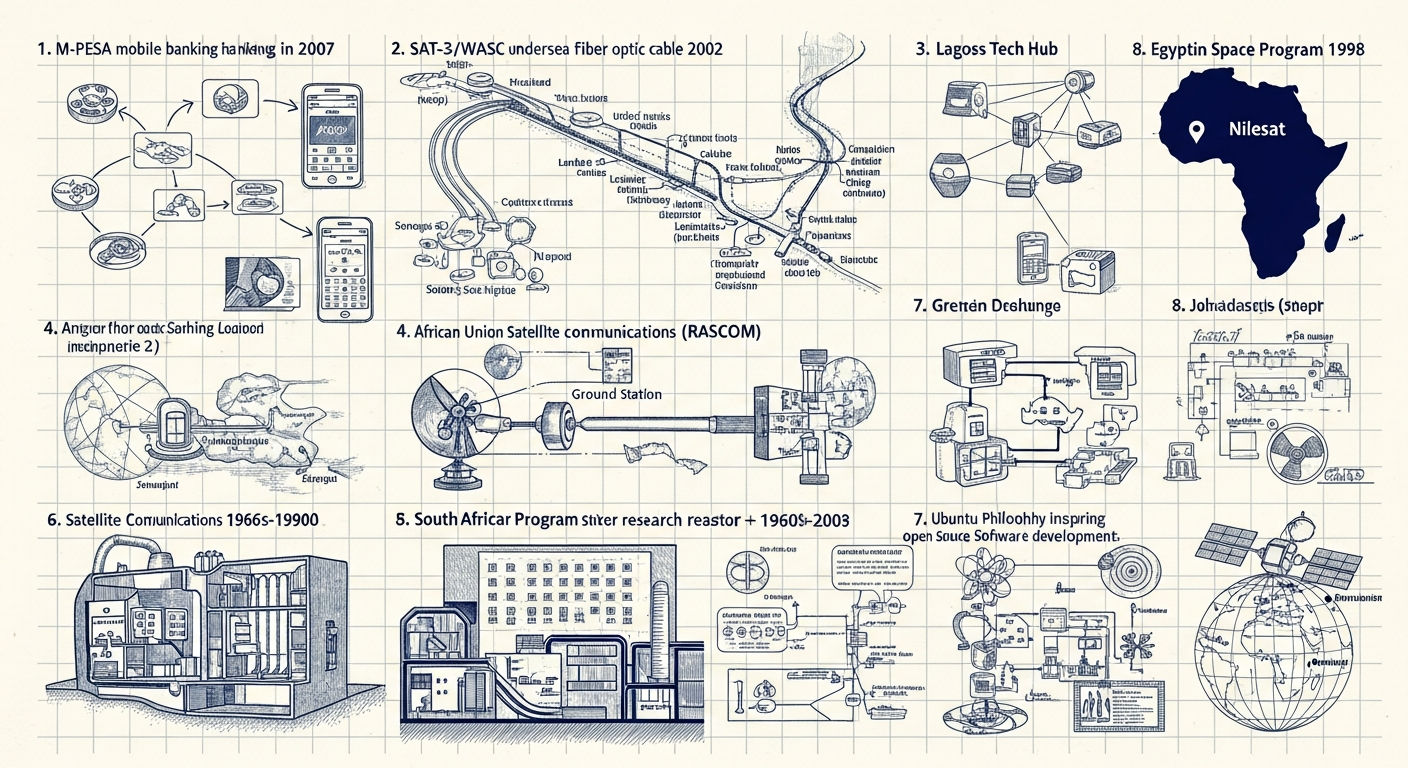
Africa: decolonization and emergence of African technological innovation.
The Information Age: Introduction
In February 1948, in a Sydney laboratory, an engineer named Trevor Pearcey wrote a sentence that still resonates: "It is not inconceivable that an automatic encyclopaedic service operated through the existing national teleprinter or telephone system will one day exist." The Internet. Predicted from Australia. Forty years before the World Wide Web.
This moment encapsulates the era we now traverse. Between 1945 and 2010—from the end of the World War to the dawn of the deep learning revolution—humanity transformed the conceptual tools forged during the previous era into real machines, global industries, planetary networks. Shannon and Nakashima's circuits became microprocessors. Turing's universal machine became the personal computer. Boolean logic became the Internet. The Dartmouth dream—simulating human intelligence—passed through summers of euphoria and winters of disillusionment before being reborn in a new form.
But this era was also one of leaps across the abyss. Africa, disconnected from the global telephone network, jumped directly to mobile payments and invented M-Pesa before the West imagined Apple Pay. India, having missed the hardware turn, leaped toward software services and became the world's digital subcontractor. Taiwan invented an industrial model—the pure-play foundry—that enabled fabless companies to transform global technology. Israel, a six-year-old nation surrounded by enemies, built one of the world's first computers and became the "Startup Nation."
This fifth part continues the journey begun in Antiquity, the Middle Ages, the Early Modern Period, and the Age of Revolutions. Six continents, sixty-five years of history—and everywhere the same question: who inherits the digital revolution, and who is excluded from it?
Africa — The Digital Palaver Tree
In every African village, there is a tree beneath which people gather to decide together. The palaver tree.
Ubuntu: "I am because we are." This African philosophy of collective intelligence contained, without knowing it, the very principles of distributed systems and consensus protocols. Mark Shuttleworth, South African billionaire who became the second space tourist in history, named his operating system Ubuntu Linux—the palaver tree made into computer code.
Africa invented mobile payments with M-Pesa before the West thought of it. It created Ushahidi, the citizen mapping platform used during the Haiti earthquake. Rose Dieng-Kuntz, the first African woman admitted to Polytechnique, became a pioneer of the semantic web. Timnit Gebru revealed that facial recognition systems erred up to thirty-five percent for dark-skinned women. Africa teaches us that innovation can emerge from the margins—and that the biases of AI bear the mark of those who designed it.
The Americas — The Forge and the Forgetting
In 1956, twenty-one researchers gathered at Dartmouth College. They thought they could create artificial intelligence in one generation. They were wrong—by a great deal.
North America experienced AI summers and winters. The founding summer of Dartmouth. The first winter when promises went unfulfilled. The summer of expert systems. Their collapse. Then the renaissance with deep learning. Meanwhile, Betty Holberton and the ENIAC programmers remained in the shadows of the official photographs.
But other forges were lighting up further south. Mexico created the first computer science master's program in Latin America. Argentina had its ComIC pioneers—Clarisa Cortes, Cristina Zoltan, Liana Lew, Noemi Garcia. Brazil manufactured sixty-seven percent of its computers locally. And Chile dreamed of Cybersyn—a socialist Internet before its time, destroyed by the 1973 coup. The Americas teach us that the history of AI is made of cycles—and that some forges were extinguished by force.
Asia — Parallel Paths Converge
Railway tracks appear to converge at the horizon. It is an optical illusion—the rails never touch. But this illusion tells a truth: separate paths can lead to the same place.
Japan moved from copying to innovation—and from triumph to failure. The Fifth Generation project promised a revolution; it became "the lost generation." But Japanese robotics conquered the world: seventy percent of global production in 1980. India leaped over hardware to become a software giant thanks to the Y2K bug. Morris Chang, "put out to pasture" at Texas Instruments at fifty-four, left for Taiwan and invented TSMC—the "silicon shield" that today manufactures the world's chips. China protected its market and saw the emergence of Lenovo, Huawei, and the BAT giants.
Fei-Fei Li created ImageNet from Stanford. Kai-Fu Lee developed speech recognition. Asia teaches us that parallel paths eventually converge—and that technological dominance can shift continents.
Europe — Digital Reconstruction
Europe invented the computer twice. The first time in secret. The second time in oblivion.
Konrad Zuse built the Z3 in Berlin in 1941—the world's first programmable computer. A bombing raid destroyed it. Tommy Flowers delivered Colossus in 1944—the first electronic computer. He was ordered to burn the plans. When history was written, America had invented everything.
Then came the Lighthill Report. In 1973, a British mathematician scuttled his own country's AI. The first "artificial intelligence winter" began.
But Europe rebuilt itself. Alain Colmerauer invented Prolog in Marseille. Tim Berners-Lee created the World Wide Web at CERN. Linus Torvalds wrote Linux in Finland. Yann LeCun laid the foundations for convolutional neural networks. DeepMind, founded in London, would beat the world champion at Go. Europe teaches us resilience—the capacity to fall, to rise again, and to start over.
The Middle East — Gardens of the Desert
No one expects flowers in the desert. Yet that is where they grow fastest—when the rain finally comes.
In 1954, a country just six years old undertook to build a computer. The advisory committee included Einstein and von Neumann. Some candidates had lost their diplomas in the Holocaust. In 1955, the WEIZAC executed its first calculation. Half a century later, Israel became the "Startup Nation"—Check Point, ICQ, Waze, Mobileye.
Lotfi Zadeh was born in Baku, grew up in Tehran, invented fuzzy logic at Berkeley. Iran had trained one of the fathers of AI. History forgot. The Emirates planted the seeds of a digital ambition—Dubai Internet City, Masdar Institute—that would flower after 2010. The Middle East teaches us that necessity is the mother of invention—and that gardens can grow in the desert.
Oceania — The Antipodes of Innovation
Great inventions sometimes emerge where no one expects them.
In 1949, Australia built the fifth stored-program computer in the world. Trevor Pearcey and his team worked "largely independently of European and American efforts." Isolation became an advantage. In 1948, Pearcey predicted the Internet. In 1950, the CSIRAC played music—the first digital concert in history.
Graeme Clark, whose father was deaf, invented the cochlear implant. More than one million people hear today thanks to him. The CSIRO developed a wireless transmission technique that became a component of WiFi—and won four hundred fifty million dollars against fourteen tech giants. Google Maps was born in Sydney. Atlassian became Australia's first tech unicorn.
Oceania teaches us that isolation can be a strength—and that the antipodes can invent bridges to the entire world.
These six narratives trace a geography of innovation where leaps across the abyss stand alongside falls and reconstructions. They reveal that the period 1945-2010 was both the moment when artificial intelligence took shape—summers of euphoria, winters of disillusionment, the renaissance of deep learning—and the moment when the maps of technological power began to be redrawn.
The period ends on the threshold of a new revolution. In 2006, Geoffrey Hinton and his students relaunched deep neural networks. In 2009, Fei-Fei Li published ImageNet. In 2012, AlexNet proved that deep learning worked. The winter was over. The summer that opened would be the longest and most transformative in the history of AI.
But this revolution inherits everything that came before—including leaps and falls, frugal innovations and extinguished forges, biases that perpetuate themselves, and parallel paths that finally converge.
Understanding this legacy—including what it built and what it forgot—is perhaps the condition for shaping what comes next.