Europe
Illustrations
1 / 5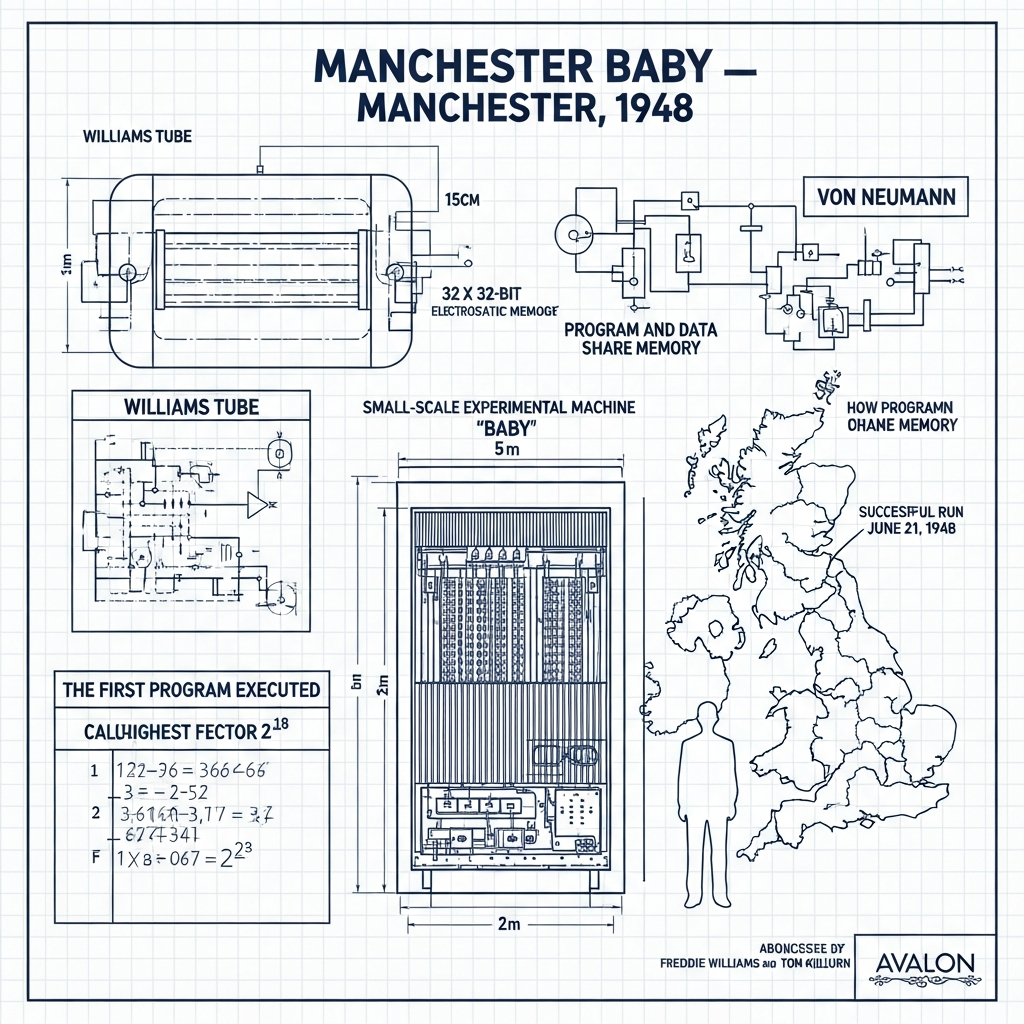
The Manchester Baby (1948): first functional stored-program computer.
Digital Reconstruction
Europe and the Foundations of Artificial Intelligence (1945-2010)
From Ruins to Renaissance: European Computing Between Two Wars
Yesterday — Pioneers from the Rubble
Europe invented the computer twice. The first time in secret. The second time in oblivion.
In 1941, in a Berlin apartment, a young civil engineer named Konrad Zuse completed a machine he had built alone, with the help of a few friends and his family. The Z3 occupied an entire living room: two thousand six hundred electromechanical relays, kilometers of cables, a reading system using perforated film. The machine calculated in binary — an innovation Zuse had developed by intuition, unaware that American mathematicians were working on the same principles. The Nazi regime took no interest. The Wehrmacht wanted weapons, not calculators. Zuse continued his work in general indifference.
On December 21, 1943, an Allied bombing raid destroyed the Z3. Three years later, when historians began writing the history of computing, they spoke of the American ENIAC, the British Colossus, the work of Alan Turing. Zuse's name was barely mentioned. Germany had lost the war. It would also lose the memory of its inventions.
A few hundred kilometers from Berlin, in an English manor surrounded by barbed wire, another revolution was brewing. Bletchley Park housed the British decryption center — the secret heart of the Allied war effort. Alan Turing arrived on September 4, 1939, one day after the declaration of war. He took charge of Hut 8, responsible for breaking German naval codes. With Gordon Welchman, he designed the Bombe, an electromechanical machine capable of penetrating the secrets of the Enigma machine. The first Bombe was operational on March 18, 1940. Hundreds followed.
But the true breakthrough came from a General Post Office engineer named Tommy Flowers. In January 1944, he delivered Colossus, an electronic machine designed to decrypt the Lorenz cipher — even more complex than Enigma. Colossus Mark 2 became operational on June 1, 1944, five days before the Normandy landings. Ten Colossus machines were running by war's end. They contributed to victory. Then they were destroyed.
The existence of Colossus remained classified until the 1970s. When the secret was finally lifted, the history books had already been written. The American ENIAC, presented in 1946 with great media fanfare, had become "the first electronic computer." Colossus, two years earlier, did not officially exist. The women who had constituted seventy-five percent of Bletchley Park's staff — cryptanalysts, operators, mathematicians — were barely mentioned.
Europe won its wars and lost its memory.
Manchester: The Birth of the Stored Program
In the ruins of the postwar period, invention continued.
On June 21, 1948, in a University of Manchester laboratory, a machine two meters tall and five meters long executed its first program. The Small-Scale Experimental Machine — which its creators called "the Baby" — was not very impressive. It weighed nearly a ton, consumed three thousand five hundred watts, and its memory could store exactly thirty-two words of thirty-two bits. But it accomplished something no machine had done before: it stored its program in its own memory and could modify it during execution.
Frederic Williams, Tom Kilburn, and Geoff Tootill had invented the principle underlying all modern computers — the stored program. This principle, theorized by Turing in his 1936 paper, was finally taking physical form. The first program, written by Kilburn, searched for the largest factor of two to the power of eighteen. It took fifty-two minutes and three and a half million operations to find the answer: one hundred thirty-one thousand seventy-two.
A year later, the Manchester Mark 1 was operational. In February 1951, Ferranti delivered a commercial version to the university — the world's first commercial computer, beating the American UNIVAC by a few months. The irony was that Tim Berners-Lee's parents — Conway and Mary Lee Woods — both worked on the Ferranti Mark 1. Their son would invent the World Wide Web forty years later.
The Ferranti Mark 1 also produced the first computer-generated music and one of the first chess programs. But these exploits were soon forgotten. The global computer industry was being built elsewhere — on the other side of the Atlantic, where IBM and its American competitors dominated the market.
Today — The Long Reconstruction
The First Winter: When Europe Scuttled Its Future
In 1963, Donald Michie — a Bletchley Park veteran who had worked alongside Alan Turing there — founded an artificial intelligence research group in an Edinburgh apartment. "There were only about four places in the world doing AI in the 1960s," he would later say. Edinburgh was one of them.
Michie built MENACE, a machine capable of learning to play tic-tac-toe through reinforcement. His team developed the Freddy robots, capable of assembling toys by integrating perception and action. British AI was pioneering, inventive, ambitious.
Then came the Lighthill Report.
In 1972, the British Science Research Council asked Sir James Lighthill — an applied mathematician with no experience in artificial intelligence — to evaluate the state of research. His verdict, published in 1973, was devastating: "total failure to achieve its grandiose objectives." The problem, according to Lighthill, was combinatorial explosion: AI algorithms worked on simple examples but collapsed in the face of real-world complexity. "The versatile robot is a mirage," he concluded.
On May 9, 1973, the BBC broadcast a debate where Lighthill faced Michie, John McCarthy, and Richard Gregory. Lighthill won — not on substance, but on effect. The British government cut funding. Laboratories closed. Researchers changed fields or emigrated. Europe had just triggered the first "AI winter."
The paradox was cruel. The United Kingdom had invented the stored-program computer, the first commercial computer, laid the foundations of academic artificial intelligence. And it was the United Kingdom that, with a fifty-page report, scuttled its own research.
The Battle for Sovereignty
On the continent, other countries were waging a different war — not against AI, but for technological independence.
In 1964, General Electric had acquired the majority of Compagnie des Machines Bull, the flagship of French computing. The "Bull affair" traumatized the government. More seriously: the United States refused to export IBM and CDC computers to the Atomic Energy Commission — France was not to perfect its H-bomb with American equipment.
General de Gaulle responded in July 1966 with the Plan Calcul. The objective: create a national computer industry capable of rivaling American giants. CII (Compagnie Internationale pour l'Informatique) was founded. IRIA — the future INRIA — opened its doors in 1967 to coordinate research. More than one hundred million dollars were invested over five years.
The results were mixed. CII produced respectable computers — the Iris 50 in 1967, the Iris 80 in 1969. Negotiations with Siemens and Philips gave birth to Unidata, a European consortium that delivered its first computers in 1974. But the election of Giscard d'Estaing, an opponent of the Plan Calcul, ended the adventure. Unidata was liquidated. CII was absorbed into Honeywell-Bull.
The ambition of sovereignty had collided with economic reality. IBM dominated the global market. No European manufacturer could compete alone.
Prolog and the Seeds of AI
While governments battled over large systems, researchers were planting more discreet seeds.
In the summer of 1972, in a laboratory at the University of Aix-Marseille, Alain Colmerauer and Philippe Roussel completed the first version of a new programming language. They called it Prolog — a contraction of "PROgrammation en LOGique" (Logic Programming). Colmerauer had worked on natural language processing and machine translation. He wanted a tool capable of manipulating logical rules as other languages manipulated numbers.
Prolog allowed programs to be written as facts and rules: "Socrates is a man. All men are mortal. Therefore Socrates is mortal." The machine deduced the conclusions. The paradigm was radically different from procedural languages like FORTRAN or COBOL.
The language attracted Japan's attention. When the Japanese Ministry of International Trade launched its ambitious Fifth Generation Computer project in 1982, it chose Prolog as the base language. The project's failure — the "lost generation of Japan," the New York Times headlined in 1992 — tarnished Prolog's reputation. But the language survived. Fifty years later, it remains the reference for logic programming, used in expert systems, theorem proving, and natural language processing.
The Renaissance of the 1980s
In 1983, the British government launched the Alvey Programme — a response to the Japanese Fifth Generation and an attempt to repair the damage of the Lighthill Report. Three hundred fifty million pounds, more than three hundred projects, one hundred fifteen companies, two thousand researchers at peak activity. Program managers carefully avoided the term "artificial intelligence," preferring to speak of "intelligent knowledge-based systems." The Lighthill wound had not healed.
The results were mixed — as always with major technology programs. But Alvey created a model of industry-academia cooperation that would inspire later European programs.
In 1984, the European Community launched ESPRIT — European Strategic Programme on Research in Information Technology. Five successive programs, from 1983 to 1998, funded hundreds of projects in microelectronics, software engineering, knowledge-based systems, and human-machine interface. ESPRIT imposed a crucial rule: to receive funding, a project had to involve at least two organizations from different European countries. Cooperation was no longer an option — it was a condition.
From these programs emerged a generation of researchers trained to work across borders. Europe had not caught up with the United States. But it had learned to collaborate.
On the Other Side of the Iron Curtain
While Western Europe was trying to build a computer industry against American dominance, the Soviet Union was running its own race.
Sergei Lebedev, in Kiev and then Moscow, built the MESM in 1950 — the first programmable Soviet computer — then the BESM, designed to surpass the American ENIAC. The BESM-6, operational in 1965, was a remarkable machine: instruction pipeline, memory interleaving, virtual address translation. Three hundred fifty-five units were produced until 1987. The BESM-6 calculated parameters for the Soviet anti-missile defense system.
Even more impressive: the Elbrus. In 1978, Soviet engineers built a superscalar processor with out-of-order execution, register renaming, and speculative execution — techniques that Western processors would not adopt until fifteen years later. The Elbrus equipped the nuclear centers of Arzamas-16 and Chelyabinsk-70.
But military secrecy stifled innovation. The most advanced Soviet computers remained confined to bunkers. No transfer to the civilian economy took place. In the 1970s, facing bureaucratic chaos and semiconductor lag, the Soviet government made a fatal decision: abandon original designs to clone the IBM System/360. The USSR was giving up on its computing future.
Beyond — Europe's Gift
The Web: A Gift to the World
In March 1989, a British computer scientist working at CERN submitted a proposal of a few pages to his supervisor. Tim Berners-Lee wanted to solve a concrete problem: how to enable physicists around the world to share their data and documents? His solution combined two existing technologies — the Internet and hypertext — into something new.
His boss, Mike Sendall, scribbled on the cover: "Vague but exciting."
By late 1990, Berners-Lee had developed the three pillars of the Web: HTML to display pages, URL to identify them, HTTP to link them. The first server and the first browser were running on his NeXT computer. In August 1991, he announced the project on Internet forums. The first American server appeared in December at the Stanford Linear Accelerator Center.
On April 30, 1993, CERN made a decision that would change the world: placing the Web protocol in the public domain, free of rights. No patents. No licenses. A gift.
If the Web had been American, it probably would have been patented, licensed, monetized. A company would have taken a cut on every page, every link, every transaction. The history of the Internet would have been different — more restricted, more controlled, more unequal. But the Web was European. It was born in an international research laboratory funded by public funds. And it was offered to humanity.
Linux: The Cathedral and the Bazaar
In Finland, a twenty-one-year-old student was working on another project.
Linus Torvalds had grown up with a VIC-20, programming in BASIC and then machine code from age eleven. In 1991, he bought an IBM-compatible PC with an Intel 80386 processor and installed MINIX, an educational operating system. Frustrated by its limitations, he decided to write his own.
On August 25, 1991, he announced his project on a newsgroup: "I'm doing a (free) operating system (just a hobby, won't be big and professional like gnu) for 386(486) AT clones." The message was modest. The project was not.
Torvalds wanted to call his system Freax — a contraction of "free," "freak," and "x" (like Unix). Ari Lemmke, administrator of the university's FTP server, found the name ridiculous and replaced it with "Linux." Torvalds protested. Lemmke refused to change. Linux remained.
In January 1992, Torvalds relicensed his kernel under the GNU General Public License. The code became truly free — not only free of charge, but modifiable and redistributable by anyone. Thousands of developers around the world began contributing. By 1994, version 1.0 was ready.
Linux never conquered the desktop — Windows still reigns there. But it conquered everything else. Web servers, Android phones, supercomputers, connected objects, autonomous cars. Today, virtually all of the world's digital infrastructure runs on a kernel written by a twenty-one-year-old Finn who just wanted "a hobby."
Nokia: The Rise and Fall
Finland produced another revolution — and a warning.
Nokia was born in 1865 as a pulp mill. Over the decades, the company had diversified: cables, rubber, electronics. In the 1980s, it developed mobile phones for the Nordic NMT network. In 1987, the Mobira Cityman weighed eight hundred grams — down from nearly ten kilograms for the first models. Mikhail Gorbachev was photographed with a Cityman in Helsinki. The phone earned the nickname "Gorba."
In 1991, Finnish Prime Minister Harri Holkeri made the world's first GSM call on a Nokia phone. The following year, Jorma Ollila became CEO and focused the entire company on telecommunications. The strategy paid off beyond all expectations. In 1998, Nokia surpassed Motorola to become the world's largest mobile phone manufacturer. At its peak in 2000, Nokia represented four percent of Finnish GDP, twenty-one percent of exports, seventy percent of Helsinki's stock market capitalization.
Then came the iPhone.
In 2007, Apple presented a phone without a physical keyboard, with a touchscreen and an operating system designed for applications. Nokia had had smartphones since 1996. It had invented the concept. But it had not understood that the phone was becoming a pocket computer. By 2012, Samsung had surpassed it. In 2014, it sold its phone division to Microsoft.
The Nokia story is a warning: even pioneers can be overtaken. Innovation is not an acquired right — it is an endless race.
Convolutional Networks: From France to the World
In 1989, in Bell Labs laboratories in New Jersey, a French researcher was developing a technique that would transform artificial intelligence.
Yann LeCun had done his doctorate in Paris, then a postdoc in Toronto with Geoffrey Hinton. At Bell Labs, he created LeNet — a "convolutional" neural network capable of learning to recognize handwritten characters. The central idea: instead of treating each pixel independently, the network learned local patterns — curves, angles, lines — that it combined into characters.
LeNet learned to read handwritten postal codes for the US Postal Service. The 1998 version achieved ninety-nine percent accuracy. The check recognition system developed by LeCun was deployed by NCR and processed more than ten percent of American checks at the turn of the century.
For years, convolutional networks remained a curiosity — a technique that worked on digits but not on complex images. Computers were not powerful enough. Data was lacking. In 2012, everything changed. A deep convolutional network named AlexNet crushed the ImageNet image recognition competition with an error rate half that of its competitors. Deep learning was born — and LeCun's convolutional networks were at its heart.
In 2018, LeCun received the Turing Award with Hinton and Yoshua Bengio — the "godfathers of AI." Two of the three laureates had European roots. The invention was made in America. But the seeds had germinated in France and Canada.
DeepMind: Europe's Return
In November 2010, three researchers founded a startup in a London office. Demis Hassabis, Shane Legg, and Mustafa Suleyman had an outsized ambition: "to solve intelligence."
Hassabis was a British child prodigy — chess champion at thirteen, award-winning video game designer, neuroscience PhD. He had studied how the human brain forms memories and drawn ideas from it. DeepMind combined deep learning, reinforcement learning, and computational neuroscience.
The first successes came from video games. In 2013, DeepMind created a system capable of learning to play forty-nine Atari games simply by observing the pixels on screen — without rules, without explicit programming. Google noticed. In 2014, the company acquired DeepMind for more than five hundred million dollars — the largest European acquisition in its history.
In 2016, AlphaGo beat Lee Sedol, world Go champion, four games to one. Go was considered the last bastion of games where humans dominated machines — too complex for brute force, requiring intuition and creativity. AlphaGo proved that machines could learn intuition.
In 2020, AlphaFold solved a fifty-year-old problem: predicting the three-dimensional structure of proteins from their amino acid sequence. Biologists had spent decades determining these structures one by one, through X-ray crystallography. AlphaFold predicts them in hours. In 2024, Demis Hassabis received the Nobel Prize in Chemistry.
Europe had triggered the first AI winter with the Lighthill Report. Fifty years later, a London startup was at the forefront of the revolution.
Epilogue — The Lessons of Reconstruction
The history of European computing is a history of paradoxes.
Europe invented the programmable computer — and no one remembered. It created the first commercial computer — and lost the market. It laid the foundations of academic artificial intelligence — and scuttled its own research. It launched plans for technological sovereignty — and saw its champions absorbed by American conglomerates.
Yet something survived. The Web was born at CERN and given to the world. Linux was born in Finland and conquered infrastructure. Convolutional networks were born from a Frenchman and transformed AI. DeepMind was born in London and pushed the frontiers of artificial intelligence.
The lesson may not be the one expected. Europe never caught up with the United States in the computer industry. It did not create an equivalent to IBM, Microsoft, Apple, Google, or Amazon. Its attempts at technological sovereignty — Plan Calcul, Alvey, ESPRIT — produced mixed results at best.
But Europe did something else. It gave.
The Web is free because a European laboratory chose not to patent it. Linux is free because a Finnish student adopted an open license. These gifts transformed the world more profoundly than any commercial product.
Europe also trained researchers who spread everywhere — LeCun at Facebook, Hassabis at Google, thousands of others in laboratories and startups around the world. It created institutions — INRIA, ETH Zurich, Cambridge, Oxford, Edinburgh — that continue to produce fundamental innovations.
Europe's digital reconstruction is not finished. It never will be. The computers we use today bear the imprint of Turing and Zuse, of the Manchester Baby and the Ferranti Mark 1, of Prolog and Linux, of the Web and DeepMind. Europe did not win the industrial war. But it shaped the terrain on which that war is fought.
And sometimes, shaping the terrain matters more than winning the battle.