Africa
Illustrations
1 / 5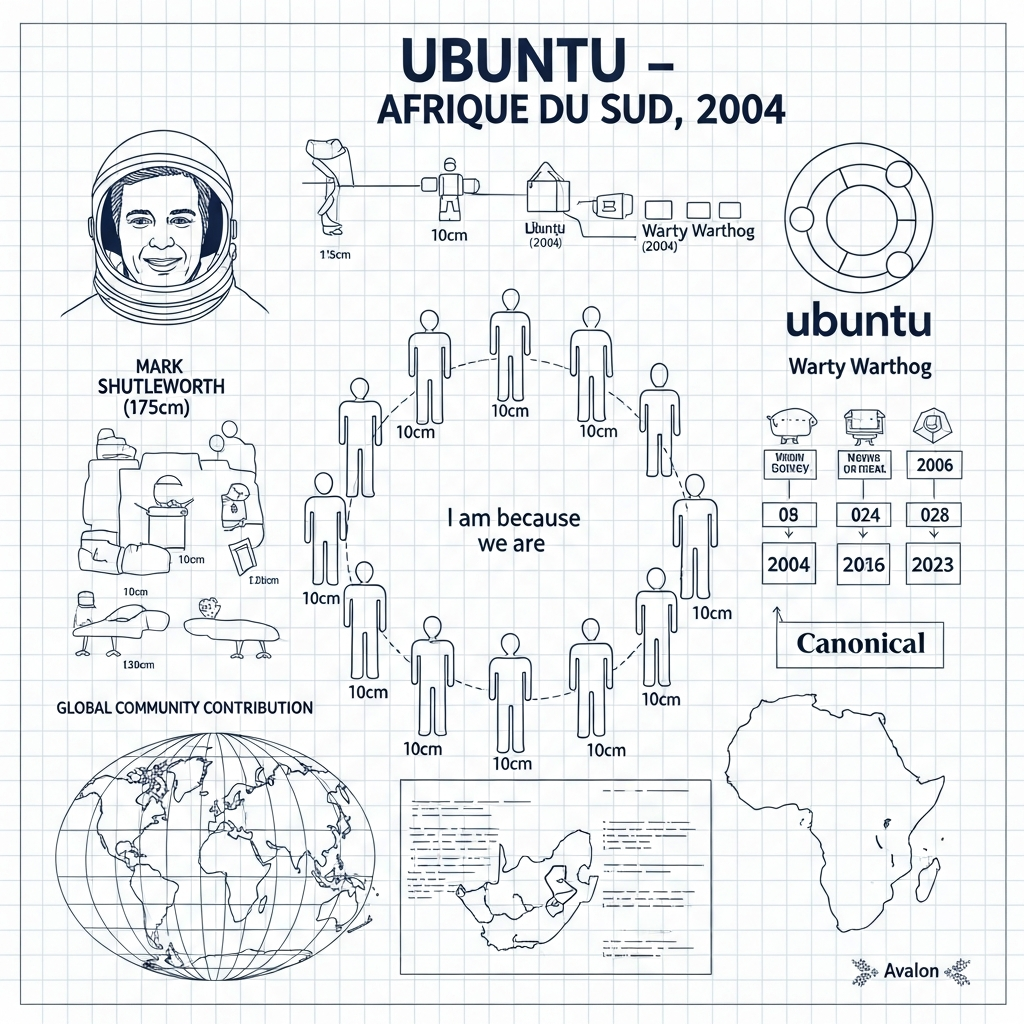
Ubuntu: African philosophy of interconnection, 'I am because we are'.
The Digital Palaver Tree
Africa and the Foundations of Artificial Intelligence (1945-2010)
Yesterday — The Roots of Collective Intelligence
In every African village, there is a tree. Not just any tree—the one beneath which people gather to talk, listen, and decide together. The palaver tree. Nelson Mandela described it as "a democratic institution in its own right." Under its shade, decisions are binding only when all parties express their agreement. No majority vote crushing the minority. No hierarchy imposing its will. A patient consensus, sometimes lengthy, always inclusive.
This way of thinking about intelligence—not as the privilege of an individual, but as the emergence of a collective—runs through African history. It has a name: Ubuntu. "Umuntu ngumuntu ngabantu," says the Zulu proverb. A person is a person through other persons. I am because we are. This philosophy, which places community at the center of human existence, guided Desmond Tutu in his leadership of the Truth and Reconciliation Commission. It nourished Mandela's leadership in post-apartheid South Africa. And it contained, long before the invention of computers, the very principles that today underpin distributed systems and digital network consensus mechanisms.
For what does the palaver tree do, if not what blockchain consensus protocols attempt to achieve? Gathering diverse voices, seeking agreement rather than imposition, collectively validating a decision. The talking drums that transmitted coded messages across the savanna prefigured communication protocols. The griots who memorized entire genealogies were living databases. Africa did not wait for the computer to think about information and its sharing.
But this thinking was long ignored, then actively destroyed.
When colonial powers installed their first communication systems in Africa—the telegraph, then the telephone—these technologies did not serve Africans. They served resource extraction, population control, colonial administration. The infrastructure was oriented toward ports, toward export, toward centers of colonial power. Indigenous innovation was systematically suppressed. Local knowledge, declared primitive, was marginalized in colonial school curricula.
The wave of independence in the 1960s opened a window. The UN declaration of 1960 recognized that colonization was a denial of human rights. Within a few years, more than half of European colonies in Africa obtained their sovereignty. Universities were established—in Ghana, Nigeria, Kenya, Senegal. In 1960, there were approximately four thousand five hundred university graduates in Ghana, more than five thousand in Nigeria. A generation of African thinkers began to imagine what technologies adapted to their contexts might look like.
At the University of Dakar in the 1980s, an interdisciplinary team working with microcomputers formulated a principle that still resonates today: to be useful in Senegal, software had to be developed by Senegalese experts according to Senegalese culture. This assertion—which might seem obvious—was in fact revolutionary. It posited that technology was not neutral, that it carried the values of those who designed it, and that Africa had to create its own tools rather than simply import those of others.
But while some dreamed of an African computing, others used computers to oppress.
South Africa under apartheid was totally dependent on imported computers—no mainframe was ever manufactured locally. And these machines served one of the most methodical racial classification systems in history. The computerized population register—the regime's most crucial tool—filed more than twenty-five million Black Africans. Every individual classified, categorized, surveilled. The Department of Plural Affairs managed an internal passport system that controlled movement. The hardware and software underpinning this machinery of oppression came from IBM, the largest computer supplier in South Africa throughout the apartheid period.
In 1978, IBM's sales in the country increased by two hundred fifty percent. By 1982, they reached approximately three hundred million dollars per year. The company had specifically bid to produce national identity documents and their computer systems. Computing, in this context, was not a tool of liberation—it was a weapon of subjugation.
It took international sanctions, the divestment movement, global pressure for this complicity to end. IBM officially left South Africa in 1987. But its products continued to circulate. And the legacy of this period—computing as an instrument of control—left a lasting mark on the continent's relationship with technology.
For the other legacy of these decades was the hemorrhaging of talent. Since 1985, Africa has lost an average of twenty thousand qualified professionals per year. Doctors, engineers, scientists, computer specialists—an entire generation of brains trained on the continent but practicing elsewhere. The cost to Africa: approximately two billion dollars per year. The benefit to host countries: far more. Britain alone derives approximately two billion dollars annually from the African professionals it has welcomed.
This brain drain was not an accident. It was the product of decades of underinvestment, political instability, lack of opportunity. African talents were not fleeing their continent out of disaffection—they were seeking the conditions that would allow them to exercise their genius. And many, as we shall see, contributed from abroad to the history of global computing—while dreaming of the day when they could do so from home.
The palaver tree was still there. But its branches had been pruned, its roots parched. It would take time for it to grow back—and to find a new form, digital this time.
Today — The Leap Across the Abyss
The history of African computing could be summed up in a paradox: the continent most tardily connected became, in certain domains, the most innovative.
Until the 1990s, Africa was almost totally disconnected from the digital world. Telephone penetration—less than three percent—was the lowest on the planet. Landlines, deployed elsewhere since the 1880s, existed only for administrations, elites, large corporations. Less than one percent of global Internet traffic reached the continent. When Africa's first TCP/IP connection was established—in October 1991, from Tunisia to France—the rest of the world had already been online for years.
And yet.
Rather than catching up step by step—first building the fixed telephone network, then wired Internet, then mobile—Africa jumped directly to the last step. This leap across the abyss has a technical name: technological leapfrogging. But it expresses something deeper: the capacity to invent solutions adapted to one's context rather than copying foreign models.
On March 6, 2007, a Kenyan company launched a service that would transform global financial inclusion. M-Pesa—"M" for mobile, "Pesa" for money in Swahili—allowed users to send and receive money by simple mobile phone. The idea had come from an observation: Kenyans were already using phone credit as a medium of exchange, transferring minutes of communication as payment. Why not formalize this practice?
The context at launch was telling. In 2006, forty-one commercial banks in Kenya had four hundred branches for thirty-six million inhabitants. Only eighteen point nine percent of the population was banked. More than a third was totally excluded from the financial system—no account, no savings, no way to send money remotely other than in cash.
In less than two years, M-Pesa became the dominant method of money transfer in Kenya. By 2011, seventeen million subscribers. The agent network—four hundred fifty at launch—reached eighteen thousand in 2010, forty thousand in 2016. Financial inclusion rose from eighteen point nine percent to eighty percent. A quiet revolution, carried by basic phones without touchscreens or Internet connections.
The most remarkable thing? This African innovation preceded the West. When M-Pesa was deploying in Kenya, mobile payments barely existed in Europe or the United States. Africa was not imitating—it was inventing.
The following year, another Kenyan innovation circled the globe. In December 2007, Kenya's presidential election was contested. Violence erupted. And for three days, traditional media fell silent. In this silence, four technologists—Ory Okolloh, Kenyan lawyer and blogger; Juliana Rotich, Kenyan computer scientist; David Kobia, Kenyan developer; and Erik Hersman, entrepreneur based in Kenya—created within days a website to collect reports of violence.
Ushahidi—"testimony" in Swahili—allowed anyone to send a report by SMS or email. These reports were placed on a map, creating a real-time visualization of the crisis. The software was free and open. Anyone could reuse it, adapt it, deploy it elsewhere. This citizen mapping platform was used to track the earthquake in Haiti, elections in India, the Gulf of Mexico oil spill. One hundred thousand deployments in one hundred sixty countries. A technology born of African necessity, become a global tool.
These innovations were not isolated accidents. They were part of a larger vision, carried by pioneers who believed that Africa could contribute to global computing—not just consume it.
Rose Dieng-Kuntz was born in Dakar in 1956. A brilliant student at Lycee Van Vollenhoven, she won several first prizes in the Senegalese General Competition before obtaining her baccalaureate with highest honors. In 1976, at twenty, she became the first African woman admitted to the Ecole Polytechnique in Paris. She continued at the Ecole Nationale Superieure des Telecommunications, then obtained a doctorate in computer science from the Universite Paris-Sud.
Her career at INRIA—the French National Institute for Research in Computer Science and Automation—placed her at the heart of French artificial intelligence research. In 1992, she became the second woman to lead a research project in that institution. She was among the first to work on the semantic web, beginning her work just a few years after the launch of the web itself. The SMECI software she co-developed—an expert system generator—was successfully commercialized starting in 1988.
In 2005, she received the Irene Joliot-Curie Prize, recognizing the female scientist of the year. In 2006, she was made Knight of the Legion of Honor for her pioneering work in artificial intelligence. At her death in 2008, the French Minister of Higher Education declared: "France and the scientific world have just lost a visionary mind and an immense talent." Rose Dieng-Kuntz remains, in Senegal, a symbol and an example for young girls who dream of science.
Another African woman would mark the history of artificial intelligence—but in a very different way. Timnit Gebru was born in Addis Ababa, Ethiopia, in the early 1980s. Her father, an electrical engineer, died when she was five. Raised by her economist mother, she had to flee Ethiopia at fifteen during the Eritrean-Ethiopian War, after family members were deported. Initially refused a US visa, she lived briefly in Ireland before obtaining political asylum in the United States.
Her doctorate in computer science at Stanford led her toward a then little-explored field: algorithmic bias. With Joy Buolamwini, she published a groundbreaking study on disparities in commercial facial recognition systems. The results were damning: an error rate of less than zero point eight percent for light-skinned men, versus thirty-four point seven percent for dark-skinned women. Some systems reached forty-six point eight percent error for the darkest-skinned women. Artificial intelligence, supposedly objective, was reproducing and amplifying the prejudices of those who had designed it.
In 2016, Timnit Gebru attended the NIPS conference—the largest global gathering of machine learning researchers. Out of eight thousand five hundred delegates, she counted five Black men. She was the only Black woman. With Rediet Abebe, also born in Addis Ababa, she founded Black in AI—a community aimed at increasing the presence and visibility of Black researchers in the field. In 2021, Fortune ranked her among the fifty greatest leaders in the world. Nature included her among the ten scientists who had played the most important roles of the year. Time named her among the most influential people of 2022.
South Africa brought another major contribution—this time philosophical as much as technical. Mark Shuttleworth was born in Welkom in 1973. At the University of Cape Town, he founded Thawte, an Internet security company that became a world leader in electronic commerce. In 1999, he sold Thawte and became a billionaire. In 2002, he was the second space tourist in history, spending eight days on the International Space Station. From space, he had a radio conversation with Nelson Mandela.
But his most enduring contribution came two years later. In 2004, he founded Canonical and launched Ubuntu Linux—one of the most popular free operating systems in the world. The name was no accident. Ubuntu, the African philosophy of "I am because we are," perfectly embodied the spirit of free software: a global community sharing and collectively improving a common good. Technology at the service of all humanity, not a company or a country. The palaver tree, made into computer code.
Beyond — The Gatherings to Come
The palaver tree is being reborn in new forms.
In 2017, a group of African researchers frustrated by the lack of investment in artificial intelligence on their continent organized a gathering. They called it Deep Learning Indaba—"Indaba" meaning "gathering" in isiZulu. The first edition, at the University of the Witwatersrand in Johannesburg, brought together more than three hundred participants from twenty-three African countries. The following year, six hundred fifty delegates at Stellenbosch. Then Nairobi, with growing support from Google and Microsoft.
Today, Deep Learning Indaba has chapters in forty-seven of Africa's fifty-five nations. Its objective, formulated by one of its founders, South African Vukosi Marivate: "to bring together the African community to strengthen machine learning, so that we can contribute, shape, and ultimately own these emerging technologies."
Own. The word is essential. For decades, Africa has been a consumer of technologies designed elsewhere, for other contexts, according to other values. Deep Learning Indaba embodies a different ambition: that Africans should no longer be spectators of the artificial intelligence revolution, but actors and creators.
This ambition finds concrete expression in Masakhane—"We build together" in isiZulu. This grassroots organization has set itself the mission of strengthening natural language processing research for African languages, for Africans, by Africans. The challenge is immense: two thousand one hundred forty-four of the world's seven thousand one hundred eleven living languages are African—nearly a third of the total. Yet eighty-eight percent of these languages are "severely under-resourced" or "completely ignored" in computational linguistics. Fewer than fifty African languages are available on machine translation services.
Masakhane has created datasets for named entity recognition in twenty African languages—from Amharic to Yoruba, from Swahili to Wolof. Its values are explicit: ownership (Africans must be in charge of the research process, not observers or data providers), data sovereignty (Africans must decide what data represents their communities), reproducibility (publish the code and data so others can build on it). The movement has increased contributions for Yoruba by three hundred twenty percent through community annotation sprints.
For annotation has become one of the major stakes of contemporary artificial intelligence—and Africa plays an ambiguous role in it. The large language models that power current conversational agents were trained on data labeled by humans. An important part of this work was outsourced to Kenya, Uganda, and other African countries. Companies like Sama—founded in 2008 with the mission to "give work, not aid"—recruit young people in low-income communities, train them in ten days on data annotation, and employ them to label content serving tech giants.
The model seemed virtuous. But revelations have multiplied. To build safety systems against toxic content, Kenyan workers have been exposed to traumatizing images and texts—violence, abuse, hatred—for wages less than two dollars per hour. One of them described the experience as "torture." In 2024, these workers founded the Data Labelers Association to fight for fair wages and mental health support. Three hundred thirty-nine members joined the organization in its first week.
Artificial intelligence has its coal miners—and many are African. Invisible in tech companies' press releases, indispensable to the functioning of their products. This reality poses a fundamental ethical question: who truly benefits from the AI revolution?
The answer, for now, remains uncertain. But African initiatives sketch another possibility. InstaDeep, founded in Tunis in 2014 by Karim Beguir and Zohra Slim with two computers and two thousand dollars, became in 2018 one of the first young African companies to publish original artificial intelligence research at the most prestigious international conferences. In 2023, it was acquired by BioNTech for nearly seven hundred million dollars—the largest acquisition ever for an African deep tech company. During the pandemic, its early warning system had identified problematic virus variants before they spread.
North Africa, West Africa, East Africa, Southern Africa—everywhere, innovation hubs are emerging. The Silicon Cape Initiative in South Africa since 2009. Nairobi's iHub since 2010—one hundred fifty-two tech companies formed, forty million dollars raised, forty thousand jobs created. Lagos's Co-Creation Hub since 2010. In 2011, fewer than forty tech incubators existed on the continent. In 2023, more than seven hundred.
The digital palaver tree is growing in all directions.
Its shade does not yet have the reach of Silicon Valley's. Its roots are still fragile—the brain drain continues, infrastructure remains insufficient, funding remains limited. But something has changed. Africa is no longer content to import technologies designed elsewhere. It is reinventing them according to its own values—consensus rather than competition, community rather than individual, inclusion rather than extraction.
Ubuntu. I am because we are. This philosophy, born long before computers, could be Africa's most precious contribution to artificial intelligence. Not a particular algorithm, not a neural network architecture, but a way of thinking about what technology should serve.
The dominant artificial intelligence today is largely American, Chinese, European. It reflects the values of those who created it—optimization, efficiency, growth. An African artificial intelligence could be different. It could place community at the center. It could seek consensus rather than domination. It could respect the diversity of languages and cultures rather than homogenizing them.
We are not there yet. But the tree has been replanted. Its branches are beginning to spread. And under its shade, new gatherings are forming—as they formed long ago, as they will form tomorrow.
For intelligence, at its core, has never been a solitary affair. It emerges from dialogue, exchange, the benevolent confrontation of ideas. It is born under the palaver tree—whether made of wood or code.