Asia
Illustrations
1 / 5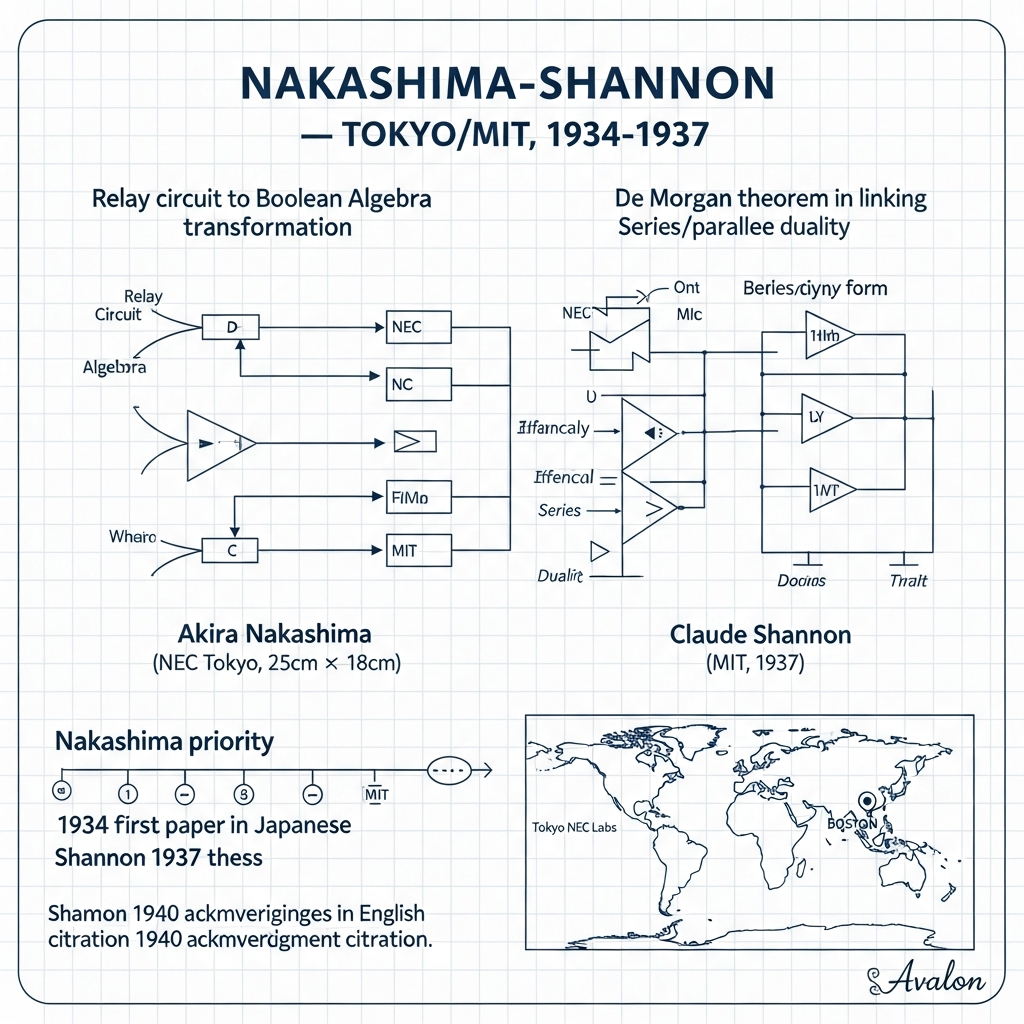
Akira Nakashima: logic circuit theory in Japan, parallel to Shannon.
Asia and the Foundations of Artificial Intelligence (1945-2010)
Yesterday — Twin Tracks
Great discoveries never happen just once. They emerge simultaneously, in places unaware of each other — as if time itself were whispering the same idea to several ears at once.
In 1937, an MIT student defended what some consider the most important master's thesis of the twentieth century. Claude Shannon demonstrated that Boolean algebra — that logical system invented a century earlier — could perfectly describe the functioning of electrical circuits. The same discovery had already been made. In Tokyo, between 1934 and 1936, an engineer named Akira Nakashima had published a series of articles showing exactly the same thing. Shannon read these articles. He cited them in his thesis. Then he became a legend.
Nakashima was forgotten.
Two men, two continents, the same idea. One started from abstract mathematics, the other from electrical engineering. One wrote in English at a prestigious American university, the other in Japanese for an industrial journal. One received all the honors; the other returned to his work at NEC and disappeared from history. This double fate summarizes something essential about Asia and computing: parallel paths, simultaneous discoveries, divergent destinies.
For Asia did not wait for the West to think about calculation and machines.
In India, a statistician named Prasanta Chandra Mahalanobis had invented as early as 1930 a measure that bears his name today: the Mahalanobis distance. This mathematical formula — which calculates the distance between a point and a distribution while accounting for correlations between variables — is still used every day in contemporary machine learning. When an algorithm detects an anomaly in a dataset, when a pattern recognition system identifies a face, there is a good chance it is using, without knowing it, the legacy of this Bengali mathematician born under the British Empire.
Mahalanobis founded the Indian Statistical Institute in Calcutta in 1931. Later, he created the National Sample Survey, which became the backbone of Indian economic planning. June 29 is celebrated in India as National Statistics Day, in his honor. But in the global history of artificial intelligence, his name rarely appears. Another parallel path.
And there was Homi Jehangir Bhabha.
Bhabha was a nuclear physicist, but his vision extended beyond the atom. He believed that India had to develop its own high technology capabilities rather than depend eternally on foreigners. In 1945, with the support of the Tata family, he founded the Tata Institute of Fundamental Research in Bombay — a research center that would produce the first computer entirely designed and manufactured in India.
Development began in 1955. The Indian engineers worked without a model to copy, without foreign experts to guide them. They started from the IAS machine design — the theoretical conception elaborated at Princeton — and built everything themselves. Two thousand seven hundred vacuum tubes. One thousand seven hundred germanium diodes. Twelve thousand five hundred resistors. A machine that consumed twenty kilowatts of electricity and had to operate in two shifts per day to meet researcher demand.
In 1960, Prime Minister Jawaharlal Nehru officially inaugurated this machine and gave it its name: TIFRAC, for Tata Institute of Fundamental Research Automatic Calculator. India had built its first computer — not by buying foreign technology, but by creating it with its own hands.
Six years later, Bhabha died in a plane crash on Mont Blanc. India lost a visionary, a leader capable of convincing the government to make big technological bets. Some believe that without this premature death, the country would have taken a different path — perhaps that of computer hardware manufacturing rather than software services. We will never know. History does not offer second helpings.
Meanwhile, Japan was taking another path — that of organized technology transfer.
After 1945, Japan was in ruins. Researchers lacked equipment, sometimes even food. The country was occupied by allied forces. International travel was difficult. Access to foreign currency was limited. Yet some officials at the Ministry of International Trade and Industry — MITI — glimpsed an opportunity in Bell Laboratories' invention of the transistor in 1948.
They organized the systematic acquisition of this technology. Japanese companies obtained American licenses. They learned. They copied. Then they innovated.
In 1957, Sony produced the world's first fully transistorized radio — marking Japan's entry into global electronics. By 1960, the country surpassed the United States with more than one hundred million transistors produced per year. The path of technology transfer had borne fruit.
But MITI did not merely import technologies. It also protected the domestic market. When Texas Instruments filed fourteen patents in Japan in 1960, the bureaucracy simply refused to process them — for years. By the time the patents were granted, Japanese companies had had time to copy and improve the American inventions. It was a deliberate strategy: block foreign products that did not include technology transfer.
In 1976, MITI launched the VLSI project — for "Very Large Scale Integration." NEC, Hitachi, Fujitsu, and other competing companies were brought together for a joint research and development program on integrated circuits. The project lasted four years. By the end of the 1980s, Japan held fifty percent of the global semiconductor market.
The parallel paths had converged — for a time.
Today — Leaps and Falls
There are several ways to catch up to a technological lag. You can copy. You can buy. You can protect your market and wait. Or you can leap over the obstacle.
India chose the leap.
In the 1980s, the country had missed the hardware turn. Indian computers had not found a global market. Bhabha's death, economic restrictions, lack of capital — the causes were multiple. But in 1991, when India opened its economy, a new opportunity appeared.
American companies had a problem. Their old computer systems used a programming language called COBOL, invented in the 1960s. This language stored dates on only two digits — 99 for 1999, for example. What would happen when the clock turned to 2000? Would systems display 00, believing they had gone back to 1900? Billions of lines of code had to be checked and corrected. But in the United States, COBOL had become obsolete. No one taught it anymore. There were not enough programmers.
In India, COBOL was still in university curricula. The curricula were behind the times — but this delay suddenly became an advantage. India had programmers who knew how to fix code that Americans could no longer read.
The "Y2K bug" became the launchpad for the Indian computer industry. TCS — Tata Consultancy Services — exceeded one billion dollars in exports by the end of the 1990s. The Indian IT services industry drew two billion three hundred million dollars from Y2K-related efforts alone. The number of companies registered in software technology parks went from two hundred in 1995 to nearly eight hundred in 2000.
Bangalore — the city where Mahalanobis had established an Indian Statistical Institute center in the 1960s — became the "Silicon Valley of India." Not by manufacturing chips, but by writing code. India had leaped over the hardware stage to become a software giant.
Infosys, Wipro, TCS — these names became synonymous with global IT outsourcing. In 2017, Bangalore represented thirty-eight percent of Indian IT exports — forty-five billion dollars. One million direct jobs. Three million indirect jobs.
The software path had led further than the hardware one.
In Taiwan, another leap was being prepared — but this one would transform the global semiconductor industry.
Morris Chang was born in Ningbo, China, in 1931. He had studied at Harvard, MIT, Stanford. For twenty-five years, he had climbed the ranks at Texas Instruments until he became senior vice president in charge of global semiconductors. Then, in 1983, his career stopped. Transferred to a struggling division, then to a position without responsibilities, he understood he had been "put out to pasture."
He left the company. At fifty-four, his career seemed over.
Two years later, the Taiwanese government recruited him to head the Industrial Technology Research Institute. He was asked to develop the island's nascent semiconductor industry. Chang had an idea that no one had had before him.
At the time, semiconductor companies did everything: design and manufacturing. Intel, AMD, Texas Instruments — all owned their own factories. But building a semiconductor factory cost billions of dollars. It was an insurmountable barrier for new entrants.
Chang proposed the opposite: a company that would only manufacture — never design. A "pure-play foundry" that would accept designs from any customer and transform them into chips. Designers would no longer need factories. They could focus on innovation.
In 1987, at fifty-five, Chang founded TSMC — Taiwan Semiconductor Manufacturing Company. The government provided nearly half the capital. Philips transferred its technology in exchange for an equity stake. Intel was the first American customer, sending a strong signal to the market.
The "fabless" model — without factories — made possible the existence of companies that could never have existed otherwise. NVIDIA, AMD, MediaTek — all these companies that design chips without owning factories owe their existence to Morris Chang's invention.
Today, TSMC holds sixty-four percent of the global foundry market. The company manufactures the chips that power NVIDIA, Meta, and Amazon's artificial intelligence systems. It is sometimes called Taiwan's "silicon shield" — because no world power can afford to lose access to its factories.
Morris Chang retired in 2018, at eighty-seven. The man who had been put out to pasture at fifty-three had created the most important company in the semiconductor industry.
But not all leaps succeed. And Japan would learn this at its expense.
In 1982, MITI launched its most ambitious project: the Fifth Generation Computer Systems. The objective was to create a "revolutionary computer" capable of inferring from incomplete instructions, using the knowledge it had accumulated, reasoning like a human. Artificial intelligence before its time.
Japan chose to base this system on the Prolog programming language — rather than Lisp, used by American researchers. It invested hundreds of millions of dollars. It created a dedicated institute, ICOT, funded by all of Japan's major computer companies.
Ten years later, the project was declared finished. Not finished in the sense of "accomplished." Finished in the sense of "abandoned."
The industry had evolved so rapidly that the technological path chosen in 1982 had become obsolete by 1992. Moore's Law — the principle that processor power doubles every eighteen months — had made standard computers faster than the specialized parallel machines of the project. Mass-produced Intel processors beat the sophisticated architectures designed by ICOT.
The New York Times headlined: "The Fifth Generation Has Become Japan's Lost Generation."
The project left a legacy: theoretical contributions to logic programming, a generation of trained engineers. But it also left a lesson. Technological ambition can lead to a dead end. Predicting the future is harder than it seems. And sometimes, parallel paths lead nowhere.
Meanwhile, China was following its own path — longer, more winding, but perhaps more solid.
The first Chinese computer was built in 1958 — a copy of a Soviet model. China was then entirely dependent on the USSR for components it could not manufacture. In 1960, the Sino-Soviet split changed everything. Moscow recalled its experts, who took documents and equipment with them. Many research projects had to stop overnight.
Chinese engineers continued alone. The computers they developed after 1960 resembled neither Soviet nor American machines. They were distinctly Chinese creations — born of necessity.
Then came the Cultural Revolution. From 1966 to 1976, most scientific research was forced to stop. Scientists were sent to reeducation camps. Universities closed. Political chaos engulfed the country.
And yet. In 1968, despite everything, Chinese factories began manufacturing integrated circuits. In 1970, the Beijing Computer Research Institute produced the 111 computer, reaching a speed of one hundred eighty kiloflops — remarkable progress in a country in political collapse.
Chinese resilience was made of this paradox: advancing despite obstacles, building despite destruction.
After 1978, when Deng Xiaoping opened the country, an immense quantity of scientific advances became available overnight. China caught up in a few years to decades of lag. In 1984, Lenovo emerged from Beijing's "Electronics Street." In 1987, a former army officer named Ren Zhengfei founded Huawei with twenty-one thousand yuan in capital — approximately three thousand dollars.
Then came the Internet giants. Tencent in 1998. Alibaba in 1999. Baidu in 2000. All funded by foreign venture capital — from Hong Kong, Boston, Silicon Valley. All protected by the "Golden Shield" — the Great Firewall — that blocked Google, Facebook, and other Western competitors.
By 2005, China had one hundred eleven million Internet users. Between 1991 and 2016, government funding for research and development was multiplied by thirty. In 2009, China surpassed Japan in R&D spending.
The Chinese path was different from all others. Neither the Indian leap, nor the Japanese transfer, nor the Taiwanese invention. A unique combination: patience, protection, massive investment. And a resilience forged in trials.
Beyond — The Convergence
Parallel paths, at the horizon, always seem to meet.
Look where we are. The chips that power contemporary artificial intelligence are manufactured mainly in Asia — by TSMC in Taiwan, by Samsung in South Korea. The robots that assemble these chips come from Japan — FANUC, Yaskawa, Kawasaki produce forty-five percent of the world's industrial robots. The data that trains AI models is annotated by workers around the world, but the algorithms that process it were often designed by researchers born in Asia.
Fei-Fei Li was born in China in 1976. She arrived in the United States at sixteen, worked in dry cleaners and restaurants to help her family, became a computer science professor at Princeton and then Stanford. In 2009, she created ImageNet — a dataset of twelve million images classified into twenty-two thousand categories. When she presented the project, no one was interested. Three years later, ImageNet became the catalyst for the deep learning revolution. She is now nicknamed the "godmother of AI."
Kai-Fu Lee was born in Taiwan in 1961. His doctoral thesis at Carnegie Mellon produced the first continuous speech recognition system, speaker-independent, with a large vocabulary. In 1988, he created a program that beat the world Othello champion — one of the first examples of a computer surpassing humans in a game. He then led the artificial intelligence divisions of Apple and Microsoft, founded Microsoft Research China — which trained the majority of current Chinese AI leaders — then headed Google China. Today, his venture capital fund invests in the next generation of Chinese artificial intelligence startups.
These individual trajectories are metaphors for something larger. Asia is no longer just the place where machines are manufactured. It is increasingly the place where the intelligence that animates them is designed.
The Mahalanobis distance, invented in 1930 by a Bengali statistician, is used every day in anomaly detection algorithms. Switching circuit theory, discovered independently by Nakashima in 1935, remains the foundation of all digital electronics. The pure-play foundry model, invented by Morris Chang in 1987, enables the AI industry to exist in its current form.
These contributions were not copies. They were not transfers. They were original creations — born of different circumstances, but answering the same fundamental questions.
The Fifth Generation project was a commercial failure. But it raised questions we still ask: How do you make a machine reason? How do you allow it to infer from incomplete information? How do you create an intelligence that is not merely calculation, but understanding?
These questions have no definitive answer. We are still groping. Parallel paths continue to be traced — some lead to dead ends, others to revolutions.
What has perhaps changed is the direction. For decades, Asia imported, copied, adapted Western technologies. It learned by doing. It caught up through transfer, protection, leaping. Today, the movement is reversing. Asian researchers are no longer followers. They are at the center.
China is investing hundreds of billions in artificial intelligence. India is training millions of engineers. Japan remains the undisputed master of robotics. Taiwan manufactures the chips without which nothing works. Singapore has transformed itself into an innovation hub — moving from the labor-intensive industry of the 1960s to the knowledge economy of the 2000s.
The parallel paths are converging.
Nakashima and Shannon had discovered the same truth, each on their side of the Pacific. One was celebrated, the other forgotten. But the truth itself — that Boolean algebra could describe electrical circuits — was universal. It belonged to no continent.
Artificial intelligence, too, is universal. It does not speak English more naturally than Chinese or Hindi. It does not think "Western" or "Eastern." It is the product of contributions from everywhere — from Mahalanobis to Nakashima, from Bhabha to Chang, from Fei-Fei Li to Kai-Fu Lee.
The history of Asia and artificial intelligence is not finished. It is only beginning. The parallel paths have not yet met at the horizon.
But they are getting closer.