Middle East
Illustrations
1 / 5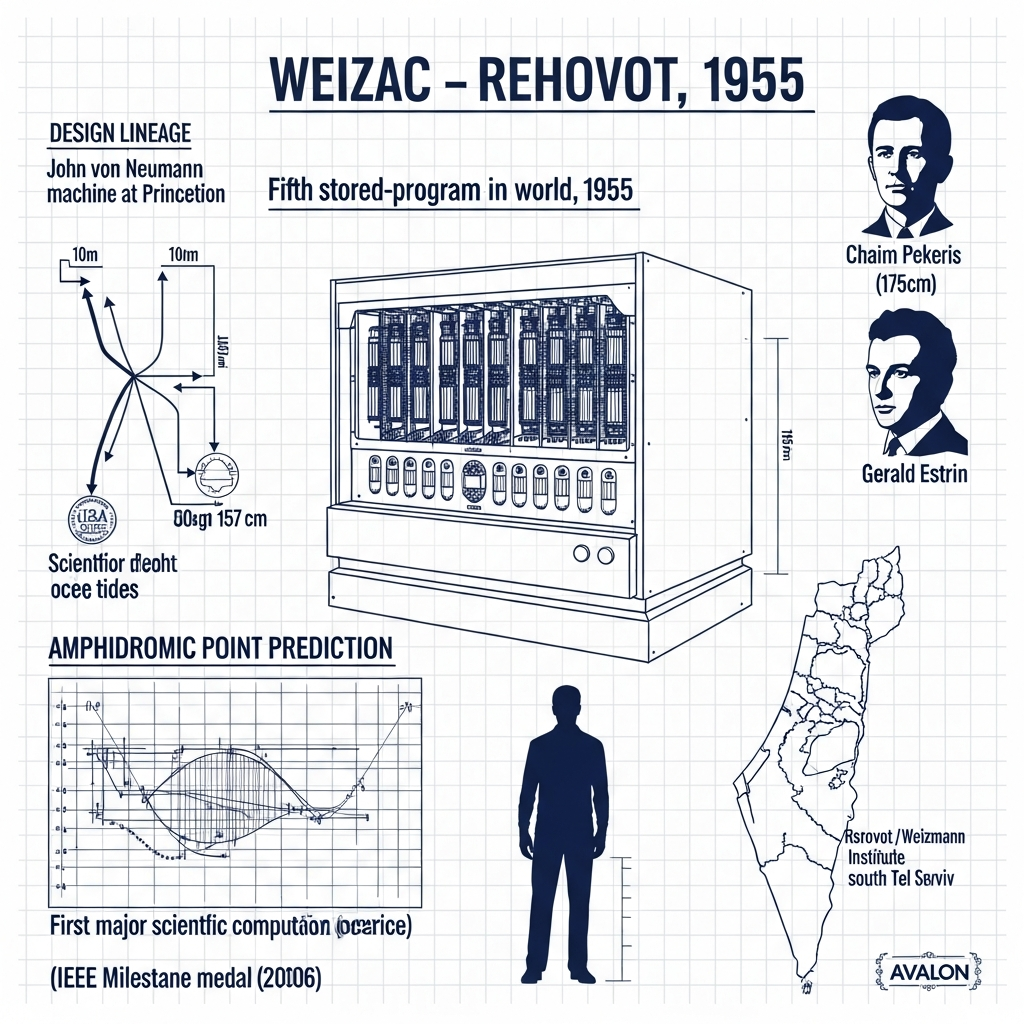
WEIZAC (1955): first Israeli computer, built at the Weizmann Institute.
The Middle East and the Foundations of Artificial Intelligence (1945-2010)
From Necessity to Innovation: How Adversity Begot Technology
Yesterday — Seeds of the Improbable
No one expects flowers in the desert. Yet that is where they grow fastest — when the rain finally comes.
In 1954, in a country that was just six years old, a group of scientists undertook to build a computer. Israel had just emerged from its war of independence. The borders were hostile. The economy was fragile. The country had neither an electronics industry nor a tradition in computing. And yet, at the Weizmann Institute of Science in Rehovot, a team was working to assemble one of the world's first stored-program computers.
The WEIZAC — a contraction of "Weizmann Automatic Computer" — was born from a conviction and an encounter. Chaim Pekeris, professor of applied mathematics, had worked at Princeton alongside John von Neumann, one of the fathers of modern computing. He had seen the IAS computer take shape. When Chaim Weizmann, future first president of Israel, asked him to create a department of applied mathematics at the new institute, Pekeris set a condition: he needed a computer.
Weizmann allocated fifty thousand dollars — twenty percent of the institute's total budget. Gerald Estrin, an American engineer from the von Neumann project, agreed to lead the construction with his wife Thelma. They arrived in Israel with blueprints but no parts. Everything had to be manufactured on site, in a country where precision industry did not exist.
The project's advisory committee included two illustrious names. Albert Einstein, skeptical, did not think the project feasible. John von Neumann gave his blessing. When the first candidates came to work on the machine, many had no diplomas to show. They had lost them — in the Holocaust, in exile, in refugee camps. But in Israel's small technical community, everyone knew everyone. Skills were proven in ways other than papers.
By late 1955, the WEIZAC executed its first calculation. It remained the only computer in Israel until 1961. Its scientific contributions were remarkable: mapping of global tides, seismic calculations, atomic spectroscopy. Weizmann researchers predicted the exact location of an amphidromic point in the South Atlantic — a place where tides do not exist. Later measurements confirmed their calculation.
In 2006, the IEEE awarded the WEIZAC its "Milestone in Electrical Engineering and Computing" medal. Professor Aviezri Fraenkel, who had worked on the machine, summarized its legacy: "WEIZAC was the main factor behind the beginning of high technology in Israel."
A six-year-old country, surrounded by enemies, without industrial resources, had built one of the most advanced computers of its time. Necessity, it was said, is the mother of invention. In the Middle East, it would become the grandmother of an entire industry.
Tehran: The Forgotten Father of Fuzzy Logic
A few thousand kilometers from Rehovot, another story was being woven — a story of exile and unrecognized genius.
Lotfi Zadeh was born in 1921 in Baku, then capital of the Azerbaijan Soviet Socialist Republic. His father, Rahim Aleskerzade, was an Iranian Muslim journalist from Ardabil, on assignment in the Soviet Union. His mother, Fanya Korenman, was a Jewish pediatrician from Odessa, an Iranian citizen. The child grew up between cultures, languages, religions.
In 1931, the family settled in Tehran. Zadeh attended secondary school at the American College, then obtained his electrical engineering degree from the University of Tehran in 1942. The world war had closed the routes to Europe. He left for the United States, obtained a master's at MIT in 1946, a doctorate at Columbia in 1949. In 1959, he joined the University of California at Berkeley, where he would spend the rest of his career.
How did he define himself? "An American, electrical engineer of mathematical orientation, of Iranian origin, born in Russia." Four identities in one sentence. None sufficient to contain him.
In 1965, Zadeh published an article that would transform computing and artificial intelligence. In it, he introduced the notion of "fuzzy set" — a way to mathematically represent vague concepts that humans handle intuitively but that computers cannot process. What is a "tall" person? A "hot" temperature? A "risky" decision? Classical logic demands binary answers: yes or no, true or false. Zadeh's fuzzy logic allowed nuance: "rather true," "quite tall," "moderately risky."
The initial reception was mixed. American computer scientists found the concept too vague — ironically. But in Japan, engineers seized upon it. The first fuzzy control systems appeared in the 1980s: air conditioners that adjust temperature smoothly, washing machines that dose water according to how dirty the laundry is, automatic transmissions that anticipate curves. Today, fuzzy logic is everywhere — in facial recognition, weather forecasting, algorithmic trading, rice cookers.
Zadeh's foundational article has been cited more than ninety thousand times. He received the IEEE Medal of Honor, the Richard Hamming Prize, countless distinctions. At his death in 2017, he was buried in Baku, the city of his birth — a symbolic return after a lifetime of productive exile.
In histories of artificial intelligence, Zadeh rarely appears as an Iranian figure. His journey — Tehran, MIT, Berkeley — dissolved him into America. Yet it was at the University of Tehran that he acquired the mathematical foundations that would nourish his invention. Iran had trained one of the founding fathers of AI. History forgot.
Today — The Startup Nation
Unit 8200: School for Founders
In the 1950s, the Israeli army created an electronic intelligence unit. Modest at first — a few specialists deciphering codes with pencil and paper — Unit 8200 grew with the wars. After 1967, it became the heart of Israeli signals intelligence, the equivalent of the American NSA. Its recruits learned to intercept communications, analyze data, penetrate systems.
No one had foreseen what would follow.
From the 1990s, Unit 8200 veterans began founding companies. During their military service, they had learned to handle cutting-edge technologies. They had worked as a team on complex problems. They had developed solutions that the civilian industry did not yet know. And above all, they knew each other — a network of comrades who could trust one another.
Gil Shwed had started programming at thirteen. At fifteen, he was studying computer science at Hebrew University of Jerusalem while finishing high school. During his service in Unit 8200, he supervised the computing of a classified subunit. The problem: how to protect sensitive data from intrusions? Shwed built a "box" that filtered network connections according to a configurable policy — essentially, a list of authorized addresses.
In 1993, with two unit comrades — Marius Nacht and Shlomo Kramer — Shwed founded Check Point Software Technologies. Their product, FireWall-1, commercialized the idea born in intelligence bunkers. By February 1996, Check Point held forty percent of the global firewall market. Gil Shwed is now considered the inventor of the modern computer firewall.
The story repeated itself dozens of times. Palo Alto Networks, CyberArk, Imperva, Wix — so many companies founded by Unit 8200 alumni. Israel exported eleven billion dollars in cybersecurity technology in 2021, nearly ten percent of the global market. A country of nine million inhabitants dominated a strategic sector of the digital economy.
The paradox was troubling. The technologies that protected civilian data had been born in military intelligence services. The boundary between surveillance and security, between espionage and protection, remained blurred. But the effectiveness was undeniable. Unit 8200 had become, without intending to, the greatest startup school in the world.
ICQ: When Israel Invented Instant Messaging
In 1996, four young Israelis who had met at Zapa Digital Arts — a company making 3D graphics tools — had a simple idea. Discussion forums had existed for a long time on the Internet. But to use them, you had to connect to a server, join a channel, hope someone else was there. Why not create a system where you could directly see who was online and send them a message?
Yair Goldfinger, Sefi Vigiser, Amnon Amir, and Arik Vardi — with the support of Arik's father, entrepreneur Yossi Vardi — founded Mirabilis and launched ICQ in November 1996. The name was a pun: "I Seek You." The software was free. There was no marketing campaign. Growth was entirely organic — digital word of mouth.
In less than two years, ICQ had millions of users. AOL, the American Internet giant, noticed. On June 8, 1998, the American company acquired Mirabilis for two hundred eighty-seven million dollars in cash, plus one hundred twenty million over three years — more than four hundred million in total. At the time, it was one of the largest acquisitions in Internet history.
ICQ paved the way for MSN Messenger, AIM, WhatsApp, Telegram. The idea of seeing who is online and talking to them instantly — commonplace today — was revolutionary in 1996. And it came from a Tel Aviv apartment.
The Soviet Influx: When a Million Engineers Changed Everything
Between 1989 and 2000, nearly one million Soviet Jews emigrated to Israel. This was no ordinary migration. Sixty percent of arrivals had a university degree — double the Israeli proportion. Between 1990 and 1993, fifty-seven thousand engineers and twelve thousand doctors landed. Before their arrival, Israel had thirty thousand engineers in total.
Integration was difficult. Nuclear physicists washed dishes. Civil engineers worked on assembly lines. In 1992, fifty-six percent of Soviet immigrants lived in the poorest third of the population. But the Israeli government had understood the potential. "Technology incubators" were created — incubators where immigrant scientists could develop their ideas with public funding.
In 1992, the Yozma program went further. The government invested in venture capital funds, sharing risk with private investors but leaving them the profits. Money flowed in. Startups multiplied. Soviet engineers, trained in the rigorous institutes of the USSR, brought mathematical and theoretical expertise that Israelis did not have.
By 2010, the situation had reversed. Only thirty-eight percent of Soviet immigrants lived in the poorest third; twenty-seven percent had joined the wealthiest third. The influx had transformed the economy. Israel was no longer just a country of citrus and military high tech. It had become the "Startup Nation" — a title journalist Dan Senor would popularize in 2009, but which had been building for twenty years.
Waze and Mobileye: Pioneers of the Smart Road
Ehud Shabtai had received a GPS as a gift. Frustrated by its limitations — no real-time traffic, no community updates — he decided to do better. In 2006, he launched FreeMap Israel, a participatory mapping project. Users shared their routes; the system learned the roads. In 2008, the company formalized. In 2009, it became Waze.
Shabtai, Amir Shinar, and Uri Levine — all Unit 8200 veterans — had understood something the navigation giants had not seen: the value of the crowd. Every driver using Waze became a mobile sensor, reporting traffic jams, accidents, police checkpoints. The system improved with each added user.
Three days after the US launch in 2009, Waze had one hundred thousand users. The application had found its audience. Tech giants began looking toward Tel Aviv.
Another Israeli company was preparing the future of automobiles. Mobileye, founded in 1999 by Professor Amnon Shashua of Hebrew University, was developing vision systems for vehicles. Shashua had proven that automatic emergency braking could work with a simple camera — where the industry thought expensive radars were essential. In 2004, Mobileye launched its first EyeQ chip. By 2010, its systems were already equipping several automaker models.
A country without an automobile industry was inventing the eyes of tomorrow's cars.
Beyond — The New Gardens
The Emirates: First Seeds of the Digital Desert
While Israel was transforming military necessity into innovation, another model was emerging on the shores of the Gulf — that of planned vision.
The United Arab Emirates did not exist before 1971. Seven emirates scattered along the coast, united by a treaty and an ambition. Oil had made their fortune. But the leaders knew that hydrocarbons would not last forever. From the 1990s, they began preparing for what came after.
In October 1999, Sheikh Mohammed bin Rashid Al Maktoum launched Dubai Internet City. The idea was bold: create a free zone dedicated to information technology, with zero corporate tax, zero income tax, and world-class infrastructure. One year later, in October 2000, the complex opened its doors with one hundred companies. Three hundred fifty more had applied. It was the beginning of what some would call "the Silicon Valley of the Middle East."
In 2001, the Emirates launched the first e-government in the Arab region. The eDirham — an electronic currency for paying government services — replaced traditional methods. It was modest. But it was a signal: this country of three million inhabitants wanted to be at the cutting edge of digital.
Dubai Silicon Oasis followed in 2004 — an integrated technology park where one could live and work, designed as a complete ecosystem for innovation. That same year, entrepreneur Ronaldo Mouchawar founded Souq.com in Dubai — an online auction site inspired by eBay that would, in time, become the largest e-commerce platform in the Arab world.
In 2007, Abu Dhabi took a decisive step with the creation of the Masdar Institute of Science and Technology — a research university specializing in renewable energy and sustainable technologies, developed in partnership with MIT. The campus, located in the ecological city of Masdar City, embodied Emirati ambition: using the resources of the present to build the industries of the future. The first students arrived in September 2009.
The contrast with Israel was striking. Israel had built its technology ecosystem by accident — Unit 8200 veterans founding startups, Soviet immigrants bringing their skills, entrepreneurs seizing opportunities. It was organic, chaotic, unpredictable.
The Emirates planned. Dubai Internet City was not a private initiative — it was a government decision. Masdar Institute did not emerge from an existing campus — it was created from scratch, with a prestigious American partner. Each free zone, each university, each infrastructure was a piece of a puzzle drawn in advance.
By 2010, the foundations were laid. The Emirates had created the conditions — free zones, universities, infrastructure — to attract companies and talent. The country had not yet produced major local innovations. But it had planted the seeds. The next decade would show whether they could bloom.
Beirut: The Broken Hub
The Middle East could have had another technology center. Until 1975, Beirut was the intellectual hub of the Arab world — "the Switzerland of the Middle East," "the Paris of the Orient." The American University of Beirut, founded in 1866, trained the region's elite. The city attracted thinkers, artists, entrepreneurs.
Hassan Kamel Al-Sabbah was born in Nabatieh, in southern Lebanon, in 1895. He studied and then taught mathematics at the American University of Beirut before emigrating to the United States in 1921. At General Electric, he accumulated patents — including technologies that would contribute to the development of liquid crystal displays. He died in a car accident in 1935, at forty. His name is forgotten.
The Lebanese civil war, from 1975 to 1990, devastated the country. Infrastructure was destroyed. Brains fled. When peace returned, Beirut tried to be reborn. But crises piled up — economic, political, security. By 2010, the technology hub that could have emerged remained a promise. Lebanon had the talent. It lacked the stability.
Iran: Thwarted Potential
Iran had begun its computerization in the 1960s. The first computer — an IBM 1620 — was installed in 1962 by the national oil company. In the 1970s, the country developed its own terminals, trained engineers, introduced software in Persian.
The 1979 revolution interrupted the momentum. Universities closed. Ties with the West were severed. When universities reopened in 1983, computing resumed — but in isolation. International sanctions limited access to foreign technologies. Iranian scientific potential — real, attested by figures like Zadeh — remained largely unexploited.
Today, Iran trains talented computer scientists and engineers. But they often work elsewhere. The Iranian diaspora in Silicon Valley is one of the largest. The country that had trained the father of fuzzy logic exports its brains instead of their inventions.
Epilogue — Lessons from the Desert
The history of computing in the Middle East is a history of realized improbabilities.
A six-year-old country built one of the world's first computers. A son of Iranian exiles invented fuzzy logic. A military intelligence unit became a startup school. Soviet immigrants transformed an economy. Engineers without cars invented the eyes of autonomous vehicles. Oil monarchies prepared for the post-oil era.
The Middle East did not have the advantages of American pioneers — neither massive electronics industry, nor century-old universities, nor unlimited capital. What it had was necessity. Israel developed cybersecurity because its enemies attacked it. The Emirates invest in AI because the oil will run out. Iran trained scientists because education was the only exportable wealth.
Necessity is not enough, of course. Lebanon had the potential but not the stability. Iran had the brains but not the openness. Necessity creates urgency; it does not guarantee success. You also need institutions — universities, incubators, legal frameworks. You need networks — Unit 8200 alumni who trust each other, investors who share risk. You need luck — being in the right place when a technology matures.
But the Middle East recalls a truth that favored regions sometimes forget. Innovation does not come only from abundance. It also comes from scarcity. The most extraordinary gardens sometimes grow in the desert — because every drop of water counts, because every seed is precious, because survival demands ingenuity.
The WEIZAC was built with blueprints and improvisation. ICQ was launched from an apartment. Mobileye proved that simplicity could beat complexity. These innovations did not come despite constraints — they came because of them.
The future of the Middle East in artificial intelligence remains uncertain. Israel dominates cybersecurity and mobility technologies. Gulf countries are investing massively in infrastructure. Iran and Lebanon carry thwarted potential. But history suggests that surprises will come — as they have always come — from the least expected places.
The gardens of the desert have not finished blooming.