Oceania
Illustrations
1 / 5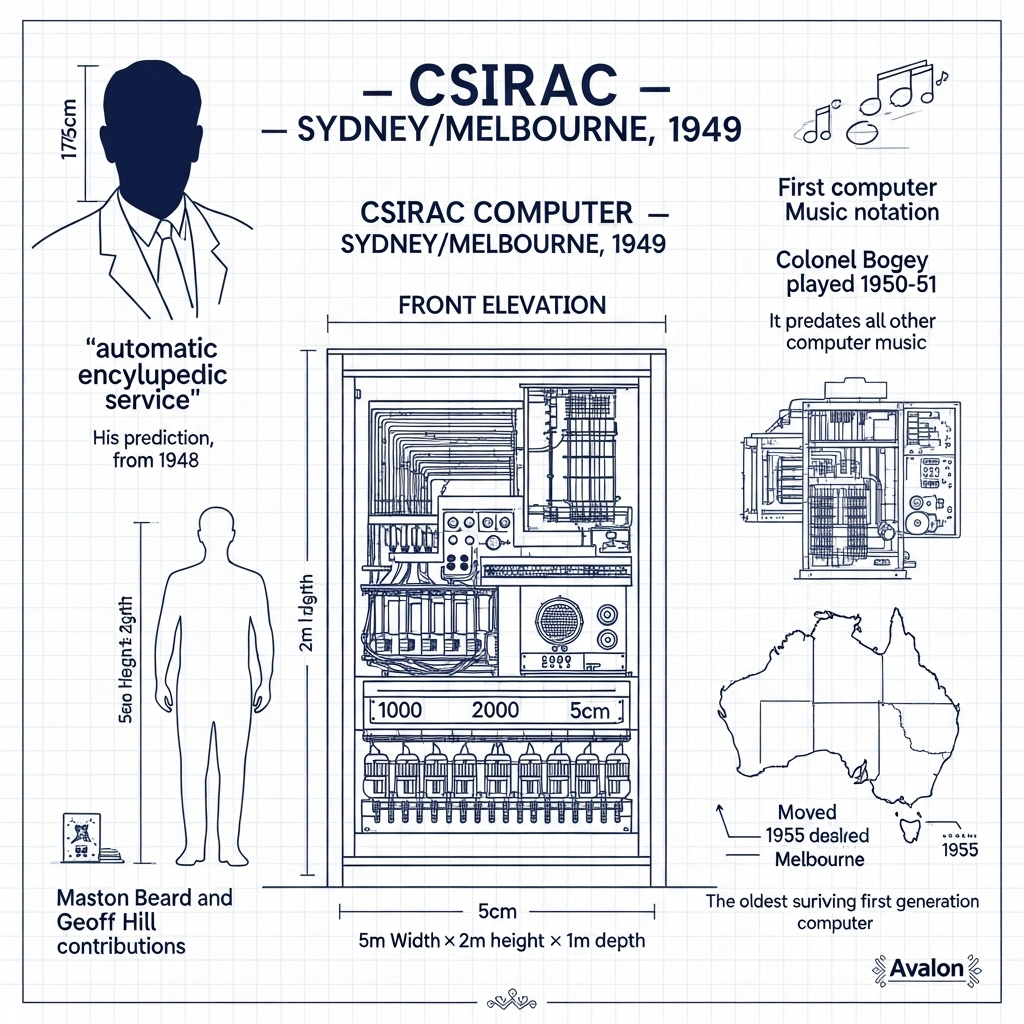
CSIRAC (1949): first Australian computer, the only one of its generation still preserved.
The Antipodes of Innovation
Oceania and the Foundations of Artificial Intelligence (1945-2010)
From Isolation to Connection: How Islands Built Bridges
Yesterday — The Fifth Computer in the World
Great inventions sometimes emerge where no one expects them.
In November 1949, in a laboratory in suburban Sydney, a machine of two thousand vacuum tubes executed its first calculation. The CSIRAC — Commonwealth Scientific and Industrial Research Automatic Computer — had just joined a very exclusive club: that of stored-program computers. There were only four others in the world. All were in Great Britain or the United States.
Australia had built the fifth.
Trevor Pearcey was born in London in 1919. During the war, he had worked on British radars, developing cutting-edge electronics skills. In 1945, he visited Harvard and saw Howard Aiken's automatic calculator — a mechanical marvel that read its instructions from punched tape. Pearcey was impressed. But he also saw the limitations: too slow, too mechanical. The future, he thought, would be entirely electronic.
That same year, Pearcey emigrated to Australia. He joined the CSIR — predecessor to CSIRO — at the Radiophysics Division in Sydney. With Maston Beard and Geoff Hill, he undertook to build a computer. They had no manual. No model to copy. British and American work was classified or simply inaccessible. The Sydney team worked "largely independently of European and American efforts," as the official history notes.
Geographic isolation became an advantage. Without access to others' solutions, Pearcey and his team had to invent everything themselves. The result was original — a machine that embodied their own technical choices, not a copy of transatlantic designs.
The CSIRAC ran at one thousand instructions per second — a thousand times faster than the best mechanical calculators available in Australia. Its memory could store two kilobytes. These figures seem derisory today. In 1949, they represented the frontier of world technology.
But the most remarkable thing was not what the CSIRAC could calculate. It was what its creator had imagined.
In February 1948 — before the machine even worked — Trevor Pearcey wrote a sentence that still resonates: "In the non-mathematical field there is wide scope for the use of these techniques in such things as filing systems. It is not inconceivable that an automatic encyclopaedic service operated through the existing national teleprinter or telephone system will one day exist."
An automatic encyclopedic service accessible by telephone. In 1948. Decades before online databases. Decades before the Internet. Decades before the World Wide Web. An engineer in Sydney had seen the future.
The First Digital Concert
The CSIRAC was also the first computer to play music.
In 1950 or 1951 — the exact date is disputed — mathematician Geoff Hill programmed the machine to produce sounds. The CSIRAC could emit a "beep" to signal the end of a calculation. Hill realized that by controlling the frequency and duration of these beeps, one could create melodies. The machine played "Colonel Bogey" — the march made famous by the film The Bridge on the River Kwai.
No recording of these first performances has survived. But witnesses are unanimous: the CSIRAC sang. It was the first time a computer had produced music — a frivolity, perhaps, but also proof that these machines could do more than calculate. They could create.
In 1955, the CSIRO decided that computer research was "outside its scope." The machine was dismantled, loaded onto trucks, and transported via the Hume Highway to the University of Melbourne. It served there until 1963, processing more than a thousand projects — from calculations for the Snowy Mountains Hydro Electric Authority to structural analyses of Australia's first high-rise buildings.
When the CSIRAC was finally decommissioned, it was not destroyed. Unlike the British Colossus machines, dismantled beyond recognition, the CSIRAC was preserved. It is today the oldest surviving stored-program computer in the world, on display at the Scienceworks Museum in Melbourne.
Australia had built a pioneering computer. It had the wisdom to keep it.
Today — Bridges to the World
The Bionic Ear: When Australia Made the Deaf Hear
Graeme Clark had grown up with a deaf father.
In the family pharmacy in Camden, New South Wales, young Graeme watched his father struggle to communicate with customers. The hearing aids of the time amplified sounds but could do nothing for those whose auditory nerve was damaged. For them, silence was permanent.
Clark decided to change that.
After medical studies in Sydney and specialization in otorhinolaryngology in Australia and the United Kingdom, he returned to the University of Melbourne with a crazy idea: directly stimulating the auditory nerve with electrical impulses. If the cochlea's hair cells — the organ of hearing — were destroyed, why not bypass them?
The medical industry was skeptical. Experts thought the brain could not interpret electrical signals as sounds. Clark persisted. In 1978, he implanted the first multichannel device in the ear of Rod Saunders, a patient who had become deaf in adulthood.
Saunders heard.
The first sounds were rudimentary — beeps, buzzes, tones. But with time and training, the brain learned to interpret these signals. Saunders recognized voices. He understood sentences. For the first time in history, a device had restored hearing to someone who had completely lost it.
In 1982, clinical trials confirmed the device's effectiveness. Cochlear Ltd. was founded for commercial production. In 1985, the US FDA approved the implant for adults. In 1990, for children. Today, more than one million people in one hundred twenty countries wear a cochlear implant. More than half are children who, without this technology, would never have heard their parents' voices.
Clark's cochlear implant became the world leader — forty years of market dominance. The Bionic Ear Institute, founded by Clark in 1983, transformed into the Bionics Institute, now working on the bionic eye and deep brain stimulation.
A country doctor had wanted to repair ears. He had opened the door to bionics.
WiFi: The Controversy of the Waves
The history of WiFi is a story of competing claims — and Australia is part of it.
In 1989, a CSIRO team began working on a thorny problem: how to transmit data wirelessly inside buildings? Radio waves bounce off walls, furniture, human bodies. Each bounce creates an echo, a distorted signal. Adding these echoes produces noise — chaos incomprehensible to a receiver.
John O'Sullivan led the team. He had worked on radio astronomy, searching for echoes of black hole explosions. The problem was similar: extracting a weak signal from a noisy environment. O'Sullivan adapted a mathematical technique — the fast Fourier transform — to decompose the signal into its constituent frequencies, then reconstruct it cleanly.
By 1992, the team had a working prototype. In 1993, they filed a US patent. In 1996, the patent was approved.
Then came WiFi.
The technology we use today to connect our phones and computers relies on standards developed by many teams around the world — in the United States, the Netherlands, Australia. The CSIRO patent did not cover "WiFi" as a whole, but a specific signal processing technique used in WiFi standards.
When WiFi equipment manufacturers refused to pay royalties, the CSIRO sued them. Dell, Intel, Microsoft, Netgear, HP, Apple — fourteen tech giants united against an Australian government research agency. David versus Goliath, digital version.
The CSIRO won. In 2009, a settlement of two hundred million dollars. In 2012, two hundred twenty million more. In total, more than four hundred fifty million dollars — of which one hundred fifty was placed in trust for future research.
Australia did not invent WiFi. But it invented an essential piece of the puzzle — and fought to have it recognized.
Google Maps: Born in a Sydney Spare Bedroom
In 2003, four laid-off developers found themselves in Sydney with an idea and not much else.
Noel Gordon and Stephen Ma were Australian. Lars and Jens Rasmussen were Danish. All four had lost their jobs in the Internet bubble collapse. Ma was working at a gas station. Gordon was cutting fabric in his father-in-law's clothing factory. Jens was sleeping on his mother's couch in Denmark.
They founded Where 2 Technologies. "Headquarters" was the spare bedroom of Gordon's apartment in Hunters Hill, a residential neighborhood of Sydney. Their project: a digital mapping program, smoother and more interactive than anything that existed.
Google noticed. The American company was working on Google Local, a map service with a "clunky and non-interactive interface." The Where 2 demo was the opposite — fast, intuitive, elegant. Larry Page asked the team to redo everything to work in a web browser.
"We hacked around for two or three weeks," Gordon later recounted, "and came up with a few very rough demos."
Google was impressed by the speed of execution. In August 2004, the company acquired Where 2 Technologies — its second acquisition in history. Unlike most acquired startups, the team did not have to relocate to Silicon Valley. Google allowed them to stay in Sydney.
On February 8, 2005, Google Maps was launched. Today, the service has more than one billion monthly users. It has transformed how we navigate, travel, and understand space. And it was born in a Sydney spare bedroom, coded by four unemployed developers who refused to give up.
Atlassian: The Collaboration Billionaires
In 2001, Mike Cannon-Brookes sent an email to his classmates at the University of New South Wales. "Anyone want to start a startup with me?"
Only one replied: Scott Farquhar.
With ten thousand dollars borrowed on a credit card, they founded Atlassian in 2002. It was the worst possible time. The Internet bubble had just burst. Investors were fleeing technology. Sydney had neither a significant tech community nor local venture capital funds.
Cannon-Brookes and Farquhar decided to do things differently. No salespeople. No aggressive marketing. "Software should be bought, not sold," became their mantra. They built tools that developers could try for free, then buy online without talking to anyone.
Their first product, Jira, allowed development teams to track bugs and tasks. In 2004, Confluence offered a space for collaboration and documentation. Both tools addressed real needs — not passing fads. Customers came on their own.
In 2015, Atlassian went public on NASDAQ with a valuation of four billion three hundred million dollars. Farquhar and Cannon-Brookes became Australia's first tech startup billionaires. The company now employs more than twelve thousand people in fourteen countries.
Atlassian did not invent a revolutionary technology. It invented a way of selling — or rather, of not selling. In a world obsessed with growth at any cost, two Australians proved you could build an empire by letting products speak for themselves.
On the Other Side of the Strait: New Zealand
MONIAC: Economics in Water
In 1950, a New Zealander named Bill Phillips built an extraordinary machine at the London School of Economics.
MONIAC — Monetary National Income Analogue Computer — was a hydraulic economic simulator. Tanks represented different sectors of the British economy: consumption, investment, exports, imports, taxes. Colored water circulated between tanks, visualizing money flows. By adjusting valves, one could simulate the effects of monetary or fiscal policy.
It was the first time a computer — even an analog one — had modeled a national economy. Fourteen MONIACs were built. One of them, restored to working order, stands today in the lobby of the Reserve Bank of New Zealand.
Phillips became famous for something else: the Phillips curve, which describes the relationship between inflation and unemployment. But his hydraulic machine remains a testament to New Zealand ingenuity — solving an abstract problem with water and pipes.
The Industry at the End of the World
New Zealand arrived later to the computer age. Its first modern computer — an IBM 650 — was installed by the Treasury in 1960. The New Zealand Computer Society was founded the same year.
The industry developed slowly but surely. In 1964, Computer Bureau Limited became the first local computer services company. In 1968, Progeni Software was the first to export New Zealand software.
Between 1975 and 1986, a window of opportunity opened. Microprocessors made it possible to build computers on a small scale, but PCs had not yet become commodities. New Zealand entrepreneurs rushed into the breach. The Poly, developed at Wellington Polytechnic, was sold to New Zealand high schools, the Australian Defence Department, and even the Chinese government.
The window closed when IBM, Apple, and their competitors made computers cheap and standardized. But New Zealand had proven that a small, isolated country could design and export technology.
Today, New Zealand's technology sector employs more than one hundred twenty thousand people. Technology exports represent eight billion seven hundred million dollars — the country's third-largest export sector. The end of the world is connected.
Beyond — Lessons from the Antipodes
Oceania should not have been a center of technological innovation.
Too far from markets. Too little population. Too isolated from the flows of knowledge and capital that irrigated North America and Europe. When Trevor Pearcey built the CSIRAC, he worked "largely independently" of global efforts — not by choice, but by necessity. Information did not easily cross the oceans.
Yet it was precisely this isolation that forced originality. Without access to others' solutions, Australians had to invent their own. The CSIRAC was not a copy of the American EDVAC or the British Manchester Baby. It was an Australian machine, designed by Australians to solve Australian problems — then adapted to the world.
This dynamic repeated itself. Graeme Clark developed the cochlear implant because existing hearing aids were not enough. The CSIRO worked on wireless signal processing because American solutions did not work in Australian buildings. Where 2 Technologies created Google Maps because existing online maps were "clunky and non-interactive."
Isolation begat necessity. Necessity begat invention.
But isolation also had a cost. Talent left. Companies were acquired. Where 2 Technologies became Google Maps — and Google, not Australia, reaped the benefits. Atlassian had to list on NASDAQ to achieve a valuation worthy of it. Capital and markets remained in North America.
Oceania invents. America industrializes. It is a division of labor that benefits both — but not equally.
Trevor Pearcey had seen this tension. In 1948, he imagined an "automatic encyclopaedic service" accessible by telephone. Sixty years later, Google and Wikipedia realized this vision — but not from Sydney. The antipodes had the idea. Others built it.
Yet something important survives in the Oceanian approach to innovation. A stubborn pragmatism. A willingness to solve real problems rather than follow fads. A capacity to see far — perhaps because, from the antipodes, the rest of the world seems small.
The CSIRAC is the only first-generation computer still in existence. Australia chose to preserve it when other countries destroyed their machines. This decision says something about how Oceanians think about their relationship to history and technology. Machines pass. Ideas remain. But sometimes, keeping the machine helps remember the ideas.
Modern artificial intelligence owes little to Oceania in terms of theoretical foundations. No equivalent of Turing or McCarthy emerged from Sydney or Melbourne. But Oceanian contributions — the first computer music, signal processing techniques, mapping interfaces, collaboration tools — have shaped how we interact with machines.
And perhaps that is the lesson of the antipodes. Innovation is not only about brilliant theories and fundamental breakthroughs. It is also about patient engineering, problems solved one by one, bridges built between idea and use.
Islands are isolated. But it is they who build the bridges.