Introduction
Illustrations
1 / 6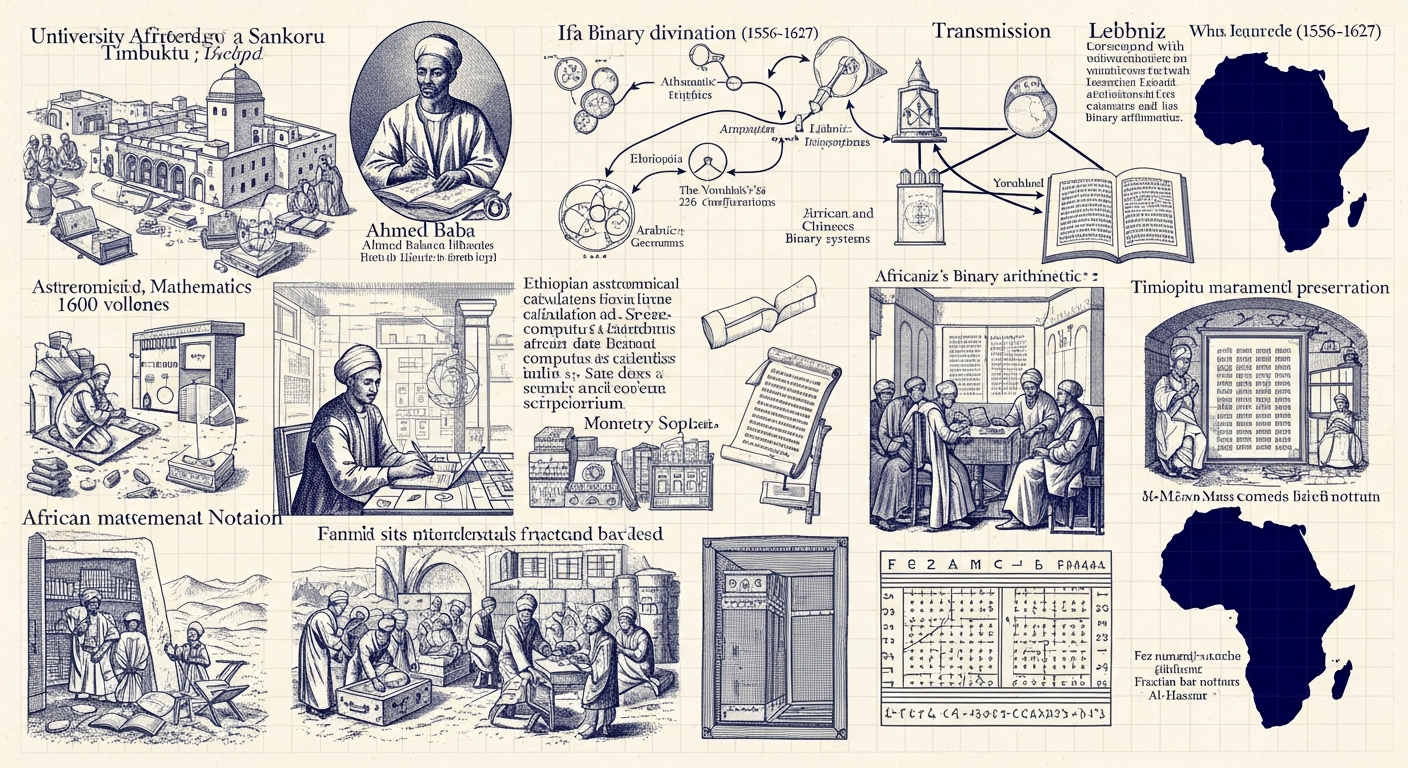
Africa in the early modern era: resistance and knowledge transmission amid upheavals.
The Age of Encounters: Introduction
In 1703, Gottfried Wilhelm Leibniz published an article on binary arithmetic—that system of zeros and ones on which all our computers rest today. That same year, he received a letter from a French Jesuit in China, Joachim Bouvet, revealing a troubling coincidence: the hexagrams of the I Ching, that divinatory text three millennia old, formed exactly the same system. Two traditions of thought separated by oceans and millennia had arrived at the same structure. This was neither transmission nor chance. It was a mirror.
The Early Modern period—from 1492 to 1789, from the discovery of the New World to the French Revolution—was the era when these mirrors multiplied. For the first time in history, civilizations that had developed separately for millennia found themselves face to face. Jesuits taught Euclid to the emperor of China. A Polynesian navigator boarded an English ship to guide its captain across the Pacific. A Japanese mathematician discovered the same theorems as a German without ever having heard of him. Everywhere, people attempted to translate their knowledge into languages that others could understand.
These translations sometimes succeeded. They often failed. They were almost always interrupted—by conquest, expulsion, death, misunderstanding. The Early Modern period was an age of missed appointments as much as of bridges built. It bequeathed us the intellectual program of artificial intelligence—and the blind spots that still accompany it.
This third part continues the journey begun in Antiquity and the Middle Ages. Six continents, three centuries of history—and everywhere the same question, posed with new clarity: can the mind be mechanized?
Africa — The Aquifers of Knowledge
There are transmissions we cannot see. Like water that seeps into the ground and resurfaces miles from its source, certain knowledge has traveled through underground channels that official history has not traced.
The Ifá system of the Yoruba—those two hundred fifty-six binary configurations we encountered in Antiquity—did not disappear with Antiquity. It continued to live, to be transmitted, to circulate. Ethnomathematician Ron Eglash traced a troubling lineage: from African binary structures to Arab geomancy, then to European alchemy, and finally to the works of Leibniz himself. The binary we believe to be European could be an African heritage.
In Timbuktu, meanwhile, the last great chancellor of the University of Sankore—Ahmed Baba, who possessed sixteen hundred volumes—was exiled to Morocco after the invasion of 1591. Seven hundred thousand manuscripts still sleep in the libraries of the Malian desert, waiting to be translated. The Africa of the Early Modern period reminds us that algorithms have a genealogy—and that this genealogy has been systematically obscured.
Americas — Threads Knotted by Conquest
A thread can be cut. It can also, sometimes, be retied.
When the conquistadors landed in Mexico, they found civilizations whose knowledge systems rivaled their own—and they systematically destroyed them. Thousands of manuscripts were burned. Entire libraries disappeared. Traditions of thought developed over millennia were interrupted within a few decades.
But fragments survived. The Codex Vergara, compiled around 1540 under Spanish colonization, preserves the calculation methods of Aztec surveyors—adaptive algorithms of remarkable sophistication. The works of contemporary philosophers like James Maffie have revealed that the tlamatinimeh—"those who know something"—had developed a logic radically different from Aristotle's. For them, the world was a slippery place where two apparently contradictory propositions could be simultaneously true. This tolerance for ambiguity strangely resembles how our large language models function—with probabilities rather than binary truths.
Asia — Bridges and Mirrors
A bridge connects what was separated. A mirror reveals that the same face can appear on both sides.
In 1581, an Italian Jesuit named Matteo Ricci arrived in China. Over the twenty-eight years that followed, he learned Chinese, dressed as a Confucian scholar, and undertook with the mathematician Xu Guangqi the translation of Euclid's Elements. This bridge between two mathematical traditions remained open for nearly a century and a half—until the Jesuits were expelled in 1723.
Meanwhile, on the other side of the sea, in a Japan closed to the world by sakoku, a samurai turned mathematician named Seki Takakazu was developing alone the theory of determinants and discovering Bernoulli numbers—before their European counterparts. And in Kerala, Madhava's mathematical school continued to transmit the infinitesimal calculus it had developed a century before Newton. These mirrors teach us that certain mathematical structures are discoveries, not inventions—accessible to any sufficiently developed intelligence, regardless of its culture of origin.
Europe — Clocks of the Soul
A clock can measure time. But can it think?
This was the question that European philosophers of the Early Modern period dared to ask—with an audacity that still seems vertiginous. Descartes declared animals to be pure machines and proposed two criteria for distinguishing humans from automata: language and universal reason. These criteria strangely resemble the Turing test and the dream of artificial general intelligence. Hobbes affirmed that "reason is nothing but reckoning." Leibniz dreamed of a universal language and a reasoning machine that would resolve disputes through calculation.
Pascal built the Pascaline—the first commercially viable calculating machine. Vaucanson created a mechanical duck capable of digesting and a flute player capable of modulating its breath. Jaquet-Droz programmed automata capable of writing any text of forty characters. Early Modern Europe did not merely build machines. It built the conceptual framework that would one day make artificial intelligence thinkable—with its assumptions, its ambitions, and its blind spots.
Middle East — Windows That Close
A window can open onto the world. It can also close—sometimes for centuries.
In 1577, the Ottoman astronomer Taqi al-Din completed in Istanbul an observatory comparable to Tycho Brahe's in Denmark. He had invented a clock with three dials—hours, minutes, seconds—and a rudimentary steam turbine. Three years later, on the orders of religious authorities, the observatory was destroyed. Printing in Arabic characters remained forbidden for two hundred fifty years.
These choices were not inevitable. They were made by people, for reasons that seemed good to them at the time. They had consequences we still measure today. The Middle East of the Early Modern period was not a scientific desert—Persian astrolabes, Mughal globes testify to a technical vitality that had not disappeared. But the institutions that could have protected innovation had stopped doing so. Governance, this history tells us, matters more than individual talent.
Oceania — The Map and the Song
There are maps we do not know how to read.
In 1769, a Polynesian priest named Tupaia boarded Captain Cook's Endeavour. He brought with him a mental map of one hundred thirty islands scattered across seven thousand kilometers of ocean. Over the months that followed, he attempted something extraordinary: to invent a cartographic system that would bridge his way of thinking about the world and that of the Europeans.
This map survived—misunderstood for two hundred fifty years. Researchers judged it confused, inaccurate, primitive. It was not until 2018 that two German academics finally understood its logic. Tupaia had not made errors. He had simply written in a language no one bothered to learn. The Oceania of the Early Modern period reminds us that our data corpora contain Cook's journals, but not Tupaia's navigation chants. This bias is not technical. It is historical.
These six tales sketch a geography of intelligence that extends beyond the borders of the West and the limits of what is usually called the "scientific revolution." They reveal that the Early Modern period was both the era when the program of artificial intelligence was formulated—and the era when other programs, other ways of thinking about intelligence, were interrupted, forgotten, erased.
Europe gave us the conceptual framework—the beast-machine, the calculus ratiocinator, programmable automata. Asia gave us proof that mathematical structures are universal. The Americas gave us alternative logics we are only beginning to rediscover. Africa gave us obscured genealogies. The Middle East gave us a warning. Oceania gave us the memory of what we do not know how to see.
The Early Modern period ends with the French Revolution—and the path opens toward the age of machines. Babbage, Lovelace, Boole, Turing: Leibniz and Pascal's heirs will transform the dream into reality. But they will do so with the materials the Early Modern period bequeathed them—including the absences, the omissions, the biases.
The artificial intelligence we are building today is the fruit of these three centuries of encounters and misunderstandings. It carries within it the questions of Descartes and the blind spots of Cook. It speaks the languages that were written, not those that were sung.
Understanding this heritage—including what it excluded—is perhaps the condition for building something different.