Europe
Illustrations
1 / 5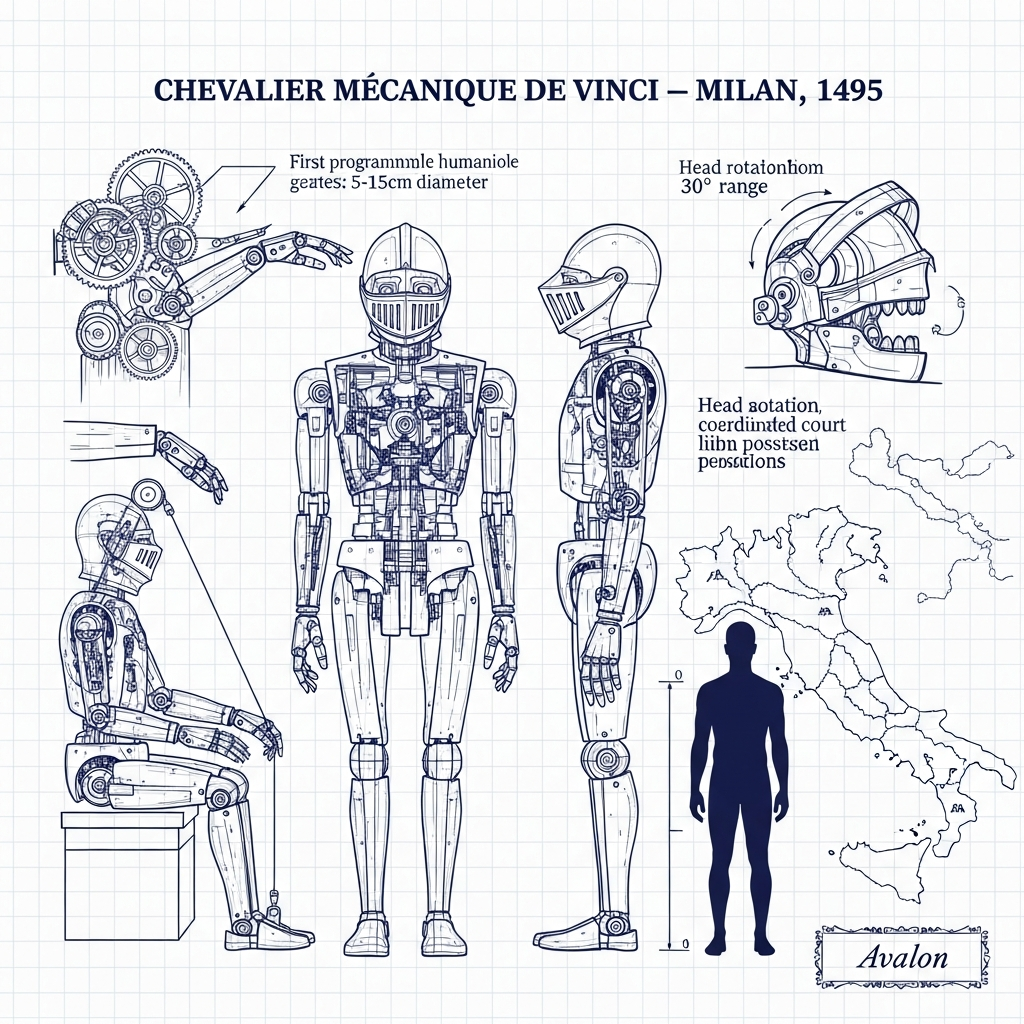
Leonardo da Vinci's mechanical knight: first humanoid robot designed in Europe.
Clocks of the Soul: When Early Modern Europe Dreamed of Mechanizing Thought
There are epochs when humanity changes how it sees itself. The Early Modern period was one of these. Between the Renaissance and the Enlightenment, Europe did not merely build ever more perfected automata. It dared a vertiginous question: what if thought itself were merely a mechanism? What if the soul, that mysterious entity theologians had placed beyond the reach of clockmakers, could be dismantled, analyzed, reproduced like the movement of planets in an astronomical clock?
This question was not innocent. It contained in germ everything we now call artificial intelligence. The Renaissance engineers who made metal lions walk, the seventeenth-century philosophers who declared animals to be pure machines, the eighteenth-century clockmakers who built androids capable of writing—all participated in the same movement of thought. They sought to understand whether the human mind was a phenomenon apart, irreducible to the laws of physics, or merely a particularly complex arrangement of gears and springs.
Yesterday — The First Mechanical Dreams
In 1495, in a Milan workshop, a man who was neither clockmaker nor professional mechanic drew plans for a knight in armor capable of moving on its own. Leonardo da Vinci did not invent the automaton—the Greeks of Antiquity had built them, medieval clockmakers had perfected them. But he did something new: he conceived a humanoid robot, a human-shaped machine that could sit down, raise its arms, turn its head, open and close its jaw. This mechanical knight was not a toy. It was a declaration: the human body itself could be imitated by gears.
Twenty years later, to celebrate King Francis I's entry into Lyon, Leonardo built a mechanical lion that walked toward the monarch, stopped before him, and opened its chest to reveal a bouquet of fleur-de-lis. The performance was spectacular, but what fascinated spectators was not merely technical skill. It was the appearance of autonomous life. The lion seemed to act on its own, to make decisions, to accomplish a coordinated sequence of actions without visible human intervention.
This fascination with autonomous movement traversed the entire sixteenth century. In Toledo, an Italian clockmaker named Juanelo Turriano, in the service of Charles V and then Philip II, built around 1560 a miniature monk about fifteen centimeters tall. This small figure of wood and metal still walks today, preserved at the Smithsonian Institution in Washington. When its mechanism is wound, the monk advances with a gliding motion, raises his crucifix in his right hand, beats his chest with his left, turns his head from right to left, opens and closes his mouth as if praying. Legend has it that Philip II commissioned this automaton to thank God for his son's recovery. Whether true or not, this story says something essential about the era: even devotion could be mechanized. Even prayer could be delegated to gears.
But these Renaissance automata remained court objects, diplomatic curiosities, or mechanical ex-votos. They did not yet explicitly pose the question that would haunt the following century: is thought, too, reducible to a mechanism?
It was René Descartes who, in the mid-seventeenth century, formulated this question with new radicality. In his Discourse on the Method published in 1637, then in his Treatise on Man which only appeared after his death, Descartes developed what would be called the doctrine of the "beast-machine." Animals, he maintained, are nothing other than extremely complex automata. They have no soul, no consciousness, no true thought. Their behaviors, however elaborate they appear, are merely mechanical responses to stimuli—like an organ that plays when its keys are pressed.
This thesis shocked many of his contemporaries. How could a dog that recognizes its master, that shows joy, fear, affection, be merely a machine? Descartes did not deny these appearances. He simply maintained that they could be entirely explained by physical mechanisms, without needing to suppose an animal soul.
Descartes's true audacity lay elsewhere. For if animals are machines, what distinguishes humans? The Cartesian answer rested on two criteria. First, language: no automaton, however perfected, would ever be capable of responding appropriately to all the questions one might ask it. Second, universal reason: a machine can only act according to its programming, while the human mind can apply itself to any domain.
These two criteria—the language test and the generality test—strangely resemble those we still use today to evaluate artificial intelligence. The Turing test, proposed three centuries later, is essentially a reformulation of the first Cartesian criterion: can a machine converse indistinguishably from a human? As for artificial general intelligence, that grail of contemporary research, it corresponds exactly to the second criterion: can a machine adapt to any task as the human mind does?
Descartes was not alone in thinking of thought as calculation. In England, Thomas Hobbes affirmed in his Leviathan of 1651 that "reason is nothing but reckoning"—the very word that would reappear in the name of Leibniz's machine. For Hobbes, to reason was to add and subtract concepts, exactly as one adds and subtracts numbers. This arithmetic vision of thought opened a vertiginous possibility: if reasoning is calculating, then a calculating machine could reason.
Today — When Thought Became Calculation
This possibility was not merely philosophical speculation. As early as 1642, a young man of nineteen named Blaise Pascal built the first commercially viable calculating machine. The Pascaline, as it was called, could mechanically add and subtract six-digit numbers. Pascal had invented it to help his father, a tax collector in Rouen, lighten the tedious calculations of his office. Fifty prototypes were built; nine are preserved today in various museums.
The mechanism was ingenious: toothed wheels with ten positions, an automatic carry system, dials for entering numbers, windows for reading results. But more than technical ingenuity, it was the philosophical significance that mattered. For the first time, a mental operation—addition—was entirely delegated to a machine. The human mind was no longer necessary to produce the result. Gears sufficed.
Half a century later, Gottfried Wilhelm Leibniz pushed the idea much further. Not content with building a machine capable of four arithmetic operations—the "Stepped Reckoner" of 1694—Leibniz dreamed of an infinitely more ambitious enterprise: mechanizing reasoning itself.
His project was called the "characteristica universalis": a universal formal language where each concept would be represented by an unambiguous symbol, and where relationships between concepts would be expressed by rules of symbolic manipulation. Once this language was constructed, Leibniz maintained, philosophical, theological, and political disputes could be resolved by calculation. "Calculemus," he said—let us calculate. When two people disagreed, they would simply sit down, take their pens, and calculate who was right.
This Leibnizian dream of a "calculus ratiocinator"—a reasoning machine—was never realized in his lifetime. But it contained in germ the entire history of formal logic and computer science. When George Boole developed the algebra of logic in the nineteenth century, when Frege invented the predicate calculus, when Turing conceived his universal machine, they all pursued, consciously or not, the Leibnizian program.
Leibniz was also the one who, in 1703, published his "Explanation of Binary Arithmetic"—that system where all numbers are represented only by zeros and ones. This arithmetic, which Leibniz saw as a metaphysical model of creation—the one representing God, the zero nothingness—would become three centuries later the universal language of computing. Every bit of every computer, every circuit of every processor, still speaks Leibniz's binary language today.
But while philosophers were mechanizing thought in theory, clockmakers were mechanizing it in practice. Jacques de Vaucanson, son of a glove-maker from Grenoble, would bring the art of automata to a summit never before achieved.
In 1737, Vaucanson presented to the Academy of Sciences in Paris his Transverse Flute Player. The life-sized automaton actually played the flute—not a disguised music box, but a real instrument activated by articulated fingers, a mobile tongue, and breath produced by internal bellows. The academicians, stupefied, verified there was no trickery. The automaton faithfully reproduced the mechanism of human breathing and fingering.
The following year, Vaucanson presented two new automata: a tambourine player and, above all, the famous Digesting Duck. This mechanical bird ate grain, "digested" it in an artificial stomach, and defecated a greenish residue. More than four hundred movable parts composed each wing. The duck paddled, quacked, stretched its neck to grab food offered to it. Voltaire was ecstatic: "Without Vaucanson's duck, you would have nothing to recall the glory of France."
The duck's trickery—for the "digestion" was only a simulation, the residue prepared in advance—matters less than the effect produced on minds. For the first time, an automaton imitated not only movement but the vital functions of a living being. The boundary between mechanical and biological seemed to blur.
Thirty years later, the Jaquet-Droz family of La Chaux-de-Fonds, Switzerland, crossed a decisive threshold. Between 1768 and 1774, Pierre Jaquet-Droz and his son Henri-Louis built three automata that are still in working order, preserved at the Museum of Art and History in Neuchâtel.
The Writer is the most remarkable. This small figure of seventy centimeters, composed of six thousand parts, can write any text up to forty characters. It dips its pen in the inkwell, shakes off the excess, traces letters on paper while following with its eyes what it writes. The text is not fixed in advance in the mechanism. It is programmed by a replaceable cam disk. The Writer is, in a sense, the first programmable computer in history—a machine whose behavior can be modified without changing its structure.
The Draughtsman draws four different pictures—a portrait of Louis XV, a royal couple, a dog, a Cupid—and blows on the paper to remove graphite dust. The Musician actually plays the organ, her fingers pressing the keys, her chest rising as if breathing, her eyes following the audience.
These automata did not think, of course. But they accomplished tasks—writing, drawing, playing music—that had long been considered the exclusive province of human intelligence. If a machine could write, what prevented building a machine capable of composing what it wrote?
This question found a troubling answer in 1770, when Wolfgang von Kempelen presented to Empress Maria Theresa of Austria his chess-playing automaton. The "Mechanical Turk"—an Oriental figure seated before a chessboard, installed on a cabinet filled with visible gears—seemed capable of playing chess against any human opponent, and of winning most often.
The Turk was a hoax. A hidden human player, concealed in the cabinet through an ingenious system of drawers and mirrors, manipulated the automaton's arm via a pantograph. But for nearly a century—until Edgar Allan Poe published his analysis of the hoax in 1836—many genuinely believed a machine could play chess. The question was no longer whether machines could simulate movement or vital functions. It was whether they could simulate intelligence itself.
Beyond — What the Automata Reveal
Wolfgang von Kempelen's Mechanical Turk, despite its fraudulent nature, crystallized a debate that has never ended since. Can intelligence be mechanized? And if so, would the machine resulting from this mechanization be truly intelligent, or merely an imitation of intelligence?
Descartes's answer—language and generality as criteria of the soul—no longer satisfied eighteenth-century thinkers. British empiricists, following John Locke and David Hume, proposed a vision of the human mind that made it much more vulnerable to mechanization.
For Locke, the human mind was born "tabula rasa"—blank slate. All our ideas came from experience, through the senses. The mind was not a mysterious substance endowed with innate powers. It was a receptacle that accumulated sensory impressions and associated them according to regular laws. This associationist vision of thought strangely resembles what artificial intelligence engineers today call machine learning: a system that forms associations between data, without starting with prior knowledge.
Hume pushed this analysis further still. Causality itself, that fundamental principle of our reasoning, was according to him merely a mental habit. We see the sun rise every morning, and we infer it will rise tomorrow. But this inference is not logically necessary. It rests on a natural disposition of our mind to generalize from repeated observations. This Humean conception of induction—passing from particular to general through accumulation of examples—describes exactly what artificial neural networks do when they learn from data.
Thus, at the end of the Early Modern period, all the puzzle pieces were in place. Automata had shown that movement, vital functions, and even certain "intellectual" activities like writing or chess could be mechanized. Philosophers had proposed theories of mind—Cartesian mechanism, Lockean associationism, Humean empiricism—that made conceivable the construction of an artificial mind. Mathematicians had invented calculating machines and dreamed of reasoning machines. Leibniz's binary system waited in the archives, ready to become the universal language of computing.
What was still missing were the technical means—electricity, electronics, the transistor—to realize these visions. Another two centuries would be needed. But the essential had been thought. Early Modern Europe had dared to conceive what the following centuries would build.
This European history of the mechanization of the mind, however rich, should not make us forget that it is only one history among others. While Leibniz dreamed of his characteristica universalis, Seki Takakazu in Japan was independently discovering determinants and Bernoulli numbers. While Vaucanson built his digesting duck, craftsmen in Edo were perfecting their karakuri—automata that served tea or shot arrows. While British empiricists described the mind as a blank slate, Nahua philosophers of the Americas had developed logics that accepted contradiction and ambiguity.
These parallels are not mere exotic curiosities. They reveal that the question of artificial intelligence—can thought be mechanized?—belongs to no particular civilization. It emerges wherever societies reach a certain level of technical and philosophical sophistication. Early Modern Europe did not invent this question. It gave it a particular form, linked to its mechanist tradition, its dualist conception of soul and body, its taste for clocks and automata.
This particular form has become dominant. The artificial intelligence we develop today follows directly from Leibniz and Descartes, Pascal and Vaucanson. It inherits their assumptions, their categories, their blind spots. It supposes, like Descartes, that thought can be separated from body. It postulates, like Leibniz, that reasoning can be reduced to symbolic calculation. It aspires, like Jaquet-Droz's automata, to produce behaviors indistinguishable from humans'.
These assumptions are not neutral. They bear the mark of an era and a place. They reflect a worldview—mechanist, dualist, reductionist—that is not the only possible one. Other intellectual traditions had developed other conceptions of thought, intelligence, the relationship between mind and matter. These traditions are almost absent from the data corpora on which contemporary language models are trained. They are therefore almost absent from the artificial intelligences we build.
The governance of artificial intelligence cannot ignore this historical dimension. The technical choices we make today—which architectures, which algorithms, which training data—are also philosophical choices. They determine which forms of thought our machines will be able to simulate, which logics they will be able to manipulate, which worldviews they will be able to reflect.
Wolfgang von Kempelen's Mechanical Turk was a hoax. Behind the automaton hid a human. This image is perhaps the best metaphor for contemporary artificial intelligence. Our machines do not truly think—not yet, not in the sense Descartes meant. But they simulate thought so well that the distinction sometimes becomes undecidable. And behind these machines, there are always humans: those who design them, those who train them, those who choose the data they will absorb.
These humans, for now, come predominantly from a small number of countries, predominantly speak English, were predominantly trained in Western universities. They inherit, whether they know it or not, the assumptions of Descartes and Leibniz. They build machines in their image—that is, in the image of a particular fraction of humanity.
The history of Early Modern European automata is not merely a technical prehistory of computing. It is the history of a particular way of thinking about thought itself—a way that has triumphed, that has imposed itself as universal, but that was originally only one possibility among others.
Recognizing this contingency is not diminishing European accomplishments. It is situating them in a larger landscape, putting them in perspective, understanding that they do not represent the only path to artificial intelligence. Other paths could have been taken. Other paths can still be taken.
The clocks of the soul that Early Modern Europe dreamed still turn. They pace the time of our computers, cadence the calculations of our processors, structure the architectures of our neural networks. But alongside these clocks, other mechanisms could function—mechanisms inspired by other traditions, other logics, other ways of conceiving what it means to think.
The artificial intelligence we will build tomorrow will depend on the stories we choose to tell ourselves about intelligence itself. If we tell ourselves only one story—that of European automata, mechanical calculators, the Leibnizian dream—we will build only one type of intelligence. If we learn to listen to other stories, perhaps we can build something different.
Vaucanson's gears are in the museum. Jaquet-Droz's automata still work. The Mechanical Turk burned in a fire. But the question they all posed—can the mind be mechanized?—remains open. Three centuries later, we are only beginning to answer it.