The Americas
Illustrations
1 / 5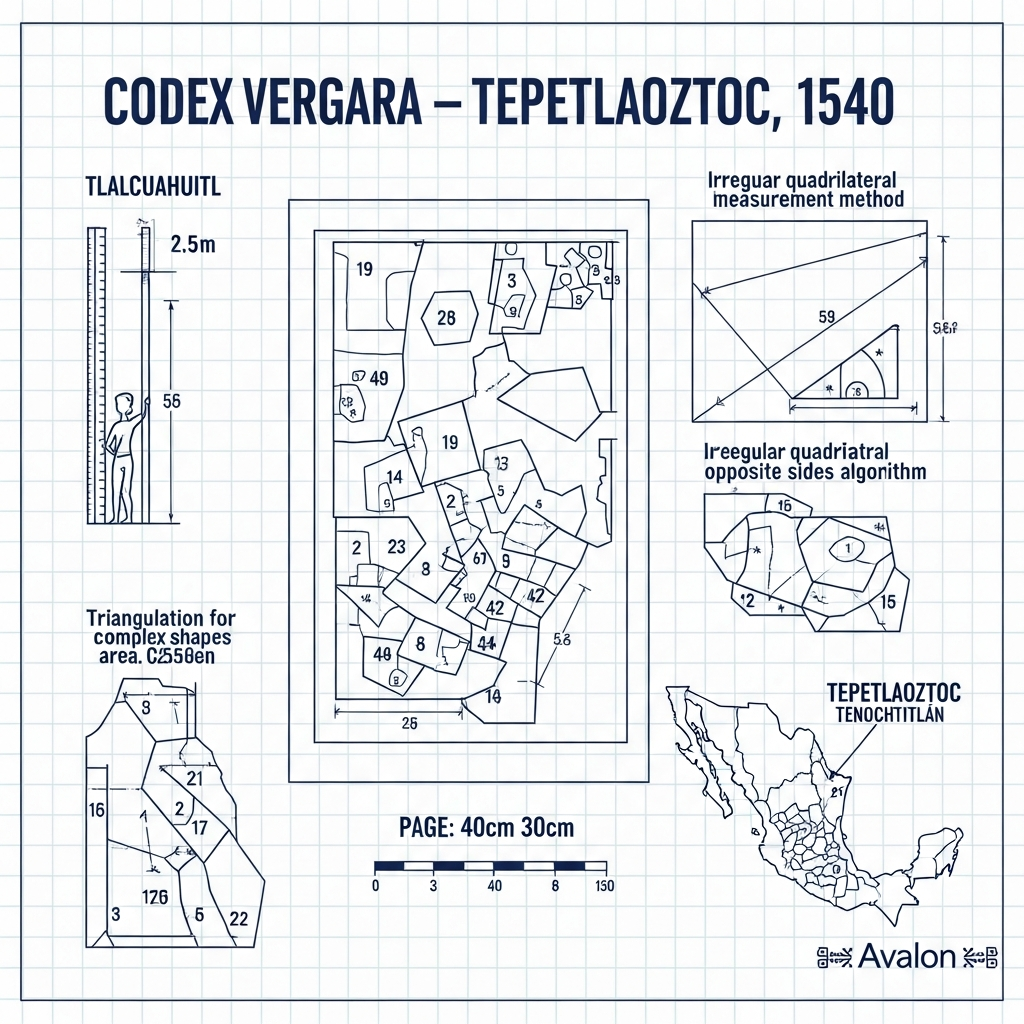
The Codex Vergara: Aztec cadastral system of remarkable precision.
Forgotten Logics: What the Americas Teach Artificial Intelligence
There are multiple ways to think about the world. Multiple ways to reason, classify, deduce. The West long believed that its logic—Aristotle's, of the excluded middle, of non-contradiction—was the only valid one, the only rational one, the only one worthy of being called thought. The civilizations of the Americas had developed other paths. The conquest interrupted them. But in colonial archives, in the fragments of philosophy that chroniclers inadvertently preserved, something persists—something that could illuminate the artificial intelligence we are building today.
Yesterday — The Codex Vergara, Ancestor of Adaptive Architectures
In 1540, about twenty years after the fall of Tenochtitlan, indigenous scribes painted under Spanish supervision what would become the Codex Vergara. This administrative document, intended to facilitate the collection of colonial taxes, represents hundreds of land parcels in the Valley of Mexico with their precise measurements. The Spanish wanted to know what they could tax. They did not realize they were preserving, in doing so, traces of remarkable algorithmic sophistication.
Aztec surveyors—the tlalpouhqueh—had developed a repertoire of methods for calculating land areas. Faced with a rectangular field, the procedure was simple: multiply length by width. But real parcels are rarely perfect rectangles. Faced with a quadrilateral with unequal sides, the tlalpouhqueh applied another method: they calculated the arithmetic mean of the two opposite sides, then multiplied this result by the length of an adjacent side. For more complex shapes—five or six-sided plots, parcels with irregular contours—they decomposed the surface into triangles and added the partial areas.
This adaptive approach foreshadows what artificial intelligence engineers today call conditional architectures. A retrieval-augmented generation system—those devices that enrich a language model's responses by fetching information from an external knowledge base—functions according to similar logic. Faced with a simple query, the system can respond directly. Faced with a complex question requiring factual information, it triggers a search in its document base. Faced with an ambiguous request, it can reformulate, ask for clarification, or combine multiple strategies.
The tlalpouhqueh did not have computers, but they had understood something fundamental: that a good algorithm is not a rigid procedure applied mechanically, but a repertoire of methods from which one chooses according to context. This situational intelligence—knowing which technique to employ facing which problem—is precisely what modern AI architectures seek to reproduce.
The Codex Vergara itself constitutes a multimodal knowledge base before its time. Each parcel is represented by a schematic drawing showing its shape, numerical glyphs indicating its dimensions in the Aztec vigesimal system, and sometimes annotations in Nahuatl or Spanish specifying the owner's name or the terrain's nature. Information is not stored in a single format, but in a combination of modalities—visual, numerical, textual—that complement and reinforce each other.
Contemporary AI systems are rediscovering this intuition. Multimodal models, capable of simultaneously processing text, images, and structured data, reproduce this integration that Aztec scribes practiced on their amate paper. The scale difference is dizzying—our machines process billions of parameters where the Codex Vergara counts only a few hundred parcels—but the architectural principle is the same: combining multiple representations to enrich understanding.
More troubling still, researchers who have studied the Codex Vergara discovered that measurements were not always consistent with each other. Some parcels seem to have been measured with different units, or according to conventions that varied from one village to another. Rather than seeing these inconsistencies as errors to correct, we could recognize in them a form of tolerance for ambiguity—this ability to function with imperfect, partial, sometimes contradictory data, that modern AI systems also seek to develop.
Today — Logics That Embrace Contradiction
Aristotelian logic, that which has structured Western thought for more than two millennia, rests on three fundamental principles. The principle of identity: a thing is what it is. The principle of non-contradiction: a thing cannot be and not be at the same time and in the same respect. The principle of the excluded middle: a proposition is either true or false; there is no third possibility.
These principles seem obvious. They are not.
Nahua philosophers—the tlamatinimeh, literally "those who know something"—had developed a radically different conception of reality and reasoning. For them, the world was tlalticpac, "on earth"—a slippery, unstable place, in perpetual motion. Wisdom did not consist of freezing reality into sharp categories, but of navigating this flux, finding a balance always provisional, always to be renegotiated.
The central concept of this philosophy was teotl—not a god in the Western sense, but a force, an energy, a dynamic process animating all things. Teotl manifested in a particular form: Ōmeteōtl, dual cosmic energy. Not two opposed principles like good and evil, true and false, but two complementary aspects of a single reality—like day and night, which do not exclude each other but succeed and define each other mutually.
This thinking of complementary duality allowed acceptance of what Aristotelian logic rejects: that two apparently contradictory propositions could be simultaneously true according to context, moment, point of view. A warrior could be both courageous and prudent. A decision could be both just and cruel. The world itself could be both ordered and chaotic, depending on the scale at which it was observed.
This tolerance for contradiction was not a defect of rigor. It was another form of rigor—adapted to a world recognized as fundamentally complex, ambiguous, irreducible to simple categories.
Contemporary large language models function, in a way, according to a logic closer to the tlamatinimeh than to Aristotle. Unlike the expert systems of the 1980s, which manipulated strict Boolean rules—if A and B then C—neural networks work with probabilities, distributions, nuances. A proposition is not true or false; it has a certain degree of plausibility given the context. An answer is not correct or incorrect; it is more or less adapted to the situation.
This flexibility allows language models to produce nuanced responses, to recognize ambiguity in questions, to propose multiple possible interpretations of a single statement. It also allows them to contradict themselves—to say one thing in one context and its opposite in another—without this necessarily constituting an error. Like Nahua philosophers, these systems accept that truth can depend on point of view.
More profoundly still, the relational thinking of indigenous peoples of the Americas—this conviction that nothing exists in isolation, that everything is connected to everything in a network of mutual relationships—finds echoes in the knowledge graph architectures that today structure part of artificial intelligence. A knowledge graph does not define entities by their intrinsic properties, but by their relationships with other entities. A person is not defined by a list of attributes, but by their links with places, organizations, events, other people. This relational ontology strangely resembles what indigenous thinkers had elaborated centuries before the invention of computers.
Lakota thinker Vine Deloria described indigenous epistemology as a method where no data is rejected a priori as irrelevant. Individual experiences, the accumulated wisdom of the community, dreams, visions, messages perceived in animal behavior—all this constitutes a unified body of knowledge to be interpreted as a whole. This holistic approach, which refuses to rank information sources before understanding their relationships, evokes unsupervised learning methods where the algorithm discovers relevant structures in data on its own, without being told in advance what to look for.
Beyond — What Intelligences for What Worlds?
These parallels between Amerindian logics and modern AI architectures are not mere historical curiosities. They point toward a fundamental question: on what knowledge are we building our thinking machines, and what knowledge are we leaving aside?
Training data for large language models comes overwhelmingly from the internet—and the internet, despite its apparent universality, remains dominated by English-language content, produced in Western countries, reflecting the concerns and thought frameworks of these societies. Indigenous knowledge of the Americas, transmitted orally for millennia, systematically destroyed by colonization, barely documented in archives accessible online, is virtually absent from these training corpora.
This bias is not trivial. A language model trained almost exclusively on Western texts will reproduce Western thought categories, the implicit assumptions of Aristotelian logic, the value hierarchies of the societies that produced these texts. It will be able to discourse on Plato and Descartes, but will ignore the tlamatinimeh. It will master the subtleties of English grammar, but will know nothing of the conceptual structures of Nahuatl or Quechua.
More seriously: this bias will be invisible to most users. AI systems present themselves as neutral, objective, universal tools. They respond to questions with an assurance that masks the limits of their knowledge. A user who queries a model about the nature of logic will probably receive an answer centered on Aristotle, Frege, Western formal logic—without mention of other logical traditions that have existed and still exist in the world.
What worldviews can these systems reflect when they have been fed only a fraction of human experience? What governance should be put in place for tools that shape our relationship with knowledge while ignoring entire swaths of humanity's collective intelligence?
These questions are not merely theoretical. They involve concrete choices in the design and deployment of AI systems. Transparency about training sources constitutes a necessary first step: users should be able to know what corpora were used to train the models they use, what languages are represented, what perspectives dominate. This transparency would at least allow awareness of blind spots.
Active diversification of training corpora represents a second, more ambitious project. It is not simply a matter of adding a few texts in minority languages to already constituted databases. It is about rethinking what counts as knowledge worthy of being integrated—including forms of knowledge that do not present themselves in textual form, oral traditions, embodied practices, modes of reasoning that do not correspond to the formats expected by our algorithms.
Including underrepresented communities in system design itself constitutes a third level of requirement. Indigenous peoples of the Americas, whose knowledge has been pillaged and destroyed for centuries, should have a say in how artificial intelligence represents—or fails to represent—their intellectual traditions. This inclusion cannot be symbolic; it must translate into real power over design choices.
But beyond these institutional measures, it is perhaps our individual relationship with these technologies that must evolve. If the artificial intelligences we use daily know only a fraction of the logics invented by humanity, how do we develop the critical thinking needed to perceive their limits?
The first step is undoubtedly to recognize that these limits exist—that the fluid, assured responses of language models mask profound ignorances, systematic biases, cultural blind spots. The second step is to actively cultivate knowledge of these other traditions of thought that our machines ignore—to read Nahua philosophers, to study paraconsistent logics, to take interest in indigenous epistemologies not as exotic curiosities, but as living intellectual resources.
The third step, perhaps the most difficult, is to accept that intelligence—whether human or artificial—is never neutral, never universal, never complete. It is always situated, always partial, always under construction. The tlamatinimeh knew this: the world is slippery, and wisdom consists of navigating this uncertainty rather than pretending to abolish it.
The algorithms we create today bear the mark of the societies that design them. They inherit our knowledge and our ignorance, our curiosities and our prejudices. Recognizing this heritage—including what it has excluded, erased, forgotten—is perhaps the condition for building artificial intelligences more conscious of their own limits.
In colonial archives sleep fragments of forgotten logics. In surviving indigenous communities persist traditions of thought that five centuries of domination have not managed to completely extinguish. This knowledge does not only ask to be preserved as relics of the past. It asks to be heard as voices of the present—voices that could enrich our understanding of what it means to think, reason, know.
The artificial intelligence we build will reflect the intelligences we feed it. If we give it only a fraction of human heritage, it will be able to reflect only a fraction of what humanity has learned to think. The threads cut by conquest can no longer be retied exactly as they were. But we can choose to weave differently—to include in the fabric what had been excluded, to recognize what had been denied.
Perhaps this is how the forgotten logics of the Americas will finally find their place in the future of intelligence—not as vestiges of a bygone past, but as resources for a present that needs them.