Oceania
Illustrations
1 / 5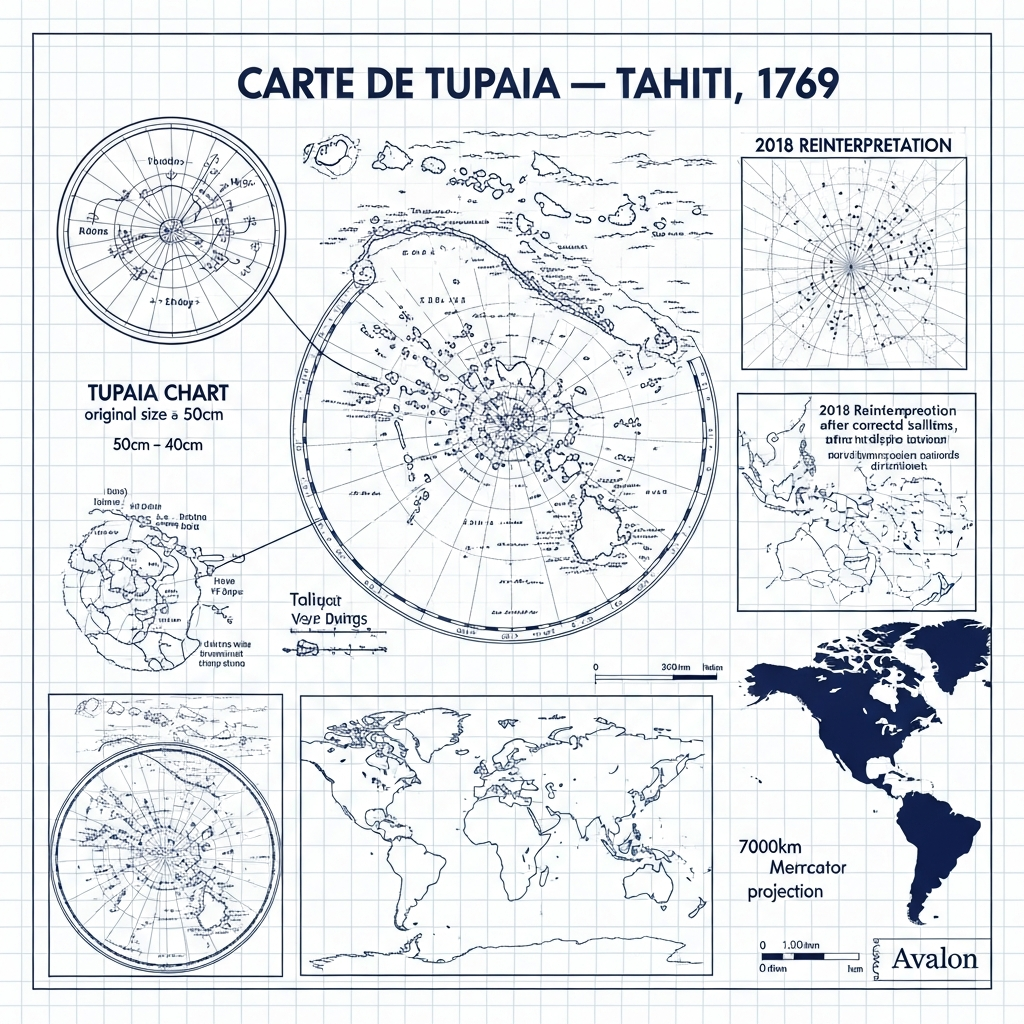
Tupaia's map: Polynesian cartography of an ocean spanning 4 million km².
The Map and the Song: When Two Intelligences Tried to Translate Each Other
In July 1769, a Polynesian priest named Tupaia boarded the Endeavour, Captain James Cook's ship. He brought with him something Europeans had never seen: a mental map of one hundred thirty islands scattered across more than seven thousand kilometers of ocean, astronomical knowledge transmitted for generations, an intelligence of the sea that no European instrument could equal. Over the months that followed, this man attempted something extraordinary: to translate his knowledge into the invaders' language, to invent a cartographic system that would bridge two radically different ways of thinking about the world.
This attempt at translation, both heroic and tragic, casts a particular light on the questions we ask today about artificial intelligence. For Tupaia faced a problem that remains ours: how to make knowledge systems built on different foundations dialogue? How to prevent translation from becoming betrayal?
Yesterday — The Man Who Knew Where the Islands Were
Tupaia was no ordinary navigator. Born around 1725 on the island of Ra'iatea, he had been trained at the marae of Taputapu-atea—the most important center of sacred knowledge and navigation in Eastern Polynesia. He was both an arioi priest and master of the stars, keeper of genealogies going back dozens of generations and knower of the sea routes linking the islands of the vast Pacific.
When Cook arrived in Tahiti in 1769 to observe the transit of Venus, Tupaia saw an opportunity. Europeans possessed ships capable of crossing oceans, weapons that could change the local balance of power, techniques Polynesians did not master. In exchange, Tupaia could offer what Europeans desperately sought: knowledge of the Pacific that no European map contained.
Joseph Banks, the expedition's botanist, insisted Tupaia be welcomed aboard. The demonstration that convinced him was stunning. Questioned about the region's geography, Tupaia had drawn a map showing one hundred thirty islands within a two-thousand-mile radius. He could name seventy-four of them. This knowledge was not written on any document—it existed in his mind, transmitted by generations of navigators who had never needed paper or compass.
But the most remarkable thing was not the extent of this knowledge. It was the way Tupaia attempted to communicate it. Polynesians did not measure distance like Europeans. They did not think in terms of miles or degrees of longitude. For them, distance between two islands was measured in navigation time—how many days of voyage, under what conditions of wind and current. Space was not an abstract grid; it was a lived, bodily experience, rhythmed by the movement of stars and the swell of waves.
Tupaia then invented something new. On the map he drew for Cook, he placed each island in relation to a center marked with the word "avatea"—the sun at noon. This system allowed him to translate his knowledge of sea routes into the logic of the European compass. It was not a traditional Polynesian map, for Polynesians did not use maps in the European sense. Nor was it a European map, for it did not respect conventions of longitude and latitude. It was an invention—a hybrid born of the encounter between two intelligences.
For nearly two hundred fifty years, researchers were unable to correctly read this map. They found it inaccurate, confused, full of positioning errors. It was not until 2018 that two German academics, Lars Eckstein and Anja Schwarz, after six years of research, finally understood its logic. Tupaia's map was not erroneous. It was simply written in a language no one had bothered to learn—a language Tupaia had invented especially for them.
Today — What the Ship's Logs Do Not Tell
Tupaia was not only a cartographer. During the six months the Endeavour spent along the coasts of New Zealand, he served as interpreter between the crew and the Māori. Polynesian languages being related, he could communicate with them—something no European was capable of doing. The Māori, moreover, seem to have considered him the true leader of the expedition, the "tahu'a of Havai'i" whose presence gave meaning to this strange visit.
Cook's journals and those of his officers abundantly document this period. They describe Māori customs, their agricultural practices, their social organization, their tattoos, their weapons, their dwellings. These observations provided European scholars with what they considered "valuable insights" into cultures until then unknown. They fed philosophical debates about the "noble savage" and human nature. They enriched museum collections and academy libraries.
But what did they miss?
Almost everything, in reality. Europeans documented what they could see and measure—objects, behaviors, appearances. They did not understand the knowledge systems underlying these visible manifestations. They collected Marshall Islands stick charts without understanding that they represented not island positions, but patterns of ocean swell disturbance. They noted that Polynesians navigated without instruments, but did not grasp the sophistication of the mental star compass that divided the horizon into thirty-two houses corresponding to the rising and setting positions of stars.
More profoundly still, they did not perceive that these peoples had developed forms of intelligence radically different from their own. Modern research has revealed that Papua New Guinea and Oceania harbor nearly nine hundred distinct counting systems, using bases ranging from two to twenty-seven, often employing the body as a calculation support—each joint, each phalanx serving as a landmark in an embodied arithmetic. Australian Aboriginal kinship systems, with their complex rules of marriage and filiation, can be modeled by group theory—a branch of mathematics that would not be formalized in Europe until the nineteenth century.
This knowledge existed. It worked. It had allowed peoples to colonize the world's largest ocean, to maintain complex societies on tiny islands, to transmit knowledge over millennia without alphabetic writing. But Europeans, prisoners of their own categories, could not see it.
Tupaia died in Batavia in December 1770, carried off by a disease contracted during the ship's stop. With him disappeared a possibility—that of a dialogue between two intelligences that could have enriched both parties. What remained were Cook's journals, Banks's collections, the travel accounts that would shape for centuries the European image of the Pacific. A partial image, biased, blind to what it did not know how to seek.
Beyond — Knowledge Awaiting Translation
This story of a missed encounter resonates strangely with the challenges of contemporary artificial intelligence. For we may also be explorers who document what we know how to see while remaining blind to what we do not know how to seek.
The data corpora on which large language models are trained reflect what has been written, digitized, made accessible online. They contain Cook's journals, but not the navigation chants Tupaia carried in his memory. They include European descriptions of Oceanian societies, but not the knowledge systems these descriptions missed. The history of the Pacific as our machines can learn it is history written by the victors—or at least by those who had writing.
This bias is not trivial. A language model queried about Polynesian navigation may know how to cite Cook's voyages. Will it know how to explain how Tupaia calculated his position by feeling the rhythm of waves under his canoe's hull? Will it know the nine hundred counting systems documented by researcher Glendon Lean? Will it be able to account for the mathematical sophistication of Aboriginal kinship systems?
These questions concern not only historical accuracy. They touch on the very nature of the intelligence we are building. If our machines learn only a fraction of the ways humanity has known how to think, reason, calculate, navigate, they will be able to reflect only a fraction of human intelligence. They will reproduce the blind spots of our archives, the prejudices of our historiographies, the implicit hierarchies of our knowledge systems.
Tupaia's map took two hundred fifty years to be understood. Two hundred fifty years during which it was judged confused, inaccurate, primitive—when it was simply written in a language no one bothered to learn. How much knowledge still awaits translation? How many thought systems, developed by peoples that official history has marginalized, could enrich our understanding of what it means to be intelligent?
The artificial intelligence we develop today will reflect the intelligences we feed it. If we give it only Cook's journals, it will never know Tupaia's chants. If we do not make the effort to translate—truly translate, not simply digitize—knowledge that has not been written in dominant languages, we will reproduce on a planetary scale the blindness of eighteenth-century explorers.
Tupaia had invented a language to bridge two worlds. This language was lost with him, then found, then finally understood—too late for the dialogue it made possible to take place. We who build today machines capable of processing all the world's languages perhaps have a second chance. Not to remake history, but not to repeat its errors.
The Pacific has been mapped. The islands Tupaia knew by heart are now on Google Maps, with their precise coordinates in degrees, minutes, and seconds. But something was lost in this translation—embodied knowledge, the memory of sung routes, the intelligence that knew how to sense land before seeing it. This loss is not irremediable. Oceanian communities are working today to revive their navigation traditions, their knowledge systems, their ways of thinking about the world.
Artificial intelligence could be a tool for this renaissance—or an instrument of its completion. Everything depends on what we choose to put in it. Everything depends on our ability to learn, finally, the languages we did not know how to read.
Tupaia died in Batavia, far from his islands, taking with him knowledge no one had taken the time to truly gather. His map survived—misunderstood for centuries, then deciphered by patient researchers. This map reminds us that intelligence has never had only one form, one language, one path. It reminds us that translating means first accepting not to understand—and making the effort, despite everything, to build bridges.
The machines we create today do not yet know how to read Tupaia's map. Perhaps it is time to teach them.