Asia
Illustrations
1 / 5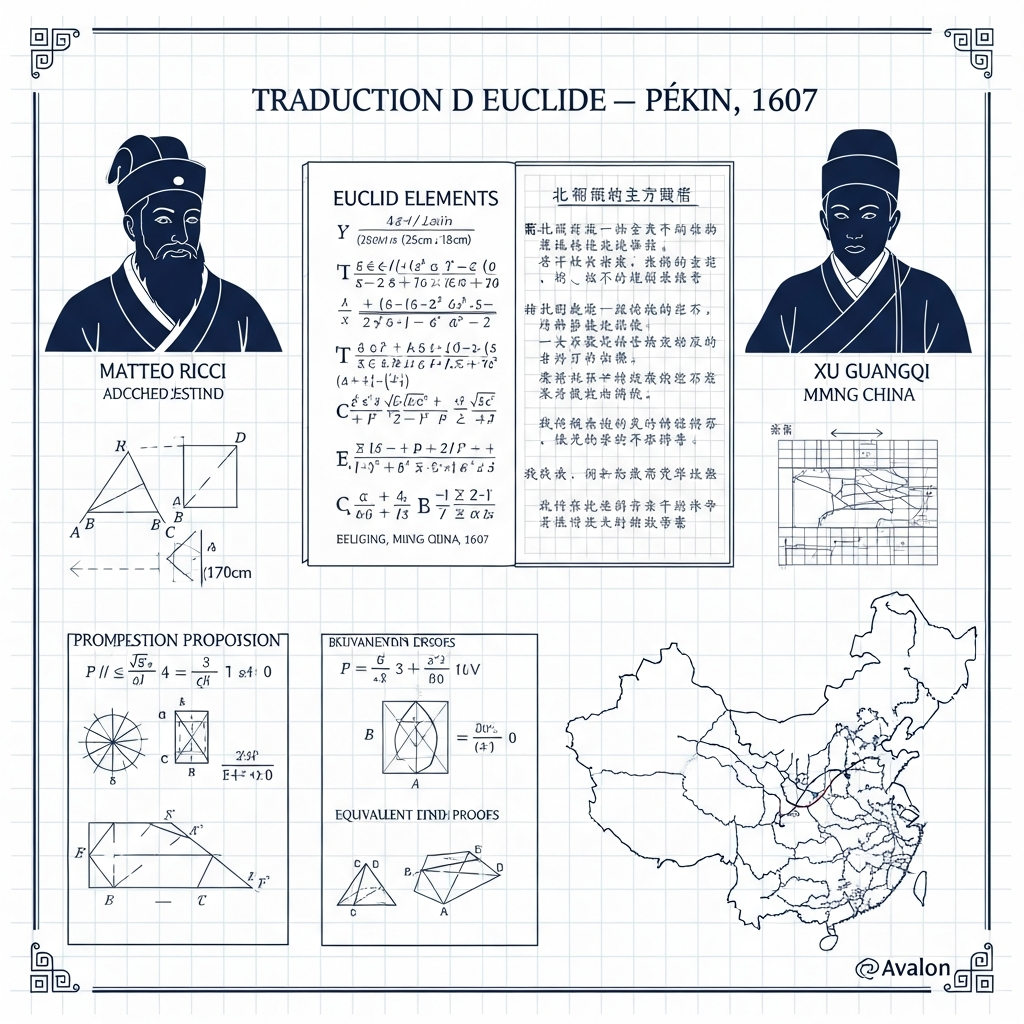
Matteo Ricci's Euclid translation: mathematical bridge between Europe and China.
Bridges and Mirrors: When Early Modern Asia Conversed with World Intelligence
There are two ways for knowledge to circulate between civilizations. The first uses bridges—those fragile constructions where people cross oceans of difference to exchange what they know. The second passes through mirrors—those troubling reflections where minds separated by thousands of kilometers discover, without knowing each other, the same truths. Early Modern Asia knew both. Jesuits built bridges between Beijing and Rome, between Euclid's mathematics and the calculations of Chinese scholars. And meanwhile, in a Japan closed to the world, a samurai discovered alone what Leibniz was seeking in Europe—as if certain ideas simply waited to be found, regardless of which shore one started from.
Yesterday — The Bridge Builders
In 1581, an Italian Jesuit named Matteo Ricci landed on the coast of China. He came not only to preach the Gospel. He brought in his baggage clocks, world maps, geometry treatises—and above all, a conviction that would transform relations between Europe and Asia: that science could be a common language, a bridge between worlds that did not know each other.
Ricci learned Chinese, adopted the clothing of scholars, studied Confucius. He understood that to be heard at the imperial court, he must first be respected as a learned man. In 1607, with the scholar Xu Guangqi, he completed the translation of the first six books of Euclid's Elements—the first time Greek geometry spoke Chinese. This was not an academic exercise. It was a quiet revolution. Euclid's demonstrations, with their rigorous chain of propositions, introduced into China a method of reasoning that had no equivalent in the local tradition.
After Ricci came other builders. The German Adam Schall von Bell became official astronomer of the imperial court, reforming the Chinese calendar according to European methods. The Belgian Ferdinand Verbiest supervised the construction of new astronomical instruments for the Beijing observatory and—irony of history—manufactured cannons for the emperor. These men were not merely missionaries. They were intermediaries, translators, go-betweens linking two worlds that were only beginning to discover each other.
The transfer did not operate in one direction only. In 1627, Johann Schreck published "Diagrams and Explanations of the Marvelous Machines of the Far West"—the first book presenting European mechanical techniques to a Chinese audience. But the Jesuits were also discovering. They sent to Rome descriptions of Chinese thought systems, translations of Confucian classics, accounts of this civilization that had developed, by entirely different paths, an intellectual sophistication comparable to Europe's.
The peak of this encounter came at the end of the seventeenth century. In 1685, Louis XIV sent to China a mission of five Jesuits he called his "king's mathematicians": Jean de Fontaney, Joachim Bouvet, Jean-François Gerbillon, Louis Le Comte, Claude de Visdelou. These men were not adventurers. They were the vanguard of a scientific diplomacy, charged with forging ties with Emperor Kangxi—himself passionate about mathematics and astronomy.
Kangxi invited the Jesuits to teach him European geometry and algebra. He studied with them for several hours a day, sometimes correcting their Chinese errors. Under his reign, more than one hundred thirty European scientific works were translated into Chinese. Prefectures where Jesuits resided saw their scientific publications quadruple compared to other regions. The bridge seemed solid, the traffic intense.
Then came the rupture. In 1723, Emperor Yongzheng, Kangxi's successor, expelled the missionaries. The "Rites Controversy"—a theological conflict over the compatibility of ancestor worship with Christianity—had poisoned relations between Rome and Beijing. The bridge collapsed. The window of exchange closed for more than a century.
What would have happened if the Jesuits had stayed? If the dialogue had continued through the Age of Enlightenment, through the Industrial Revolution? We will never know. The history of science is also made of these paths not taken, these bridges that collapsed before bearing all their fruit.
Today — The Mirrors of Discovery
While the Jesuits were building their bridges between China and Europe, something remarkable was happening on the other side of the Sea of Japan. In a country closed to the world by imperial decree, a samurai named Seki Takakazu was developing alone a mathematics of stunning sophistication.
Seki was born around 1642—the same year as Isaac Newton. He died in 1708—eight years before Leibniz. These three men never knew each other. They never read each other's works. And yet, each on their own side, they discovered strikingly similar mathematical truths.
In 1683, Seki published a treatise on what we today call determinants—those mathematical objects that allow systems of linear equations to be solved. He had developed this theory independently, before Leibniz published his own work on the subject. He also discovered the numbers that today bear Bernoulli's name—before Jacob Bernoulli himself. He invented convergence acceleration methods equivalent to those Aitken would formalize two centuries later.
How to explain these coincidences? Edo-period Japan lived in almost total isolation. The only foreigners allowed to trade were a few Dutch merchants confined to an artificial island in Nagasaki harbor. Seki had no access to European works. He worked from ancient Chinese texts, which he extended and generalized by his own means.
This situation creates what historians of science call a "natural laboratory." When two intellectual traditions, completely separated, arrive at the same results, it suggests these results are not arbitrary. They perhaps reflect deep structures of reality—or deep structures of the human mind confronting certain problems.
Seki was not an isolated case. He founded a school—wasan, "Japanese mathematics"—that flourished throughout the Edo period. His disciples hung carved wooden tablets, sangaku, under the roofs of temples and shrines. These tablets contained geometry problems, offered to the gods as prayers—and to passersby as challenges. A mathematical culture thrived in isolation, developing its own notations, its own methods, its own aesthetics.
At the same time, in the workshops of Edo and Osaka, craftsmen were perfecting another tradition: that of karakuri, Japanese automata. In 1662, Takeda Omi presented his first "butai karakuri"—large theater automata capable of complex movements. The "zashiki karakuri," parlor automata, served tea to guests or shot arrows at targets. These machines were not mere toys. They embodied a fascination with autonomous movement, with these creatures of wood and metal that seemed to act on their own.
Further west, in Korea, the mathematician Choi Seok-jeong corresponded with his friend Lee Segu about arithmetic and astronomy. Around 1683, he studied magic squares—those grids of numbers where each row, column, and diagonal gives the same sum. He obtained unprecedented results, applicable to what contemporary mathematicians call the "hexagonal tortoise problem." Korea received Western knowledge through China—Korean envoys returned from Beijing with telescopes, clocks, astronomy books—but it reworked this knowledge according to its own traditions.
And in southern India, in Kerala, a mathematical school founded two centuries earlier continued transmitting its discoveries. Jyeshtadeva, at the beginning of the sixteenth century, had written the Yuktibhasa—the first treatise in the world containing formulas for integration and differentiation. A hundred years before Newton and Leibniz, the mathematicians of Kerala were already manipulating the fundamental concepts of infinitesimal calculus. This was not a sketch, an approximation. It was a complete system, written in Malayalam—the local language—rather than Sanskrit, as if the author wanted to make it accessible to as many people as possible.
These mirrors trouble us. Leibniz, Newton, Seki, Jyeshtadeva—men who never met, who did not speak the same languages, who lived in entirely different cultural universes—discovered strikingly similar mathematical truths. As if these truths existed somewhere, simply waiting to be found.
The most striking episode of this period perhaps remains the encounter—by correspondence—between Leibniz and the I Ching. In 1701, the Jesuit Joachim Bouvet, then in China, sent the German philosopher an engraving representing the sixty-four hexagrams of the Book of Changes. Leibniz was stunned. These figures, composed of continuous and broken lines, corresponded exactly to the binary numbers he himself had developed—from 000000 to 111111. In 1703, he published his "Explanation of Binary Arithmetic," seeing in it confirmation that the zero-and-one system was a universal language, perhaps the very language of creation.
It was a fruitful misunderstanding. The Chinese did not use hexagrams for calculation. The sequence Bouvet had sent was not the traditional order of the I Ching, but a late rearrangement due to the philosopher Shao Yong, in the eleventh century. Leibniz had developed binary independently, before knowing about the hexagrams. And yet, this encounter between a millennial Chinese metaphysics and a nascent European logic would mark the imagination of computing for centuries to come.
Beyond — What the Mirrors Reveal
These stories of bridges and mirrors teach us something essential about the nature of intelligence—and about the artificial intelligences we are building today.
The first lesson concerns transmission. Did Kerala's knowledge influence European calculus? Could the Jesuits, who traveled between India and Europe, have served as vectors? The debate rages among historians. Some see hidden transmission, others coincidence. We may never know. But the question itself reveals a deep bias in our historiography: we have long told the history of science as an exclusively Western epic, where Newton and Leibniz invent calculus ex nihilo, without predecessors, without parallels.
This vision is false. It is factually false—Seki, Jyeshtadeva, Chinese mathematicians existed and produced remarkable work. It is conceptually false—it supposes that intelligence has only one source, one center, one legitimate lineage. The mirrors of Early Modern Asia remind us that the human mind, confronting certain problems, tends to find certain solutions—regardless of cultural origin.
This lesson has direct implications for artificial intelligence. The systems we develop today are trained on data corpora massively biased toward the West, toward English, toward the perspectives of the societies that produce them. They inherit our partial historiographies, our selective amnesias, our implicit hierarchies between forms of knowledge.
A language model trained on the world's scientific corpus will know everything about Newton and Leibniz. Will it know anything about Seki Takakazu? Will it know the Yuktibhasa? Will it be able to explain that determinants were discovered in Japan before Europe, that infinitesimal calculus existed in Kerala a century before Cambridge?
These questions are not anecdotal. They touch on the very governance of artificial intelligence systems. What mathematics do we encode in our algorithms? What logics? What worldviews? If we are not careful, we risk reproducing at planetary scale the biases of our historiography—creating machines that "think" exclusively according to Western categories, ignoring humanity's other intellectual traditions.
The second lesson concerns universality. The mirrors of Asia suggest that certain mathematical structures are not arbitrary inventions, but discoveries—forms that exist independently of those who find them. Seki's determinants and Leibniz's are the same mathematical objects, even though they were discovered thousands of kilometers apart, in different languages and notations.
This universality is perhaps what makes artificial intelligence itself possible. If mathematics were purely conventional, entirely dependent on the cultures that produce it, how could we hope to build machines capable of "understanding"—or at least efficiently manipulating—logical structures? The fact that separated human minds converge on the same truths suggests these truths have an objective existence, accessible to any sufficiently developed intelligence.
But—and this is the third lesson—universality does not erase diversity. Seki's mathematics and Leibniz's are equivalent in their results, but not in their methods, notations, motivations. Japanese wasan had an aesthetic and religious dimension—the sangaku offered to temples—that European mathematics did not. The Kerala school wrote in vernacular, democratizing access to knowledge. These differences are not impurities to eliminate. They are riches to preserve.
A truly universal artificial intelligence should be able to recognize this diversity—not as an obstacle to overcome, but as a resource to exploit. It should know that infinitesimal calculus has several histories, several notations, several genealogies. It should be able to navigate between traditions without ranking them, compare them without reducing them to each other.
We are far from this. Current systems reproduce the biases of their training data. They know what their corpora have taught them—and ignore what those corpora omitted. Developing critical awareness of these limitations, actively diversifying knowledge sources, including underrepresented perspectives in system design: these are all projects for a fairer, more complete artificial intelligence, more faithful to the richness of human intelligence.
The Jesuits' bridges collapsed in 1723. The mirrors of Seki and Leibniz continue to reflect across centuries. The history of intelligence belongs to no continent, no tradition. It is made of these encounters and these parallels, these transfers and these independent discoveries.
The artificial intelligence we build will reflect the history we tell it. If we give it only one version—Western, English-speaking, partial—it will be able to reflect only a fraction of what humanity has learned to think. If we offer it the multiplicity of traditions, the richness of mirrors, the memory of collapsed bridges, perhaps it can become what its creators have not yet known how to be: a truly global intelligence.
The hexagrams of the I Ching and Leibniz's binary calculation say the same thing in different languages. It has taken three centuries for us to begin to hear it.