Middle East
Illustrations
1 / 5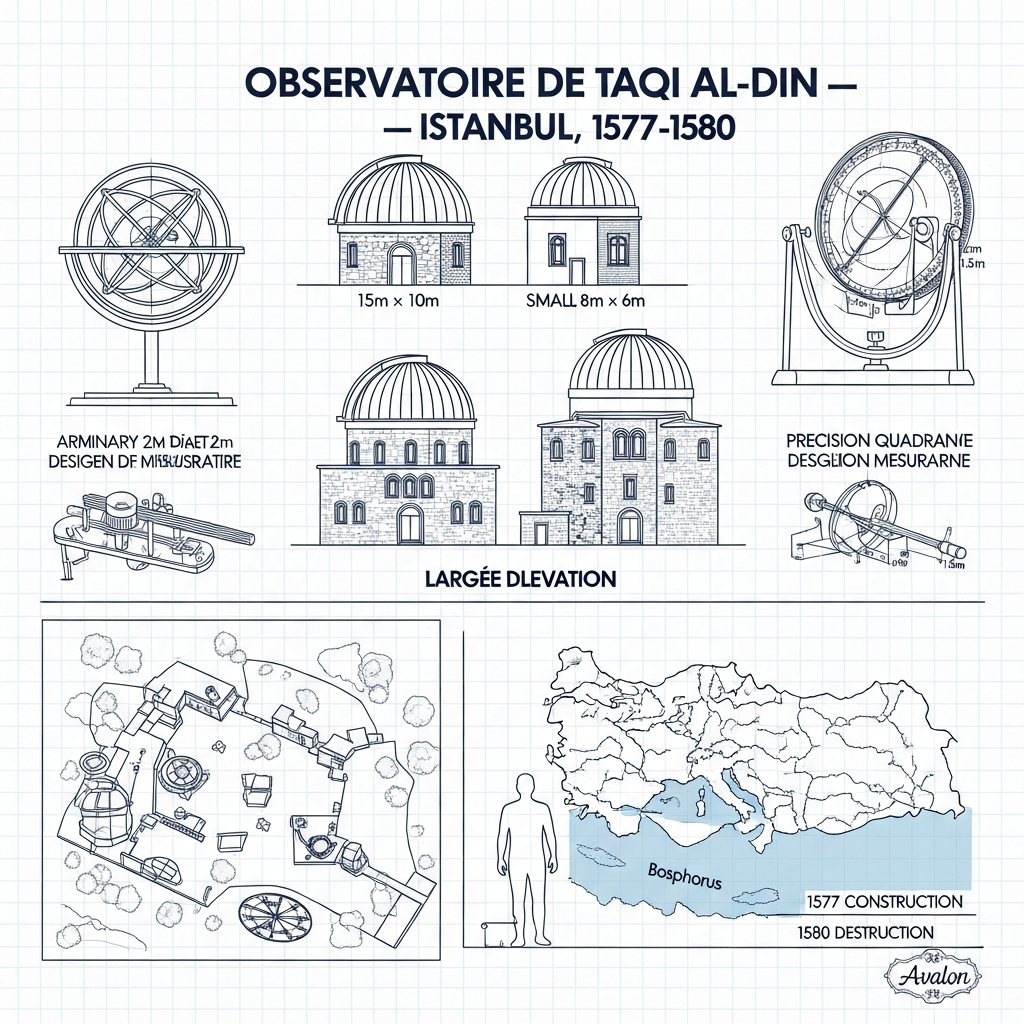
Taqi al-Din's observatory in Istanbul: rise and destruction of Ottoman astronomy.
Windows That Close: When the Early Modern Middle East Turned Away from Its Own Inventions
There are moments when history hesitates. When two paths open, equally possible, equally promising—and when a choice, sometimes invisible at the time, decides everything that follows. The Early Modern Middle East knew one of these moments. In 1577, an Ottoman astronomer was building in Istanbul an observatory as large as Tycho Brahe's in Denmark. Three years later, that observatory was destroyed on the order of religious authorities. This destruction was not an accident. It was the symptom of a deeper shift—the moment when a civilization that had for centuries been at the forefront of scientific thought began to close its windows on the world.
Yesterday — The Observatory and the Comet
In 1577, a comet with an immense tail crossed the skies of Europe and Asia. At Uraniborg, in Denmark, an astronomer named Tycho Brahe observed it with instruments of unequaled precision. In Istanbul, another astronomer, Taqi al-Din Muhammad ibn Ma'ruf, did the same from the observatory he had just completed in the Tophane quarter.
These two men did not know each other. They would never correspond. But they represented, each on their side, the summit of the astronomy of their era. And their fates would diverge spectacularly.
Taqi al-Din was no ordinary scholar. Born in 1526 in Damascus, he had studied mathematics, optics, mechanics, and astronomy before being called to Istanbul by Sultan Murad III. His work covered domains we today associate with computing and automation. In his treatise on "Sublime Methods of Spiritual Machines," he described automata, automatic fountains, hydraulic machines—and a rudimentary steam turbine that prefigured, by two centuries, the machines that would transform industrial Europe.
But his most remarkable innovation concerned the measurement of time. Taqi al-Din built an observation clock equipped with three dials—hours, minutes, seconds. This precision was revolutionary. At the beginning of the sixteenth century, clocks were not reliable enough to serve astronomy. Taqi al-Din changed that. He was the first astronomer to use an automatic mechanical clock for his observations, the first to employ decimal notation rather than the sexagesimal fractions inherited from the Babylonians. His calculations on solar movement are considered the most remarkable of his century.
The observatory he built in Istanbul matched these ambitions. Two buildings—one large, one small—equipped with armillary spheres, quadrants, measuring instruments designed by Taqi al-Din himself. The sultan, passionate about astronomy and astrology, had generously financed the project. Everything seemed in place for the Ottoman Empire to become a major center of the astronomical revolution beginning to take shape.
Then the comet appeared.
The sultan asked his astronomer for a prediction. Taqi al-Din, working day and night, studied the phenomenon and rendered his verdict: the comet was "an indication of well-being and splendor," an omen of "conquest of Persia." Instead, a devastating plague struck the empire. Several important figures died. The religious chief—the şeyhülislam—seized the opportunity. He issued a decree stating that countries possessing observatories were struck by catastrophes. In 1580, only three years after its completion, the Istanbul observatory was demolished.
Meanwhile, at Uraniborg, Tycho Brahe continued his observations. His data would later serve Kepler in formulating his laws of planetary motion. In 1609, Galileo would point his telescope at the sky, opening a new era of astronomy. Europe was embarking on the path of scientific revolution. The Ottoman Empire had just closed a window that would not reopen for a long time.
Today — Ink and Silence
The destruction of the Istanbul observatory was not an isolated event. It was part of a larger movement—growing mistrust of certain forms of knowledge, a tension between religious authorities and innovations coming from outside or questioning the established order.
Nowhere was this tension more visible than in the history of printing.
In 1493, Jewish refugees fleeing Spain established a Hebrew press in Istanbul. In the 1560s, Armenians did the same. These religious minorities were allowed to print in their own characters. But for Muslims, printing in Arabic characters remained forbidden—formally or informally, sometimes under penalty of death according to some sources—for more than two centuries.
The reasons for this prohibition remain debated. Some historians invoke the sacredness of Arabic writing, the medium of the Quranic text. Others point to the economic interests of Istanbul's roughly four thousand professional scribes, whose work consisted almost entirely of copying the Quran and religious texts. Still others mention the ulema's mistrust of a technology that would have allowed uncontrolled dissemination of ideas.
Whatever the cause, the result was the same: while printing transformed Europe—enabling the Reformation, the spread of science, mass literacy—the Ottoman world remained apart from this information revolution.
It was not until 1729 that a man named Ibrahim Muteferrika finally obtained permission to open a Muslim printing press. His journey was singular. Born in Transylvania to a Hungarian Unitarian family, converted to Islam, he became a diplomat and scholar who understood what the absence of printing was costing the empire. He negotiated for years with the grand vizier, the grand mufti, and religious authorities. The permission he finally obtained was carefully limited: he could print dictionaries, maps, scientific works—but not religious books. Istanbul's scribes retained their monopoly over the sacred text.
From 1729 to 1743, Muteferrika's press published seventeen works in twenty-three volumes. It was a beginning—but a late, timid, circumscribed beginning. The prohibition on printing religious books would not be lifted until 1803. Two hundred fifty years after Gutenberg, the Muslim world was only beginning to catch up.
This delay was not fatal in itself. Other innovations continued elsewhere. In Safavid Persia, craftsmen produced astrolabes of remarkable beauty and precision—a European mathematician who visited Isfahan in the late 1660s judged them "better and more accurate" than their Western equivalents. In Mughal India, Kashmiri metallurgists invented around 1590 a technique that modern experts long believed impossible: lost-wax casting of hollow, seamless celestial globes. These innovations testified to a scientific and technical vitality that had not entirely disappeared.
But something had changed. The overall momentum—that dynamic which had made the medieval Islamic world the center of global science—had reversed. Knowledge now flowed the other way. Mughal astronomers integrated European knowledge. Delhi nobles took interest in Descartes's philosophy. Persian astrolabes, however beautiful, perpetuated an ancient tradition rather than creating a new one.
Historians still debate the causes of what is sometimes called the "Great Divergence"—that moment when Europe gained a decisive lead over the rest of the world in scientific and technical matters. Some invoke economic factors: Atlantic trade, the influx of American gold. Others point to political factors: Europe's fragmentation into competing states, each seeking to attract scholars and develop new technologies. Still others emphasize institutional factors: European universities, royal academies, learned societies that created protected spaces for research.
What is certain is that choices matter. The destruction of the Istanbul observatory in 1580, the prohibition of printing for two hundred fifty years—these decisions were not inevitable. They were made by people, for reasons that seemed good to them at the time. They had consequences that are still measured today.
Beyond — What Closed Windows Teach Us
This history of the Early Modern Middle East resonates strangely with contemporary debates about artificial intelligence. For we may also be living through one of those moments when windows open or close—when apparently technical choices actually determine civilizational trajectories.
The first lesson concerns the relationship between innovation and institutions. Taqi al-Din had the skills, the instruments, the vision. What he lacked was an institutional environment capable of protecting his work from political and religious pressures. Uraniborg's observatory outlived its founder; Istanbul's was destroyed during its founder's lifetime. The difference lay not in the men, but in the structures surrounding them.
Contemporary artificial intelligence poses the same question in a different form. What institutions govern its development? Who decides what can be researched, published, deployed? AI laboratories today are concentrated in a small number of countries and companies. The data feeding the models comes overwhelmingly from Western English-speaking societies. The values encoded in these systems reflect the concerns of those who design them.
This concentration is not unlike what happened when Europe absorbed and "nationalized" medieval Islamic knowledge. The translations from Arabic to Latin, in the twelfth and thirteenth centuries, transferred to the West an immense corpus of knowledge—mathematics, astronomy, medicine, philosophy—that Europeans made their own, often forgetting their sources. Al-Khwarizmi's algorithm became the foundation of global computing, but how many computer scientists still know who al-Khwarizmi was?
The same phenomenon could recur with artificial intelligence. The systems we develop today are trained on data reflecting certain worldviews, certain languages, certain intellectual traditions. They will reproduce these biases on a planetary scale, presenting them as universal when they are particular. The windows that close are not only those preventing certain societies from producing knowledge. They are also those preventing certain knowledge from being recognized, integrated, transmitted.
The second lesson concerns the relationship between technology and power. Printing was forbidden in the Ottoman Empire because it threatened established interests—the scribes, certainly, but also all those whose power rested on controlling information. Artificial intelligence poses similar questions today. Who controls the models? Who decides their uses? Who benefits from their outputs and who bears the risks?
Debates about AI regulation sometimes strangely resemble those that must have surrounded the introduction of printing in the Middle East. Some want to slow down, regulate, limit—out of caution, concern to protect the existing order, mistrust of the unknown. Others want to accelerate, liberate, deploy—out of conviction that innovation is always beneficial, out of economic interest, out of competition with rivals who are not waiting. Between these two positions, balance is hard to find.
Yet the history of the Istanbul observatory suggests there are irreparable errors. Closing a window at the wrong moment can have consequences measured in centuries. The Islamic world never truly caught up with the lag it took in the exact sciences in the sixteenth century. The choices we make today about artificial intelligence—where to invest, what to regulate, whom to include—will perhaps shape the world for generations.
The third lesson, finally, concerns the diversity of intelligence's sources. The Early Modern Middle East was not a scientific desert. Scholars worked there, innovations were born there, traditions lived there. What was lacking was not talent, but the conditions for its flourishing. Persian astrolabes, Mughal globes, Taqi al-Din's clocks testify to what could have been—to paths not taken, to possibilities not realized.
The artificial intelligence we build today draws from a limited repertoire of intellectual traditions. It knows Aristotle better than Avicenna, Newton better than Taqi al-Din, Western formal logic better than other forms of reasoning developed elsewhere in the world. This limitation is not technical—it is historical, cultural, political. It reflects the power relations that have shaped the production and circulation of knowledge for five centuries.
Reopening closed windows would mean actively diversifying the sources of our collective intelligence. It would mean recognizing that algorithms have a history, that this history does not belong to a single continent, that forgotten or marginalized knowledge could enrich the systems we build. It would perhaps mean avoiding reproducing on a planetary scale the errors that cost the Early Modern Middle East so dearly.
In 1580, an observatory was destroyed in Istanbul. In 2025, we are building machines capable of simulating human intelligence. Between these two dates, windows have opened and closed, knowledge has circulated or been lost, civilizations have advanced or fallen behind. The history of intelligence is never written in advance. It depends on the choices we make—on the windows we decide to open or close.
Taqi al-Din had invented a clock with seconds and a steam turbine. These inventions could have changed the world. They did not—because a window closed at the wrong moment. We who build today's machines of the future would do well to remember this.