Africa
Illustrations
1 / 5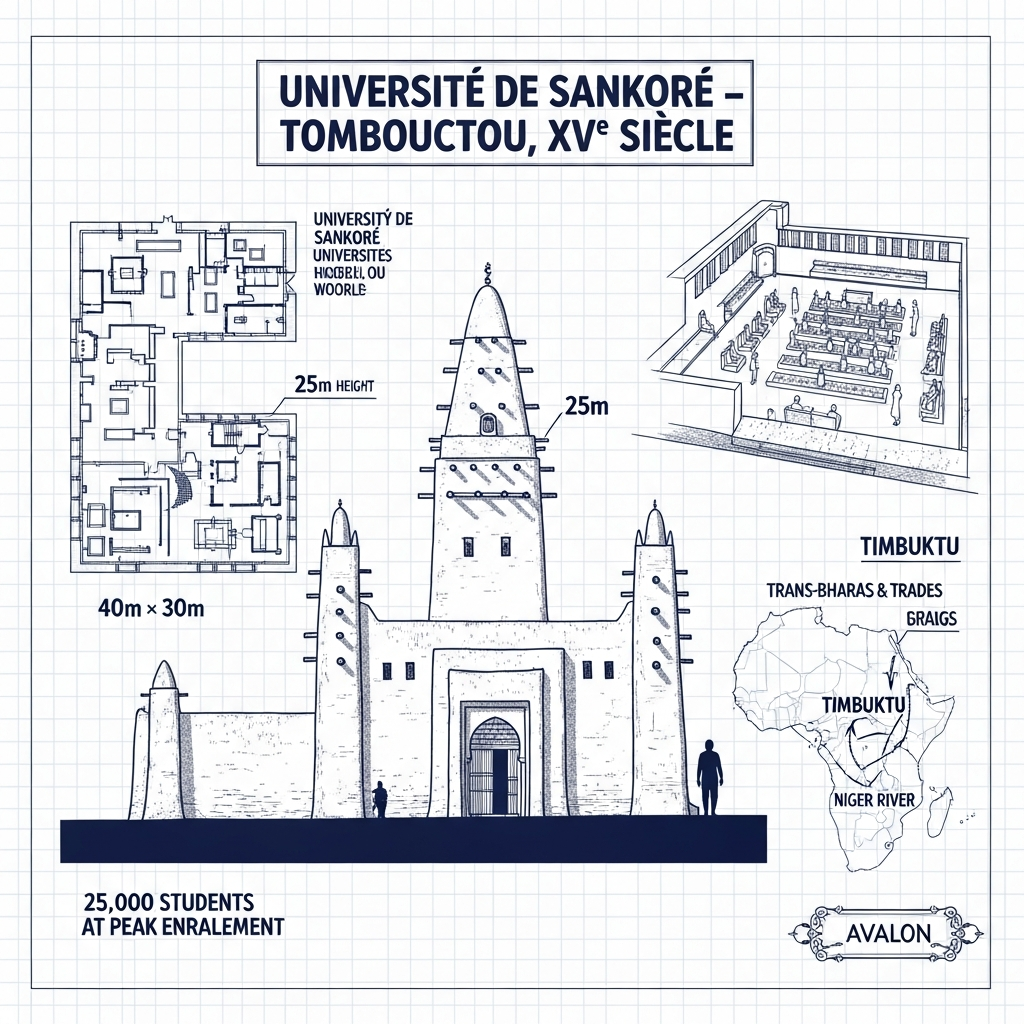
The University of Sankoré: rise and decline of a major African intellectual center.
Aquifers of Knowledge: When Early Modern Africa Irrigated the Foundations of Artificial Intelligence
Great ideas never spring from nowhere. They travel underground, across centuries and continents, before emerging where no one expected them. Like those aquifers that feed distant springs, certain African knowledge of the Early Modern period irrigated, through unsuspected channels, what we now call artificial intelligence.
Yesterday — The Learned Cities of the Forgotten Continent
In the sixteenth century, while Europe was barely emerging from the Middle Ages, a city in Mali shone upon the learned world. Timbuktu was not only a commercial crossroads where gold and salt passed through. It was a city of the mind, where people came to study from Egypt, Syria, the Maghreb.
The University of Sankore then welcomed thousands of students. They were taught Aristotelian logic, translated into Arabic. Philosophy was debated there. Treatises on mathematics covering arithmetic, geometry, and algebra were copied there. Professors trained their students in rhetoric and astronomy. Plato and Aristotle rubbed shoulders with Arab commentators in a curriculum of remarkable rigor.
Ahmed Baba embodies this intellectual effervescence. Born in 1556, the last chancellor of Sankore, he wrote more than forty works. His personal library contained sixteen hundred volumes—and this was, he complained, the most modest among those of his friends. When Moroccan troops invaded Timbuktu in 1591, they exiled him to Marrakesh with his manuscripts. Knowledge, even captive, continues to circulate.
Further south, in Yoruba lands, another system of thought had developed for centuries. Ifá was not merely a religious oracle. It was an intellectual architecture of stunning sophistication. Imagine a system organizing four hundred thirty thousand messages into two hundred fifty-six categories, each identified by a combination of eight binary symbols. A single line or a double line. Open or closed. One or zero.
This structure—four columns of two lines each, or eight binary positions producing two hundred fifty-six possible combinations—strangely resembles what our computers manipulate today. The priests of Ifá did not know it, but they had invented a form of information coding that prefigured computer logic.
Further east still, Ethiopia cultivated its own scholarly traditions. The Ethiopian calendar, with its mathematical regularity, testifies to ancient mastery of astronomical cycles. The chronicles of Emperor Gelawdewos, in the mid-sixteenth century, already mention sophisticated measuring systems. This knowledge, transmitted from generation to generation, formed fertile ground for abstract thought.
Seven hundred thousand manuscripts have been rediscovered in the libraries of the Malian desert. Seven hundred thousand witnesses to an intellectual tradition that official history long ignored.
Today — Underground Rivers of Thought
This knowledge did not disappear with the empires that housed it. It traveled by circuitous paths.
The German mathematician Gottfried Wilhelm Leibniz is generally credited with inventing binary arithmetic, that arithmetic of zero and one that makes our computers work. What is less well known is that Leibniz corresponded with Jesuit missionaries returning from China and Africa. These exchanges introduced him to thought systems where duality—open and closed, active and passive, present and absent—structured all knowledge.
Researcher Ron Eglash traced this intellectual lineage: from African binary systems like Ifá to Arab geomancy, then to European alchemy, and finally to Leibniz's own works. An aquifer that crossed three continents before emerging in Enlightenment philosophy.
Leibniz himself admired, in these systems, what he called a "profound binary logic" capable of representing the entire universe. He saw in it a metaphysical model as much as a mathematical one. Without knowing it, he was drawing from sources his European contemporaries scorned or ignored.
This underground transmission illuminates our present with a particular light. Modern artificial intelligence rests on successive layers of abstractions: electrical circuits that know only two states, algorithms that manipulate strings of zeros and ones, neural networks that calculate probabilities. At the base of this edifice, there is always this first intuition: that all information can be reduced to a series of binary choices.
The scholars of Timbuktu who taught formal logic, the Yoruba priests who organized their corpus into binary structures, the Ethiopian astronomers who calculated the cycles of time—all contributed, without knowing it, to a river of thought that would one day flow into the digital age.
We never build on virgin soil. Every foundation rests on other foundations, older, often invisible. Recognizing these strata does not diminish later accomplishments. It enriches them. It reminds us that humanity thinks together, across space and time, even when it does not know it.
Beyond — Toward an Ecology of Knowledge
Why does this genealogy matter for those interested in artificial intelligence today?
Because it decenters our gaze. We tend to tell the history of computing as a Western epic, born in American and British laboratories of the twentieth century. This vision is true, but partial. It forgets the aquifers that have fed these laboratories for centuries and from entire continents.
The Ifá corpus, with its four hundred thirty thousand hierarchically organized messages, prefigures our databases. The philosophical debates at Sankore, where arguments were refined through confrontation of ideas, announce our problem-solving methods. The tradition of commentary, where each generation enriches previous texts, strangely resembles the way machine learning systems accumulate and refine knowledge.
These parallels are not coincidences. They reveal constants of human intelligence grappling with the complexity of the world. Everywhere societies have sought to organize information, predict the future, transmit knowledge, they have invented structures that echo each other across oceans and centuries.
UNESCO recognized the Ifá system as intangible heritage of humanity. This belated recognition points toward a broader requirement: that of an ecology of knowledge where the contributions of all traditions would find their place.
The artificial intelligence we develop today inherits this long history, whether it knows it or not. Its algorithms bear the trace of thinkers who never saw a computer. Its logical structures extend intuitions born in the courts of Timbuktu or under the sacred trees of Yoruba country.
We are heirs to conversations we did not hear, libraries we did not visit, traditions we still struggle to recognize. The future of intelligence—whether human or artificial—will be built on the memory of all this buried knowledge.
Aquifers always end up finding their spring.