The Americas
Illustrations
1 / 5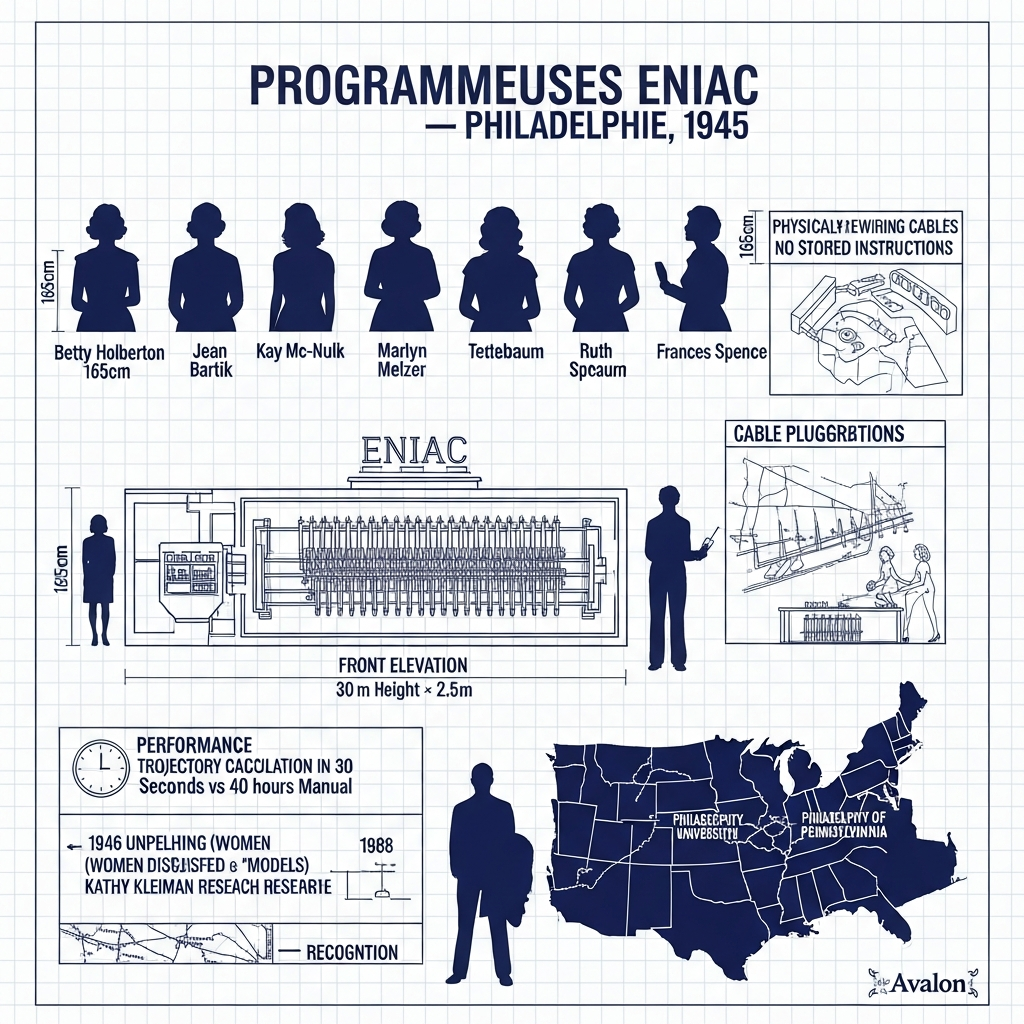
The six ENIAC programmers (1945): forgotten pioneers of computing.
The Forge and Forgetting — Version 2
The Americas and the Foundations of Artificial Intelligence (1945-2010)
The Cycles of AI: Summers of Hope, Winters of Disillusion
Yesterday — Birth and First Promises
Great inventions have no fathers. They have mothers—and those mothers, too often, are erased.
In February 1946, the U.S. Army presented its new marvel to the press: ENIAC, America's first electronic computer. The machine filled an entire room, weighed thirty tons, consumed as much electricity as a small neighborhood. Journalists were dazzled. Officers were named, congratulated, photographed. In the background of the images, six women manipulated cables and switches. No one introduced them. No one asked their names.
These six women—Betty Holberton, Jean Bartik, Kay McNulty, Marlyn Meltzer, Ruth Teitelbaum, Frances Spence—had accomplished what no one had ever done: translating complex mathematical equations into instructions a machine could execute. There was no manual. No precedent. They had to understand the machine's architecture by studying the engineers' blueprints, then invent programming as they went. Decades later, when a researcher named Kathy Kleiman inquired about the identity of the women in ENIAC's historical photos, she was told: "They're models."
They were not models. They were trained mathematicians. Betty Holberton invented breakpoints for debugging. She designed the numeric keypad. She persuaded engineers to replace computers' black exterior with the beige-gray that became the universal color of machines. But her name, for fifty years, was erased.
Grace Hopper, a Yale doctorate in mathematics, rear admiral in the U.S. Navy, invented the first compiler in 1952—the program that translates human instructions into machine language. She participated in creating COBOL. She popularized the term "debugging." Her genius eventually gained recognition—but how many others never received that second chance?
Katherine Johnson, Dorothy Vaughan, Mary Jackson—the Black "computers" at NASA, working in offices labeled "Colored Computers"—calculated rocket trajectories by hand. In 1962, John Glenn refused to board his space capsule before Katherine Johnson had personally verified the computer's calculations. He distrusted the machine. He trusted the woman.
The American forge produced wonders. It also erased the names of those who held the bellows.
The Founding Summer: Dartmouth and the Birth of AI (1956)
In the hills of New Hampshire, in the summer of 1956, another foundation was being laid—with less discretion and more arrogance.
Dartmouth College hosted for eight weeks a group of mathematicians, engineers, and theorists. John McCarthy, Marvin Minsky, Claude Shannon, Nathaniel Rochester had obtained a grant from the Rockefeller Foundation to explore an audacious idea. In their proposal, dated September 2, 1955, they had written a sentence that would define an entire field: "Every aspect of learning or any other feature of intelligence can in principle be so precisely described that a machine can be made to simulate it."
They called their project "artificial intelligence"—the term appeared for the first time. The conference produced no spectacular concrete result. But it gave birth to a community, an ambition, a vocabulary. More importantly: it defined a research program that would structure the coming decades.
Allen Newell and Herbert Simon presented Logic Theorist, a program capable of proving mathematical theorems. Arthur Samuel discussed his checkers-playing program that could learn from its mistakes—one of the first examples of machine learning. The participants left convinced that artificial general intelligence was within reach. A few decades, perhaps less.
This conviction—this arrogance, some would say—would shape the first "summer" of artificial intelligence.
The Golden Age of Academic Research (1956-1973)
In the years following Dartmouth, artificial intelligence became a recognized, funded, institutionalized field. Laboratories opened at MIT, Stanford, Carnegie Mellon. The American government, through ARPA—ancestor of DARPA—poured millions of dollars into these laboratories. The director of the Information Processing Techniques Office, J.C.R. Licklider, funded the most promising projects without worrying too much about their immediate military applications. It was the era of fundamental research, of unconstrained exploration.
The results were remarkable.
In 1966, Joseph Weizenbaum, a German-American computer scientist at MIT, created ELIZA—the first program explicitly designed to converse with humans. ELIZA simulated a Rogerian psychotherapist, reformulating the user's questions as new questions. The program had no real understanding of language. It operated through pattern recognition and word substitution. Yet users were astonished. Some asked to be alone with the machine to confide their secrets. Weizenbaum's own secretary demanded privacy to "talk" to ELIZA.
Weizenbaum was shocked. He had created an illusion—and people believed it. He named this phenomenon the "ELIZA effect": the human tendency to attribute intelligence and empathy to machines that possess neither. Later, he became one of artificial intelligence's most virulent critics, publishing in 1976 Computer Power and Human Reason, a warning about the dangers of machine thinking.
Between 1966 and 1972, the Stanford Research Institute developed Shakey—the first mobile robot capable of reasoning about its own actions. Unlike previous robots, which had to be programmed for each specific task, Shakey could receive a general objective and determine the steps to achieve it on its own. The robot stood two meters tall, moved on wheels, and carried an antenna, a camera, sonars, and "whiskers" to detect obstacles.
In 1969, the New York Times devoted an article to Shakey. In 1970, Life Magazine called it "the first electronic person." The project, funded by DARPA, spawned innovations that extended far beyond robotics: the A* algorithm for pathfinding, the Hough transform for image analysis, the STRIPS planner that remains a reference in artificial intelligence.
Marvin Minsky received the Turing Award in 1969 for his pioneering work. Artificial intelligence seemed on the verge of revolutionizing everything. Herbert Simon had predicted in 1965 that "within twenty years, machines will be capable of doing any work a man can do." Minsky had declared in 1967 that "within a generation, the problem of creating artificial intelligence will be substantially solved."
These predictions would prove spectacularly wrong.
The First Winter: The Fall of Illusions (1974-1980)
The initial arrogance contained the seeds of a fall.
In 1969, the U.S. Congress adopted the Mansfield Amendment, which required DARPA to fund only "mission-oriented" research rather than basic research. The message was clear: Pentagon money had to produce tangible military results, not philosopher robots. Artificial intelligence researchers found themselves forced to justify their work through concrete applications—a demand many could not meet.
In 1973, the coup de grâce came from across the Atlantic. Professor Sir James Lighthill, commissioned by the British Parliament, published a devastating report on the state of artificial intelligence. His verdict: "complete failure to achieve its grandiose objectives." The fundamental problem, according to Lighthill, was "combinatorial explosion"—the fact that AI algorithms worked on simple examples but collapsed when faced with the complexity of the real world.
The Lighthill Report led to the near-total dismantling of AI research in the United Kingdom. In the United States, the effects were almost as devastating. DARPA funding for artificial intelligence became difficult to obtain. Laboratories closed. Doctoral programs were reduced. Researchers changed fields.
The term "artificial intelligence" itself became toxic. Researchers who wanted funding preferred to speak of "computer science," "computational intelligence," "knowledge systems"—anything but the cursed phrase. It was the first "AI winter": a period of freeze when research barely survived, kept alive by a few stubborn laboratories and residual funding.
The book Perceptrons, published in 1969 by Minsky and Seymour Papert, finished killing a promising approach: artificial neural networks. By demonstrating the theoretical limitations of perceptrons—a simple form of neural network—Minsky and Papert discouraged an entire generation of researchers. Neural networks would not return for decades.
The winter lasted six years.
Today — Cycles of Hope and Disenchantment
The Second Summer: Expert Systems (1980-1987)
In the early 1980s, artificial intelligence experienced an unexpected renaissance. The cause: expert systems.
An expert system is a computer program that encodes a human specialist's knowledge in the form of rules. "If the patient has fever AND red spots, then consider measles." Hundreds, thousands of such rules, organized into knowledge bases, allowed the machine to "reason" like an expert.
The first significant expert system, DENDRAL, had been developed at Stanford as early as 1965 to help chemists identify organic molecules. In the 1970s, MYCIN, also developed at Stanford, was designed to diagnose infectious diseases and recommend treatments. MYCIN achieved a success rate of sixty-nine percent—better than many human doctors. Yet it was never used in clinical practice, notably for legal reasons: who would be responsible in case of a diagnostic error?
The real commercial success came with XCON, developed at Carnegie Mellon for Digital Equipment Corporation. XCON automated the configuration of VAX computer systems—a complex task that had previously required human experts. The system contained more than two thousand rules and saved DEC over forty million dollars per year.
Industry caught fire. In 1983, DARPA launched the Strategic Computing Initiative with promises of direct military applications: expert systems for battle planning, natural language understanding, computer vision. The budget reached hundreds of millions of dollars. In the United Kingdom, the Alvey project revived AI research with three hundred fifty million pounds. In Japan, the Fifth Generation Computer Systems project aimed to create revolutionary computers based on logic programming.
Companies specializing in "Lisp machines"—computers optimized for artificial intelligence—thrived. Symbolics, Lisp Machines Inc., Texas Instruments sold dedicated hardware at astronomical prices. The AI industry represented a billion-dollar market.
In 1984, at the annual meeting of the American Association for Artificial Intelligence, two of the pioneers—Roger Schank and Marvin Minsky himself—issued a prophetic warning: enthusiasm was out of control, disappointment would inevitably follow.
Three years later, the prophecy came true.
The Other Americas: Parallel Forges
While the United States went through its cycles of hope and disillusion, other forges were being lit elsewhere in the Americas—and some were forcibly extinguished.
On June 8, 1958, Mexico received its first computer. UNAM—the National Autonomous University of Mexico—had acquired an IBM-650, a used machine from UCLA. The more modern IBM-709 was too expensive. The founding team—Rector Nabor Carrillo, mathematician Carlos Graef, engineer Sergio Beltrán López—wanted to solve equations for Mexico City's soil mechanics, a city built on an ancient lake whose subsoil posed unique engineering problems. In 1965, Mexico created Latin America's first master's program in computer science.
In Argentina, the University of Buenos Aires installed "Clementina," its first scientific computer, at the Computing Institute. A team led by Professor Wilfred Durán developed ComIC, the first Argentine programming language. The team was composed of women: Clarisa Cortes, Cristina Zoltán, Liana Lew, Noemí García. In the 1960s, Argentina had its own female computing pioneers—names that history has forgotten.
In Brazil, the government adopted an innovation policy in 1972 to develop a national computer industry. In 1974, a commission was created to regulate computer imports and protect local manufacturers. The result was spectacular: in 1982, sixty-seven percent of computers installed in Brazil were manufactured domestically. American giants—IBM, Hewlett-Packard, Burroughs—had been kept at bay.
But the most audacious experiment—and the most tragic—took place in Chile.
In 1970, Salvador Allende was elected president of Chile on a socialist platform. His government undertook to nationalize major enterprises. But how to manage a nationalized economy with the means of the time? Fernando Flores, a young engineer working for the state development agency, wrote a letter to British cyberneticist Stafford Beer. He proposed that Beer come to Chile to build something that had never existed: a computer system to manage the national economy in real time.
Beer accepted. The project was called Cybersyn—a contraction of "cybernetics" and "synergy." The challenge was immense: only about fifty computers existed in all of Chile, and IBM had reduced its operations for fear of being nationalized. The solution was ingenious: connect a single obsolete computer to several hundred telex machines scattered across nationalized factories. Each day, factory directors sent their production data by telex. The central system analyzed the information and flagged anomalies.
At the heart of the project was a futuristic operations room: hexagonal, with seven fiberglass armchairs facing wall screens, control buttons integrated into the armrests. The objective was not to centralize power, but to decentralize it: to enable factory workers to make informed decisions, to develop the economy's self-regulation. In 2003, The Guardian called Cybersyn "a sort of socialist Internet, decades ahead of its time."
On September 11, 1973, a military coup overthrew Allende. Cybersyn's operations room was destroyed. Fernando Flores was imprisoned for three years. Stafford Beer returned to England. The project that could have shown that another kind of computing was possible—decentralized, serving workers, designed in the Global South—was erased from history.
Cuba, subjected to the American embargo since 1962, met a different but equally isolating fate. Possession of computer equipment was prohibited there until 2008. Mobile Internet was not authorized until 2018. An entire country, excluded from the digital revolution by geopolitical decision.
These parallel stories reveal another face of digital Americas. While Silicon Valley celebrated its garages and billionaires, Mexico trained computer scientists, Argentina created its own programming languages, Brazil protected its industry, Chile dreamed of cybernetics serving the people. Some of these forges were extinguished by force. Others burned out on their own. All deserve to be remembered.
The Second Winter: The Collapse of Expert Systems (1987-1993)
The Lisp machine market collapsed almost overnight. Apple and Sun Microsystems had launched general-purpose workstations as powerful as specialized machines, but at a fraction of the price. Why buy a Symbolics computer for one hundred thousand dollars when a Sun workstation at ten thousand did the same job?
Expert systems revealed their limitations. They were expensive to maintain—every time the world changed, hundreds of rules had to be manually updated. They were rigid—unable to adapt to unforeseen situations. They only worked in very narrow domains. MYCIN diagnosed infections but knew nothing about cardiology. XCON configured VAX computers but not other machines.
The Japanese Fifth Generation project, launched with such fanfare in 1982, was declared complete in 1992 without having achieved its objectives. The New York Times headlined: "Fifth Generation Became Japan's Lost Generation." The industry had evolved so rapidly that the technological path chosen in 1982 was obsolete ten years later.
DARPA, under Jack Schwarz's direction, cut AI project funding, calling expert systems "clever programming" rather than true intelligence. The Strategic Computing Initiative was abandoned.
The second winter was harsher than the first. Because it followed a period of intense hope. The promises had been greater. The disappointment was proportional.
For nearly a decade, the term "artificial intelligence" once again became cursed. Surviving researchers took refuge in niches: speech recognition, computer vision, robotics. They carefully avoided uttering the forbidden words.
Embers Beneath the Ash (1993-2006)
Artificial intelligence did not die during the second winter. It mutated.
In 1997, an event captured the world's attention. Deep Blue, a supercomputer designed by IBM, faced Garry Kasparov, the world chess champion, in a six-game match. Kasparov had beaten an earlier version of Deep Blue in 1996. This time, the machine won three and a half games to two and a half.
On May 11, 1997, when Deep Blue won the sixth game in nineteen moves, Kasparov rose from the table, stunned. It was the first time a computer had beaten a world chess champion under tournament conditions. Kasparov himself had said that chess was "the ultimate test of machine intelligence." The machine had passed the test.
Deep Blue was not artificial intelligence in the classical sense. The machine did not "think." It analyzed two hundred million positions per second, using brute force rather than understanding. But for the general public, the distinction mattered little. A machine had beaten the best human brain at the most intellectual game there is.
IBM retired Deep Blue after its victory and sent it to the Smithsonian Museum. The machine became a relic—the symbol of a bygone era when people believed raw computing power could simulate intelligence. IBM turned to other projects: Blue Gene for scientific computing, then Watson for natural language understanding.
Meanwhile, other forms of artificial intelligence were emerging quietly. Google, founded in 1998 by two Stanford doctoral students, used machine learning to improve its search results. Amazon developed recommendation algorithms. Netflix predicted user tastes. These systems were not called "artificial intelligence"—the term remained toxic. They were called "machine learning," "data mining," "predictive analytics."
In 2004, Google introduced an advertising engine capable of targeting ads based on page content and user searches. This innovation—machine learning applied to advertising—would fund the company's rise and give it the resources to invest massively in research.
Microsoft, for its part, developed speech recognition and machine translation tools. In 1998, the company founded Microsoft Research China—which would train a generation of Chinese artificial intelligence researchers.
Embers smoldered beneath the ash. The renaissance was approaching.
The Third Summer: The Deep Learning Revolution (2006-2010)
Geoffrey Hinton had never stopped believing in neural networks.
Born in England, settled in Canada because American funding had dried up, Hinton had worked on neural networks since the 1980s—at a time when almost everyone had abandoned them after the Perceptrons book. In 1986, with David Rumelhart and Ronald Williams, he had published a foundational paper on backpropagation—a mathematical technique enabling the training of multi-layered neural networks.
But computers of the time were not powerful enough to exploit this technique. Neural networks remained an academic curiosity.
In 2006, Hinton published a paper showing how to train "deep" neural networks—with many layers—by pre-training them layer by layer. This technique, called "deep belief networks," opened a new path. The following year, Fei-Fei Li, a researcher born in China who arrived in the United States at sixteen, began building ImageNet—a database of twelve million images classified into twenty-two thousand categories.
In 2009, when Li presented ImageNet at a Miami Beach conference, no one was interested. Her poster was relegated to a corner. The scientific community did not believe that more data would improve models.
Three years later, in 2012, Hinton and his students Alex Krizhevsky and Ilya Sutskever entered a deep neural network in the image recognition competition organized around ImageNet. Their system, AlexNet, achieved an error rate half that of the best competitor. The victory was so crushing it left no doubt: deep learning worked.
That moment—often called the "Big Bang" of modern artificial intelligence—marked the beginning of the third summer. This time, conditions were different. Graphics processing units (GPUs), developed for video games, offered massive computing power at low cost. The Internet had generated astronomical amounts of data. Tech giants—Google, Microsoft, Facebook, Amazon—had the resources to invest heavily in research.
In 2013, Google acquired a British startup named DeepMind for over five hundred million dollars. In 2014, Facebook recruited Yann LeCun, a French researcher who had developed convolutional networks in the 1980s. Microsoft intensified its speech recognition and translation research.
The third summer of artificial intelligence had begun. This time, perhaps, it would not end in winter.
Beyond — Lessons from the Cycles
The history of artificial intelligence in the United States is a history of cycles—summers of hope followed by winters of disillusion. Each summer produced remarkable innovations: ELIZA and Shakey in the 1960s, expert systems in the 1980s, deep learning in the 2010s. Each winter killed careers, closed laboratories, discouraged a generation of researchers.
These cycles follow a recurring pattern. First, a technical breakthrough generates enthusiasm. The media gets excited. Investors flood in. Promises become excessive. Then the gap between promises and reality becomes too great. Systems do not do what was expected of them. Skepticism sets in. Funding collapses.
But each cycle leaves a legacy. The first summer produced the theoretical foundations of artificial intelligence and trained a generation of researchers. The second summer showed that AI could have commercial applications, however limited. The third summer demonstrated the power of learning from data.
And each winter taught humility. Machines do not "think" like us. Human intelligence cannot be reduced to a set of rules. The complexity of the real world always exceeds the simplified models of laboratories.
The American history of artificial intelligence is also a history of forgetting. The six women of ENIAC, erased for fifty years. The Black "computers" of NASA, relegated to segregated offices. The Argentine pioneers of ComIC—Clarisa Cortes, Cristina Zoltán, Liana Lew, Noemí García—long ignored by official history. The Cybersyn project, destroyed by a coup d'état and forgotten for decades. Fernando Flores, imprisoned for dreaming of computing that served workers.
In Canada, from the late nineteenth century until 1996, the federal government operated residential schools for Indigenous children. The explicit objective: "to kill the Indian in the child." At least one hundred fifty thousand children were torn from their families. More than four thousand deaths have been documented. Since 2021, more than thirteen hundred unmarked graves have been discovered. What the residential schools destroyed was not only lives. It was knowledge systems, languages, ways of thinking about the world.
Today, the divide persists. In Latin America, sixty-seven percent of households have Internet access, compared to ninety-one percent in OECD countries. In rural areas, that figure drops to thirty-seven percent. Indigenous peoples, the very ones whose ancestors were sent to residential schools, are among the least connected. The technology that was created on their soil did not include them.
America forged artificial intelligence. It also forged forgetting.
The three "godfathers of AI"—Geoffrey Hinton, Yoshua Bengio, Yann LeCun—who received the Turing Award in 2018, are not all American. Hinton is British, based in Canada. Bengio was born in France to Moroccan parents. LeCun is French. Fei-Fei Li, the "godmother of AI," was born in China. American artificial intelligence is a story of immigration—and that story is rarely told.
In 2024, Hinton received the Nobel Prize in Physics for his work on neural networks. The same year, he left Google so he could speak freely about the dangers of artificial intelligence. After a lifetime spent developing these technologies, he was now warning humanity of their risks.
The history of artificial intelligence is not over. A fourth winter may yet come. Or perhaps this time, conditions are truly different. Data is infinite. Computing power continues to grow. Commercial applications generate profits that fund research.
What is certain is that the future of artificial intelligence will depend on our ability to learn from past cycles. To moderate our expectations without abandoning our ambitions. To recognize the contributions of those who were forgotten. To remember that machines, however intelligent, are only tools—and that it is up to us to decide what they will be used for.
The American forge produced wonders and forgetting. The artificial intelligence we are building today bears the imprint of this dual history. It speaks English better than any other language. It recognizes some faces better than others. It reflects the data on which it was trained—and that data reflects the world that created it.
Understanding this history is not a matter of guilt. It is a matter of lucidity. The cycles will continue. Summers will return. So will winters. What matters is what we learn—and what we choose not to forget.