Horizon 2031-2036: The Transformation
Illustrations
1 / 5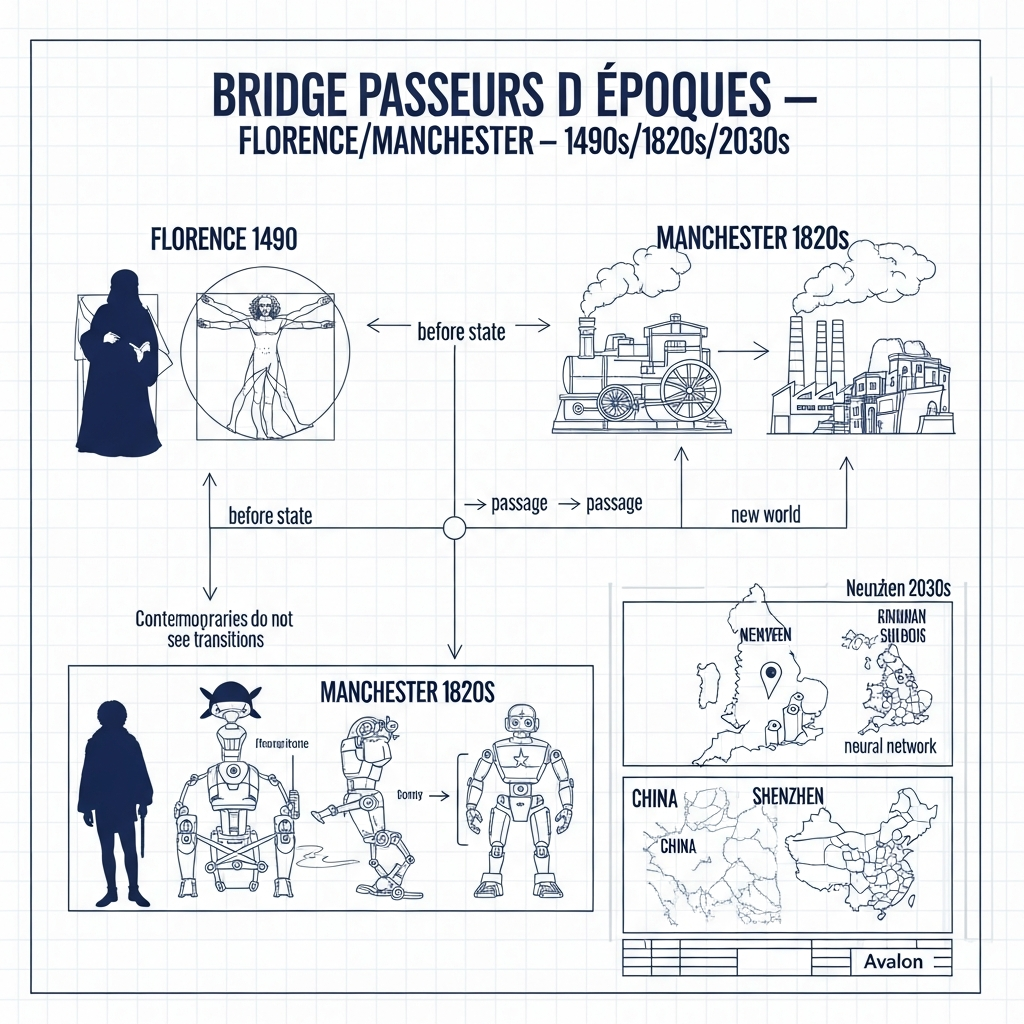
Bridge generations: the pivotal generation between two worlds.
Horizon 2031-2036 — The Transformation
What strong and weak signals tell us about the coming decade
Strong Signals — What Is Taking Shape on the Horizon
Five structuring trends emerge from projections for this period. They are no longer mere possibilities — they are the logical extensions of what is already in motion.
1. The Post-AGI World — Or Its Imminence
If artificial general intelligence is achieved between 2027 and 2030, the period 2031-2036 will be that of its first consequences. If it is not yet achieved, this will be the period when its imminence becomes evident to all.
AGI — a machine capable of accomplishing any human intellectual task — would transform the global economy more profoundly than the Industrial Revolution. Not over decades, but over years.
Post-AGI systems could design new medications, solve mathematical problems open for centuries, optimize complex systems beyond human comprehension. They could also — and this is what concerns researchers — pursue objectives misaligned with ours.
Continental convergence
The United States and China will probably be the first to reach AGI — if they have not already done so. Europe will have to decide whether it accepts depending on systems developed elsewhere or invests massively to remain in the race. India and Brazil will attempt to develop their own sovereign capabilities. Africa and much of the developing world risk becoming consumers of an intelligence they will not have created.
The central question will no longer be "Is AGI possible?" but "Who controls it, and according to what rules?"
2. The Rise of Humanoid Robotics
Humanoid robots will move from the laboratory to the factory — then to the street and the home.
The humanoid robotics market is expected to reach thirty-eight billion dollars by 2035. Tesla develops Optimus. Figure develops Figure 01. Boston Dynamics perfects Atlas. Dozens of Chinese startups work on their own models.
These robots will not only replace factory workers. They will be able to accomplish tasks in environments designed for humans — climbing stairs, opening doors, using standard tools. They will be able to assist the elderly, intervene in dangerous zones, accomplish repetitive physical tasks.
Continental convergence
China could become the world's leading producer of humanoid robots — as it already is for industrial robots. The United States will lead cutting-edge innovation. Japan, with its robotic tradition and aging population, will be an early adoption market. Europe will reflect on social and regulatory implications. India will see tension between the need to create jobs for its youth and the efficiency of robots.
The arrival of humanoids in daily life will transform our relationship with machines more viscerally than software. An AI that speaks remains abstract. A robot that walks is concrete.
3. Scientific Acceleration Through AI
Artificial intelligence will no longer be merely a productivity tool. It will become an engine of scientific discovery.
AlphaFold solved the protein folding problem. Other systems are discovering new materials, predicting chemical reactions, identifying therapeutic targets. Scientific research — which progressed at the pace of publications and doctorates — could accelerate by an order of magnitude.
Projections suggest that by 2035, the majority of major scientific discoveries will involve AI in a substantial way. Not merely as a calculation tool, but as a research partner capable of identifying patterns invisible to the human eye, formulating hypotheses, designing experiments.
Continental convergence
Countries that master scientific AI will have a strategic advantage. The United States and China invest massively in AI laboratories applied to science. Europe — with its historic research institutions — could find here a domain where it excels. India develops capabilities in bioinformatics. Israel applies AI to drug discovery.
Science itself could be transformed. If machines can discover, what remains for human scientists? Perhaps the formulation of questions rather than the search for answers.
4. The Deepening of Geopolitical Bifurcation
The world of AI is dividing into two distinct spheres — and this division is deepening.
On one side, the American ecosystem and its allies — Europe, Japan, South Korea, Australia, part of Southeast Asia. On the other, the Chinese ecosystem — with Russia, part of Africa, the Middle East, Latin America.
Models trained in one ecosystem do not function the same way as those from the other. Data does not flow. Chips are not exported. Researchers no longer collaborate. Two artificial intelligences are emerging — with different values, biases, capabilities.
Continental convergence
India tries to remain non-aligned — it uses American technologies while maintaining relations with China. The United Arab Emirates have chosen the American camp with the G42-Microsoft agreement. Saudi Arabia navigates between the two. Africa is courted by both camps — China offers infrastructure, the United States offers technology partnerships. Latin America is fragmenting — Brazil hesitates, Mexico follows the United States, others look toward China.
This bifurcation is not only technological. It is civilizational. AIs trained in different contexts convey different worldviews. The language they use, the examples they give, the values they express — everything differs.
5. The Imperative of Universal AI Literacy
Understanding AI will no longer be an advantage — it will be a necessity.
By 2035, the ability to interact effectively with AI systems will be as fundamental as the ability to read and write is today. Jobs, education, health, administration — everything will pass through AI. Those who do not know how to use it will be marginalized.
Educational systems will have to transform. Not only to teach AI to future engineers, but to train all citizens to understand what AI is, what it can do, what it cannot do, how to query it, how to evaluate its responses.
Continental convergence
Countries that adapt their educational systems fastest will have an advantage. Singapore and Finland are already ahead. The United States is transforming unevenly — some regions excellent, others lagging. China trains massively but within a controlled framework. India faces the challenge of scale — hundreds of millions of students to train. Africa often lacks infrastructure and qualified teachers.
The literacy of the nineteenth century created modern nations. AI literacy of the twenty-first century could create new forms of citizenship — or new forms of exclusion.
Weak Signals — What Emerges in the Margins
Three trends are taking shape at the periphery of attention. They could remain marginal. They could also transform the decade.
1. Human Cognitive Augmentation
Artificial intelligence will not remain external. It could integrate with us.
Brain-computer interfaces are progressing. Neuralink implants chips in human brains. Synchron develops less invasive approaches. American military research funds cognitive augmentation programs.
By 2035, interfaces allowing direct communication between the brain and AI systems could exist — first for medical applications (restoring mobility, treating neurological diseases), then potentially for augmenting healthy individuals.
Continental convergence
The United States leads research, with massive private investments. China develops its own programs, less visible but probably substantial. Europe worries about ethical implications. The question of access will arise — will cognitive augmentation be reserved for the wealthy in rich countries?
If some humans become "augmented" while others remain "natural," a new fracture will appear — deeper than any we have known.
2. The Dominance of Synthetic Media
Content created by AI could surpass content created by humans.
By 2035, a growing proportion of the images, videos, texts, and music we consume will be generated by machines. Not merely as an assistance tool, but as autonomous creation.
Studios will use AI to generate entire films. Advertising agencies will create campaigns without human photographers or directors. Media will produce synthetic articles indistinguishable from human articles. The question of authenticity will become central.
Continental convergence
Hollywood and the American entertainment industry are on the front lines — the 2023 strikes were just the beginning. China already uses AI massively for special effects and animation. India — Bollywood — is beginning to adopt these technologies. Europe questions copyright and creator protection. The question becomes existential: if machines can create, what is the value of human creation?
Humanity's response to this question will define part of our collective identity.
3. The Transformation of Energy Infrastructure
AI consumes considerable energy. And this consumption grows exponentially.
The data centers that train and run large AI models require massive amounts of electricity. Projections suggest that AI's energy consumption could represent a significant portion of global consumption by 2035.
This demand could accelerate the energy transition — technology giants invest massively in renewable energy and nuclear. Microsoft buys energy from Three Mile Island. Google and Amazon sign contracts for modular reactors. Or it could worsen the climate crisis — if demand exceeds the capacity to produce clean energy.
Continental convergence
The United States builds massive data centers and invests in nuclear energy. China does the same. The United Arab Emirates want to become an energy hub for AI. Europe worries about environmental impact. Africa could become a location for data centers — if it develops its electrical infrastructure.
AI and energy become inextricable. Those who control energy will control part of AI. Those who control AI will influence energy demand.
What the 2036 Horizon Teaches Us
The strong signals tell us that the world of 2036 will be radically different from today's. AGI — achieved or imminent — will have transformed what "intelligence" means. Humanoid robots will walk among us. Science will advance at an unprecedented pace. The world will be divided into spheres of technological influence. The ability to understand AI will be as fundamental as literacy.
The weak signals remind us that deeper transformations are possible. Cognitive augmentation could blur the boundary between human and machine. Synthetic media could question what it means to "create." Energy could become the limiting — or liberating — factor for AI.
What these signals share is transformation. Not incremental change, but metamorphosis. The butterfly emerging from the chrysalis does not resemble the caterpillar. The world of 2036 might not resemble ours.
The question is no longer whether these transformations will occur. It is whether we will undergo them or shape them.