Europe
Illustrations
1 / 5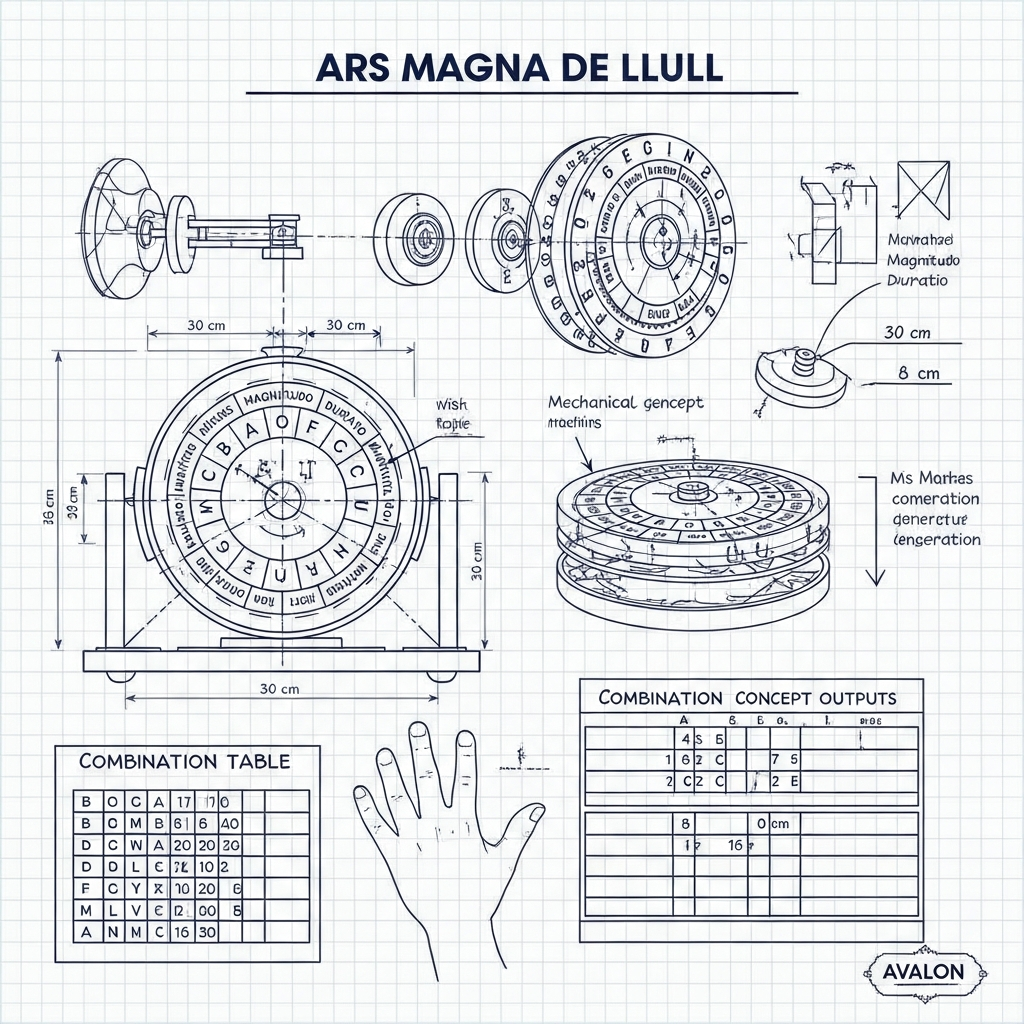
Ramon Llull's Ars Magna: first reasoning machine, ancestor of artificial intelligence.
Wheels of Reason: How Medieval Europe Built the First Thinking Machines
A wheel can transmit movement or transform it. It can also, if conceived with enough ingenuity, reproduce the ballet of planets in the sky—or the workings of thought in a mind. In the Middle Ages, Europe invented both: clocks capable of simulating the cosmos, and methods capable of formalizing reasoning. These wheels—some in bronze, others in syllogisms—constitute the forgotten foundations of what we now call artificial intelligence.
Yesterday — The Ars Magna and the Talking Heads
On the island of Majorca, around 1275, a former knight turned hermit conceived a strange machine. Ramon Llull was neither clockmaker nor blacksmith. He was a philosopher obsessed with an idea: proving the truth of the Christian faith to any interlocutor, regardless of their language or religion. To do this, he invented the Art—a system of concentric disks bearing letters and symbols, which could be rotated to generate combinations of concepts.
Llull's Art rested on nine fundamental principles—goodness, greatness, duration, power, wisdom, will, virtue, truth, glory—and on combinatorial rules for associating them. By rotating the disks, one obtained propositions that reason could then evaluate. Llull had invented a thinking machine—semi-mechanical, to be sure, but a machine nonetheless. Four centuries later, the young Leibniz would draw inspiration from it for his Dissertatio de arte combinatoria, the first step toward the logical calculus that would lead, two more centuries later, to programming languages.
Llull was not alone in dreaming of artificial intelligence. Across medieval Europe circulated a persistent legend: that of the brazen heads, bronze automata capable of answering any question. They were attributed to the greatest scholars of the era—Albertus Magnus, Robert Grosseteste, Roger Bacon. The chronicle Gesta regum anglorum, around 1125, already described a head fabricated at a propitious astrological moment, capable of answering yes or no. According to a later tradition, Albertus Magnus allegedly spent thirty years building an automaton endowed with speech and reasoning—before his student Thomas Aquinas, exasperated by its incessant chatter, destroyed it with a blow from his staff.
The most famous legend concerned Roger Bacon. The English Franciscan, it was said, had fabricated a head that eventually uttered three enigmatic phrases—"Time is. Time was. Time is past."—before shattering to pieces. The story was a warning: artificial intelligence always threatened to escape us.
These legends were not mere fables. They testified to a deep conviction: reasoning could be mechanized. The scholastics who populated the nascent universities of Paris, Oxford, and Bologna spent their days practicing the disputatio—a codified exercise where one posed a question, examined contradictory arguments, and resolved the tension through a syllogism. Was not the syllogism itself a machine? Two premises went in; a conclusion came out, with the necessity of a well-oiled gear.
We thought the idea of mechanizing thought was born with Turing. We had forgotten Llull's disks.
Today — From Clocks to Universities
If philosophers dreamed of reasoning machines, clockmakers built real ones—and of stunning complexity.
Richard of Wallingford, Abbot of St Albans, completed in 1336 an astronomical clock whose description has come down to us intact. Nearly two and a half meters tall, it showed the sun and moon moving at variable speeds, the visible stars, lunar phases, the nodes where eclipses occur, and even the height of the tides at London Bridge. To reproduce the irregular speed of the sun through the seasons, Wallingford had designed an oval wheel—a solution of remarkable elegance. The theoretical error on the moon's position was only seven parts in a million. When Henry VIII's commissioners destroyed the abbey in 1539, the clock disappeared with it.
A few years later, in Padua, Giovanni Dondi completed his astrarium—the absolute masterpiece of medieval clockmaking. Seven faces, one hundred seven gear wheels, the positions of the sun, moon, and five planets then known. Dondi had built it entirely by hand, without a single screw, using more than three hundred pins and cotter pins. In 1388, a contemporary wrote: "Never was so excellent and marvelous an artifice invented." Leonardo da Vinci drew the dials of Mars and Venus. The astrarium eventually disappeared—too complex to be maintained, like Su Song's tower in China two centuries earlier.
These clocks were not merely measuring instruments. They were proofs. They demonstrated that the universe obeyed reproducible laws—and that the human mind could capture them in gears. Between 1371 and 1380, more than seventy European cities acquired public clocks. In Strasbourg, the cathedral clock, built around 1354, presented a perpetual calendar, planetary positions, eclipses—and automata that animated at noon: Death ringing a bell, the twelve Apostles filing past Christ. The entire cosmos fit in a machine.
Meanwhile, in the universities, another form of mechanization was progressing. Fibonacci had introduced in 1202 Arabic numerals and positional notation—that modus Indorum which would revolutionize calculation. In Toledo, Gerard of Cremona translated eighty-seven works from Arabic to Latin—including Al-Khwarizmi's Algebra, that mathematician whose name would give us the word "algorithm." Robert Grosseteste, at Oxford, formulated the principle of "resolution and composition": generalizing particular observations into universal laws, then using those laws to predict new phenomena—the heart of what we today call the scientific method.
The wheels of the cosmos and the wheels of reason turned together.
Beyond — What Wheels Teach Networks
Medieval Europe bequeathed us more than a heritage of clocks and manuscripts. It transmitted a method—and a principle.
The method is formalization. The scholastics had understood that to transmit knowledge, it had to be codified. The lectio, the disputatio, the quaestio: these exercises repeated over centuries in European universities were not chatter. They constituted a protocol—a standardized way of posing questions, examining arguments, arriving at conclusions. This protocol survives today in the structure of our scientific articles, in the logic of our computer programs, in the architecture of our neural networks.
The principle is parsimony. William of Ockham, fourteenth-century English Franciscan, formulated what we now call Ockham's razor: "Entities should not be multiplied beyond necessity." This principle of simplicity, which seems so obvious, was actually revolutionary. It affirmed that the best explanation is always the most economical—the one that assumes the fewest hypotheses, the fewest invisible gears. Now this is exactly the principle that today guides the design of machine learning algorithms: avoid overfitting, prefer simple models to complex ones, seek generalization rather than memorization.
Ockham could not imagine neural networks. But he had understood something essential: intelligence—whether human or artificial—is not a matter of complexity, but of parsimony. The good machine is not the one with the most wheels. It is the one with just enough.
The history of artificial intelligence, as usually told, begins with Turing machines and Dartmouth conferences. It forgets Ramon Llull's rotating disks, which generated combinations of concepts six centuries before the first computers. It forgets Giovanni Dondi's astrarium, which reproduced the solar system with one hundred seven gear wheels. It forgets the monastic scriptoria, where monks copied for six hours a day the texts of Aristotle—that transmission infrastructure without which no knowledge would have survived.
These omissions are not merely historical injustices. They are conceptual impoverishments. For medieval Europe had understood, in its own way, what we are rediscovering today: that thought can be formalized, that the cosmos can be simulated, and that simplicity is the sign of true intelligence.
The brazen heads have fallen silent. But the wheels they set in motion still turn—in our servers, our algorithms, our learning machines.