Africa
Illustrations
1 / 5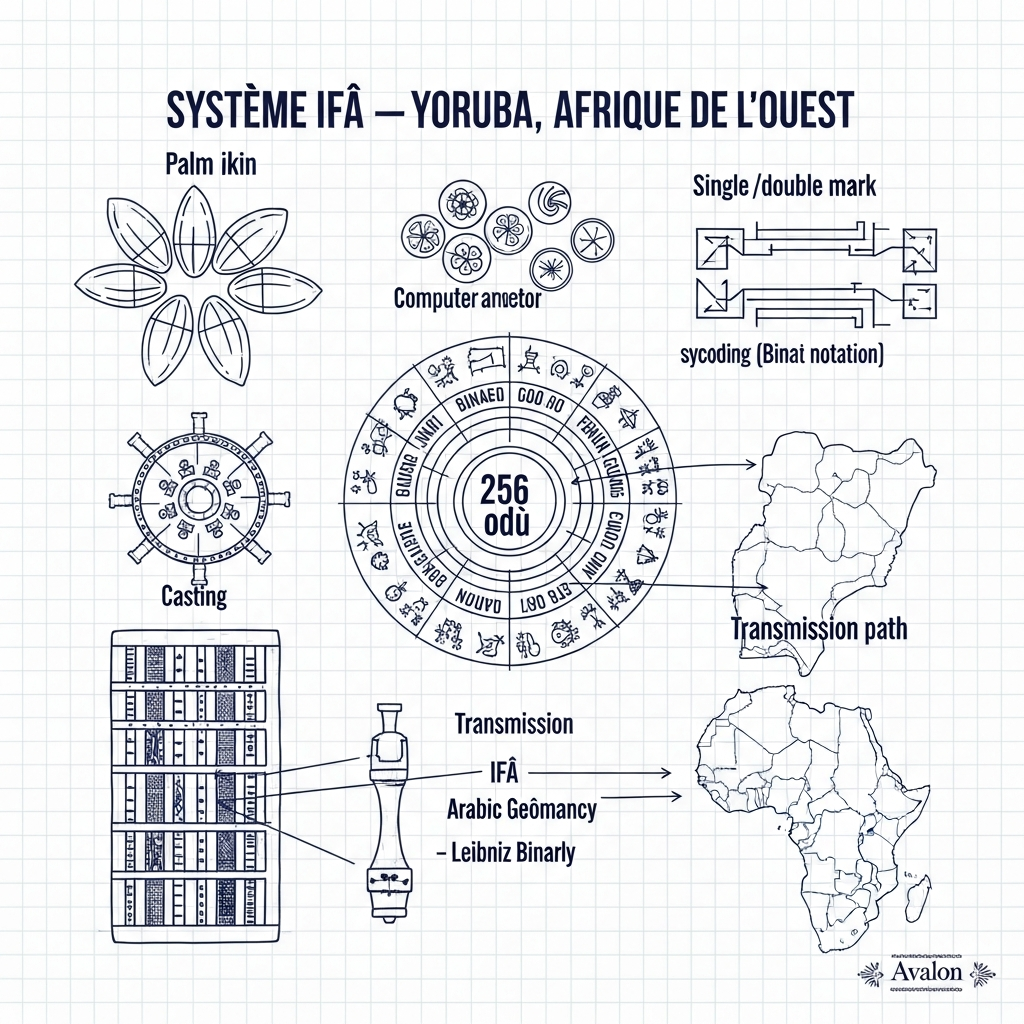
The Ifá system: binary structure with 256 configurations, precursor to modern computing.
The Invisible Threads
How Africa wove the foundations of artificial intelligence — and how colonialism tried to erase them
Yesterday — The Fabric and the Tear
There exist forms of knowledge that official history refuses to see. Threads of understanding running beneath the surface of dominant narratives, invisible but never broken, even when everything was done to sever them.
Between 1789 and 1945, Africa traversed its longest night. The slave trade was coming to an end, but colonialism immediately took its place, as if the exploitation of the continent could know no pause. In 1884, in Berlin, fourteen European powers gathered around a table to partition Africa as one might cut up a precious fabric, with no regard for the patterns already woven into it. No African was invited. No African had a voice in the matter. By 1900, Europeans had claimed nearly ninety percent of African territory.
This period was one of epistemicide — a word scholars use to describe the systematic destruction of a people's knowledge in order to impose a foreign system of understanding. Colonizers destroyed universities and libraries. They stole artifacts, technologies, scientific knowledge accumulated over centuries. African peoples were forced to believe they were "primitive, backward, irrational, unscientific, and without technology." This carefully constructed belief served a precise objective: to justify domination.
And yet. And yet, in this imposed darkness, threads continued to stretch — threads that, a century later, would prove essential to the fabric of artificial intelligence.
Consider the Ifa system, practiced by the Yoruba of Nigeria. At first glance, it appears to be a divinatory art, a spiritual tradition passed down from generation to generation. The Christian missionaries of the nineteenth century, supported by colonial administration, saw only idolatry. They waged vigorous campaigns to suppress it. Sacred groves were sometimes cleared to build schools and churches. Ifa priests — the Babalawo — were marginalized, their practices forbidden or discouraged. They were taught to feel shame for their own knowledge.
But let us look at this knowledge more closely, with the eyes of our era. The Ifa system rests on 256 figures called odu, each composed of eight positions that can take two states: open or closed, single line or double line. Two states. Eight positions. 256 combinations. We have just described exactly the structure of a computer byte — that fundamental unit upon which all modern computers rest.
The literary corpus associated with Ifa contains more than 430,000 verses, organized and indexed according to these 256 categories. Each new piece of knowledge acquired by the community was integrated into the system, classified under the appropriate odu, transmitted with a precision that defies imagination. Here we have a database, a memory addressing system, an architecture for storing and retrieving information — designed centuries before anyone in the West imagined the computer.
The ethnomathematician Ron Eglash traced a troubling conceptual lineage: from the Ifa system to Arabic geomancy, from Arabic geomancy to European alchemists, and from alchemists to Gottfried Leibniz. This German mathematician of the seventeenth century, often credited with formalizing the binary system, corresponded with Jesuit missionaries who described these African traditions to him. He admired, he wrote, the profound philosophical logic they contained.
Here is history's cruel irony: while nineteenth-century missionaries attempted to eradicate Ifa as pagan superstition, the binary system it contained — transmitted through circuitous routes — was becoming the cornerstone of Western computing. The thread was never cut. It was simply rendered invisible.
The same invisibility strikes African fractals. In 1988, Ron Eglash was studying aerial photographs of a traditional Tanzanian village when a strangely familiar pattern caught his attention. The thatched-roof huts were organized in circles within circles, an arrangement he recognized from his years as a computer engineer: fractals. Structures that repeat at ever-smaller scales — circles within circles within circles, rectangles nested within rectangles nested within rectangles.
Eglash discovered these fractal patterns everywhere in Africa: in architecture, but also in hairstyles, textiles, sculpture, painting, metalwork, games, and symbolic systems. These were not accidental decorations. "I began to understand that this is a knowledge system," he wrote, "perhaps not as formal as Western fractal geometry, but just as much a conscious use of those same geometric concepts."
Recursion, scaling, self-similarity — these fundamental concepts of modern algorithms existed in African thought long before Benoit Mandelbrot formalized fractal geometry in the 1970s. But this knowledge, like so much else, was classified under the heading "primitive" by colonial administrators who could not conceive that peoples they were striving to dominate might possess mathematical sophistication equal or superior to their own.
For colonization was not merely an economic and military enterprise. It was also, perhaps above all, an epistemological one. To justify exploitation, it was necessary to construct the image of a backward continent, an inferior race. The scientific racism of the nineteenth century provided the tools for this construction. Scientists like Pieter Camper measured skulls to establish racial hierarchies. Samuel Morton concluded that Black people had smaller brains than white people. Francis Galton, an eminent Victorian scientist, claimed that "the average intellectual standard of the negro race is some two grades below our own."
These pseudo-sciences justified colonialism: if Africans were biologically inferior, they needed to be "civilized" by their European masters. This circular logic — we dominate you because you are inferior, and you are inferior because we dominate you — permeated all colonial institutions.
Education became the primary weapon of this transformation of minds. Missionary schools, which were long the only educational institutions in colonial Africa, had a dual objective: to train docile auxiliaries for colonial administration, and to destroy Indigenous knowledge systems that might have served as a basis for intellectual resistance.
The curriculum was deliberately Eurocentric. The history taught was European history. The science taught was European science. African mathematics — the Yoruba system where "forty-five" is said ogoji marun, literally "take five and ten from three twenties," demonstrating remarkable facility with subtraction and multiplication — these mathematics were ignored, scorned, forgotten. Ethiopian multiplication, which proceeds by successive doubling and halving exactly like our modern processor circuits, was swept aside in favor of European methods.
Colonial laws completed the missionaries' work. In Kenya, a 1909 ordinance criminalized anyone claiming to possess powers of divination. In Southern Rhodesia, an 1899 law classified most traditional healer practices under the heading "witchcraft" — including medical knowledge that had nothing to do with magic. In South Africa, a 1957 law purely and simply banned traditional medicine. This law, inherited from apartheid, remains in force today.
But not all threads were severed.
In Timbuktu, in Mali colonized by France starting in 1894, families hid their manuscripts. Under floors, in attics, in mountain caves, in secret places buried in the desert — everywhere the colonizer could not find them. The French seized and burned many documents. They imposed their language, so that many lost the ability to read their ancestors' manuscripts. But between 400,000 and 700,000 manuscripts survived, testifying to the high level of civilization achieved by West Africans during the Middle Ages and early modern period. These manuscripts contained treatises on mathematics, astronomy, medicine, philosophy — everything that colonialism had claimed Africa did not possess.
And meanwhile, on the other side of the Atlantic, threads woven by the African diaspora were beginning to shine with a brilliance no one could ignore.
Today — The Rediscovered Patterns
In 1789, a free man from Maryland named Benjamin Banneker was observing the night sky with instruments he had built himself. Son of a free African American mother and a formerly enslaved father, Banneker had received almost no formal education. At twenty-two, he had built a clock entirely from wood, using only a borrowed pocket watch as his model. The clock struck the hours and would function throughout his life — tangible proof that a self-taught mind, armed only with curiosity and rigor, could rival the finest European craftsmen.
That year, Banneker predicted a solar eclipse, contradicting the calculations of several renowned European astronomers. He was right, and they were wrong. Two years later, George Washington would appoint him to participate in the survey of the new American capital — the first Black man appointed to a position by a president of the United States. Banneker made the astronomical observations that established the boundaries of Washington.
In his almanacs, published annually from 1791 to 1802, Banneker compiled tide tables, eclipse predictions, planetary positions, but also medical treatments and agricultural cycles. He used mathematics to demonstrate that locust invasions followed a seventeen-year cycle — a predictive calculation, a modeling of the natural world, an embryonic form of what we would today call algorithmic analysis.
Banneker understood the political significance of his work. In 1791, he wrote to Thomas Jefferson, then Secretary of State, to contest ideas of African inferiority. He enclosed a manuscript of his almanac for 1792 — irrefutable proof of his intellectual abilities. Jefferson responded politely, but never truly changed his mind. History would nonetheless remember Banneker's name, not those of the racists who doubted him.
The African diaspora continued to produce inventors and innovators throughout the nineteenth century, despite slavery first, then segregation. In 1821, Thomas Jennings became the first Black American to obtain a patent, for a dry-cleaning process. Alexander Miles patented automatic elevator doors in 1867. Elijah McCoy accumulated fifty-seven patents over his lifetime. Lewis Latimer drew the technical schematics for Bell's telephone and improved Edison's light bulbs.
In 1911, Shelby Davidson invented an automatic postal rate calculation device — a calculating machine, a modest but direct ancestor of computers. Henry Baker, an assistant examiner at the U.S. Patent Office, devoted his life to documenting these forgotten inventors, compiling four massive volumes of patents granted to Black Americans. His work remains an essential source today for understanding this erased history.
Meanwhile, on the African continent, institutions of knowledge persisted and transformed despite colonization. Al-Azhar University in Cairo, founded in 970, introduced modern examinations and subjects in the nineteenth century while preserving its teaching of logic and calculation. In Egypt, Muhammad Ali had engineering and medical schools built, sent students to Europe, and installed a printing press. The country then had the fifth most productive cotton industry in the world.
In Freetown, Sierra Leone, Fourah Bay College opened its doors in 1827 — the first Western-style university in sub-Saharan Africa. It trained teachers, evangelists, and then a colonial intelligentsia that, paradoxically, would become the spearhead of intellectual resistance to colonialism.
For the colonized turned against their masters the very tools that had been imposed on them. Edward Wilmot Blyden, born in 1832 in the Virgin Islands, was refused university admission in the United States because of his race. He settled in Liberia, taught Greek and Latin, became a diplomat, writer, and philosopher. He was the first to articulate the notion of "African Personality," to contest with the weapons of science and Scripture the theories of racial inferiority then spreading in Europe and America.
Blyden did not speak of artificial intelligence — the term did not yet exist. But he spoke of something more fundamental: Africa's capacity to think for itself, to produce knowledge, to contribute to universal understanding. Colonialism had strived to deny this capacity. Blyden spent his life demonstrating it. His influence would extend to Marcus Garvey, George Padmore, Kwame Nkrumah — the architects of Pan-Africanism and African independence.
And at the Cape of Good Hope, a royal observatory established in 1820 would become for one hundred and fifty years the most important source of stellar positions in the Southern Hemisphere. It was there that in 1831, Thomas Henderson made the first credible measurements of the distance to Alpha Centauri. Precision, measurement, systematic cataloging — the foundations of all science, and therefore of all artificial intelligence — were also taking root on African soil, even if Africans themselves were largely excluded.
History's irony is cruel: nineteenth-century Western science, the very science that claimed to demonstrate African inferiority, was itself built on a worldwide repertoire of wisdom, information, and specimens collected from every corner of the colonial world. European botanists appropriated African medicinal knowledge. Anthropologists plundered artifacts. Mathematicians inherited, without acknowledging it, concepts that came from Africa through the tortuous routes of intellectual transmission.
We long believed that artificial intelligence was born in American laboratories of the 1950s, the sole offspring of Turing and Shannon, of ENIAC and Dartmouth. This story is not false. It is simply incomplete. It omits the invisible threads connecting the Ifa system to binary logic, African fractals to recursive algorithms, Ethiopian multiplication to our processor operations.
When contemporary researchers examine African knowledge systems, they discover structures that seem strangely familiar. The Ifa system operates on binary logic, Boolean algebra, memory addressing — the three pillars of modern computing. Traditional villages in East Africa, photographed from the sky, reveal fractal structures testifying to an intuitive understanding of recursion. Yoruba and Akan numeral systems show facility with sophisticated arithmetic operations.
These discoveries overturn our conception of the history of science. They also pose a vertiginous question: how much of this knowledge was lost? How many threads were severed by the slave trade, by colonialism, by missionary schools, by anti-witchcraft laws?
The elders — who traditionally served as guardians of oral history, customs, and spiritual practices — were often enslaved or killed during raids. Without their guidance, younger generations struggled to preserve long-standing traditions. Languages disappeared, taking with them concepts only they could express. Traditional knowledge systems were disrupted, fragmented, forgotten.
We will never know with certainty the extent of what was lost. But we know this: despite everything, threads survived.
Beyond — Weaving the Future
In 2005, UNESCO recognized the Ifa system as part of the "Masterpieces of the Oral and Intangible Heritage of Humanity." This belated recognition — more than a century after missionaries had attempted to eradicate it — testifies to a reversal of perspective. What was once condemned as pagan superstition is now celebrated for its philosophical depth, its cultural relevance, and its urgent need for preservation.
But recognition is not enough. The Ifa priests, most of whom are now quite elderly, have only modest means to maintain the tradition and transmit their complex knowledge. Many young Nigerians still view Ifa with suspicion or embarrassment, associating it with superstition or secrecy. Colonialism's work of destruction continues to produce its effects, long after the colonizers left the continent.
South Africa still enforces a law adopted during apartheid that criminalizes aspects of Indigenous spirituality and traditional healing. The Witchcraft Suppression Act of 1957 remains in force, a troubling colonial vestige in a country that has been free for three decades. African artifacts remain in European and American museums, where Indigenous peoples cannot witness the creativity and inventiveness of their own ancestors.
And yet, the resistance continues.
Researchers like Ron Eglash are developing "ethnocomputing" tools that use African fractals to teach mathematics to young people. Librarians in Timbuktu continue to catalog and digitize the manuscripts their ancestors saved from destruction. African and Afro-descendant scholars work to reconstruct the intellectual lineages connecting traditional knowledge to modern science.
The artificial intelligence we are building today bears, whether we like it or not, the traces of its history. It carries the biases of those who designed it, the gaps of those who documented it, the silences of those who were erased. Current machine learning systems often reproduce the prejudices of their creators — including the racial prejudices that colonialism so carefully constructed.
Recognizing African contributions to the foundations of AI is therefore not merely an exercise in historical justice. It is a condition for building a truly universal intelligence — an intelligence that is not merely the product of one particular intellectual tradition, but the heir of all the traditions that preceded it.
The Ifa system teaches us that knowledge can be both structured and living, indexed and poetic, binary and spiritual. African fractals remind us that recursion — that fundamental operation of computing — can arise from intuition as much as from calculation. Benjamin Banneker shows us that a self-taught mind, deprived of all privilege, can nonetheless contribute to the science of his era. The manuscripts of Timbuktu prove that intellectual resistance is possible, even in the face of systematic destruction.
These invisible threads were never broken. They await recognition, tracing, weaving into the fabric of our common future.
The history of artificial intelligence is not the history of a Western invention. It is the history of a convergence — the convergence of threads from all continents, all eras, all traditions. The Middle East gave us the algorithm. Europe gave us formal logic. Asia gave us mechanical precision. The Americas gave us thinking in cycles. Oceania gave us embodied intelligence.
And Africa? Africa gave us binary logic inscribed in the Ifa system. Recursion embodied in fractals. The resilience that allows knowledge to survive those who wish to destroy it.
Colonialism tried to sever these threads. It failed. The threads are still there, beneath the surface, waiting for us to finally see them.
The future of artificial intelligence is plural. The Middle Ages already taught us this. The contemporary era, with its violence and its resistances, confirms it.
True intelligence, perhaps, is not that which calculates fastest. It is that which knows how to weave together the threads others have tried to separate.
Continent: Africa