Europe
Illustrations
1 / 5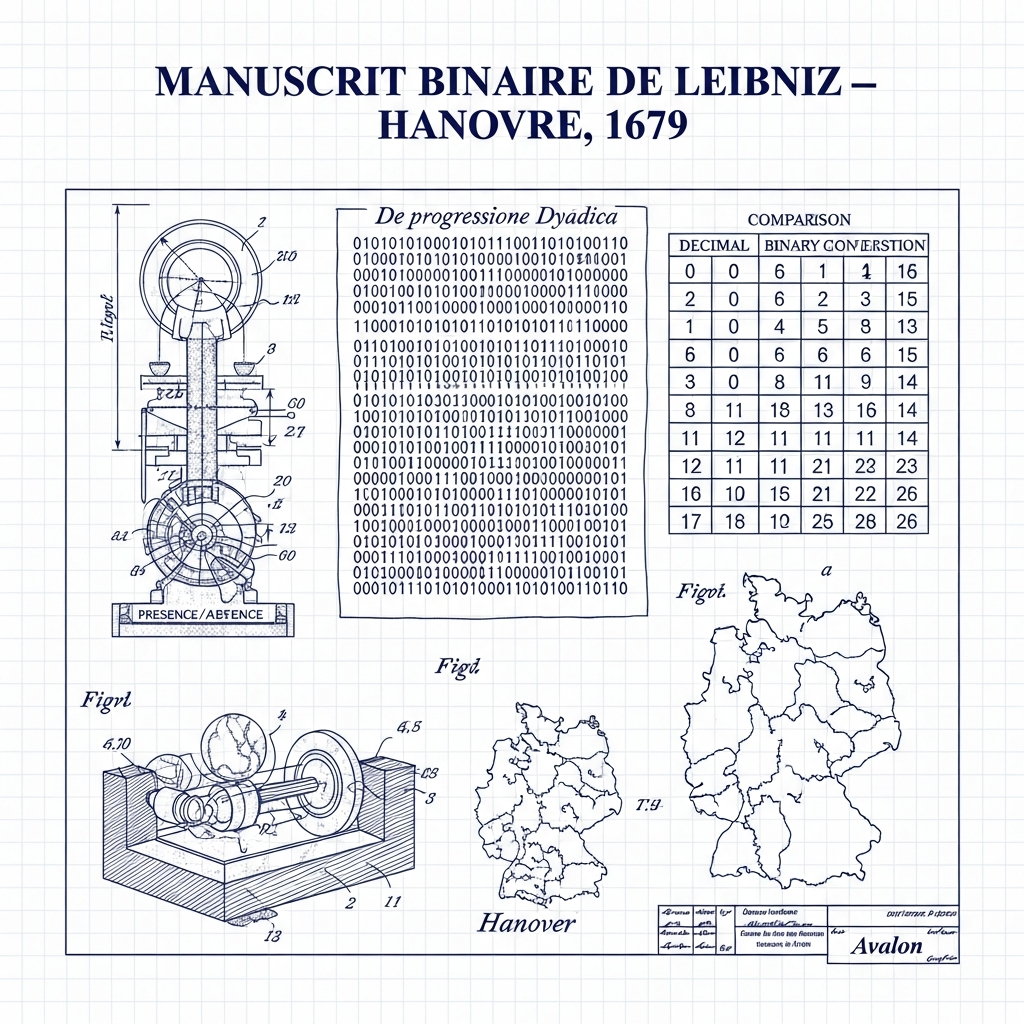
Gottfried Wilhelm Leibniz: formalization of the binary system (1679).
The Forge and the Inferno
Europe's Contributions to the Foundations of Artificial Intelligence (1789-1945)
Great inventions rarely emerge in the light. They arise in obscure workshops, cluttered offices, cellars filled with abandoned prototypes. Europe, between the late eighteenth century and the mid-twentieth, was an immense forge — a place where the conceptual tools that would make artificial intelligence possible were slowly, patiently shaped. The binary system, the algebra of logic, the universal machine, the first computer program: all these instruments were forged on European soil, by minds that could not imagine what they were making possible.
But a forge is not only a place of creation. It is also a place of fire. And Europe, during this same period, was an inferno — consuming its own creators in wars and persecutions, destroying the forges of other civilizations through colonial expansion, scattering its best minds to the four winds. This double nature — creative and destructive — runs through the entire European history of AI's foundations. Understanding one without the other means missing the essential point.
Yesterday — The First Tools
The Language of Machines
It all begins with an intuition. In 1679, in the library of Hanover, a long-haired man scribbles on a manuscript. Gottfried Wilhelm Leibniz, German polymath already famous for having invented infinitesimal calculus independently of Newton, has just conceived something apparently simpler: a numeration system using only two symbols, zero and one. He calls it binary arithmetic.
The manuscript of March 15, 1679, titled De progressione Dyadica, describes a calculating machine using movable balls to represent these digits. A ball present means one. An absent ball means zero. With this elementary system, Leibniz asserts that any number can be represented, any calculation performed. Twenty-four years later, in 1703, he published for the Paris Academy of Sciences an "Explanation of Binary Arithmetic," where he draws a connection with the Chinese Yi Jing hexagrams — as if ancient and new were suddenly converging toward the same truth.
The irony is that Leibniz also built a calculating machine, the Step Reckoner, capable of performing all four arithmetic operations. But this machine worked in base ten, not binary. The gap between idea and technical realization would last another two and a half centuries. The binary system would patiently await electronic circuits to give it a body.
Mechanical Ancestors
While Leibniz perfected his calculations, other European artisans explored a different path: that of automata, those machines capable of imitating the gestures of the living. In 1738, in Paris, Jacques de Vaucanson presented to the public three extraordinary creations: a flute player who actually blew into his instrument, a drummer who struck real drums, and above all the famous Digesting Duck — a copper automaton capable of eating grain, digesting it, and excreting it. The duck was an illusion, of course. But the illusion was so perfect that it posed a troubling question: where does mechanics end and where does life begin?
In Switzerland, the clockmaker Pierre Jaquet-Droz and his son Henri-Louis pushed the art even further. Between 1768 and 1774, they created three automata of stunning complexity. The Writer, composed of six thousand parts, could trace with a quill any text of thirty-seven characters — the text being "programmed" on interchangeable cam plates. The Musician actually played the harpsichord, her articulated fingers striking the keys with a virtuoso's precision. The Draughtsman reproduced portraits with remarkable fidelity.
These machines were not mere toys for aristocrats. They embodied an idea: that a sufficiently complex mechanism can reproduce the most subtle behaviors. The "mechanical memory" cylinders of the Writer foreshadowed punch cards. The ability to change the program by changing the cams announced programmability. Jaquet-Droz's automata, still functional and exhibited at the Museum of Art and History in Neuchatel, are the distant but direct ancestors of modern computers.
The Enchantress of Number
In June 1833, in London, a seventeen-year-old young woman met a forty-one-year-old eccentric inventor. Augusta Ada Byron, daughter of the poet Lord Byron, was passionate about mathematics — a passion encouraged by her mother who feared she might inherit her father's poetic madness. Charles Babbage was obsessed with calculating machines. He had just designed the Difference Engine, capable of calculating mathematical tables, and was already working on something more ambitious: the Analytical Engine.
The Analytical Engine, first described in 1837, was a monster of metal and steam that was never built. Had it been, it would have been the size of a factory and functioned with exasperating slowness by our current standards. But it already possessed all the characteristics of a modern computer: an arithmetic and logic unit, a memory system, loops and conditional branches, the ability to read instructions from punch cards. It was, a century before its time, the first general-purpose computer design.
Babbage called Ada "the Enchantress of Number." In 1842-1843, she translated into English an article by the Italian mathematician Luigi Menabrea describing the Analytical Engine, then augmented it with seven personal notes — three times longer than the original article. The seventh note, called "Note G," contained a detailed algorithm for calculating Bernoulli numbers on the Analytical Engine. It was the first computer program in history, written for a machine that did not yet exist.
But Ada saw further than calculation. She speculated that the Machine "might act upon other things besides number... the Engine might compose elaborate and scientific pieces of music of any degree of complexity or extent." This was a prophetic vision: the idea that a machine capable of manipulating symbols according to rules could do far more than calculate. Ada had glimpsed, a century before Turing, the true nature of computation.
She died at thirty-six, taken by cancer. Her contribution went largely unnoticed in the male-dominated scientific community of the mid-nineteenth century. It would take the advent of electronic computing, a century later, for her achievement to finally be recognized. The Ada programming language, created by the U.S. Department of Defense in the 1980s, bears her name.
The Laws of Thought
The same year Ada Lovelace died, a mathematics professor at Queen's College Cork, Ireland, published a work with an ambitious title: An Investigation of the Laws of Thought. George Boole, born in 1815 like Ada, was a self-taught man who had learned Latin, Greek, and mathematics on his own. His 1854 book proposed something revolutionary: applying algebra to logic itself.
Where traditional logic, inherited from Aristotle, laboriously catalogued valid syllogisms, Boole offered general algorithms applicable to any reasoning. He reduced logical propositions to algebraic equations, the connectors "and," "or," "not" to operations on symbols. Thought itself became calculable.
Boole died ten years later, without suspecting that his algebra of logic would become the foundation of all digital computing. In 1937, an MIT student named Claude Shannon would demonstrate that Boolean algebra could perfectly describe the functioning of relay circuits. Boole's "and," "or," "not" corresponded exactly to series connections, parallel connections, and inverters in electrical circuits. Logic could become hardware. Leibniz's dream — machines reasoning in binary — finally found its realization.
Today — The Chain of Thinkers
Hilbert's Question
At the International Congress of Mathematicians in Bologna, in 1928, the most famous living mathematician posed a question that would transform the history of thought. David Hilbert, sixty-six years old, researcher at Goettingen, wanted to know whether there existed an algorithm capable of deciding, for any mathematical proposition, whether it was true or false. He called this question the Entscheidungsproblem — the decision problem.
This was not a mere technical puzzle. It was a metaphysical wager on the very nature of truth. If such an algorithm existed, then all mathematics could be mechanized. Mathematical thought, in its purest form, could be reduced to calculation — and calculation could be performed by a machine. Hilbert firmly believed the answer would be positive. He had devoted his career to seeking solid foundations for mathematics, a bedrock of axioms from which everything else could be proven with certainty.
The first breach in this dream came from a young Austrian logician. In 1931, Kurt Goedel, twenty-five years old, published a paper that shattered Hilbert's hopes. His "incompleteness theorems" demonstrated that no consistent system of axioms powerful enough to contain arithmetic could prove all arithmetic truths. There would always be propositions that were true but unprovable — holes in the fabric of proof. Worse still, such a system could not even prove its own consistency.
Goedel had grown up in Vienna's cafes, participating in the Vienna Circle discussions around Moritz Schlick. His 1931 paper ended half a century of attempts to solidly ground mathematics. But it did not directly answer Hilbert's question. The Entscheidungsproblem remained open — until a young Englishman lay in the grass of Grantchester meadows, in the summer of 1935, and conceived the machine that would bear his name.
The Universal Machine
Alan Turing was twenty-three when he solved the decision problem. His answer, published in 1936 in a paper soberly titled "On Computable Numbers," is considered "the most famous theoretical paper in the history of computing." To prove that Hilbert's algorithm could not exist, Turing first had to rigorously define what an algorithm was — and to do so, he invented an imaginary machine.
The Turing machine is disarmingly simple. An infinite tape divided into cells, each cell containing a symbol. A read head capable of reading the symbol beneath it, erasing it, writing another, moving one cell left or right. A finite set of internal states that determine what the machine does according to the symbol read. That is all. With these elementary components, Turing showed that any imaginable calculation could be simulated.
Then came the brilliant idea: the universal machine. A Turing machine capable of simulating any other Turing machine. All one needed to do was provide it, on its tape, with the description of the machine to simulate and the input data. The universal machine would do the rest. Turing had just invented the concept of the programmable computer — a single machine capable of performing any task for which a program could be written.
John von Neumann, the Hungarian mathematician who would later design the architecture of the first electronic computers, unambiguously recognized that "the fundamental conception of the modern computer was due to Turing's paper." But Turing went further still. He believed that everything could be represented symbolically, including mental states. In 1950, in his paper "Computing Machinery and Intelligence," he would propose the test that bears his name: if a machine can converse indistinguishably from a human, why refuse it intelligence?
The Isolated Smiths
While Turing was theorizing at Cambridge, a German civil engineer was building in his parents' house in Berlin. Konrad Zuse had never heard of Turing or Shannon. He worked alone, following his own intuition. Between 1936 and 1938, he assembled the Z1, a mechanical calculator using binary logic and floating-point numbers. The machine did not work well — the mechanical parts were not precise enough — but the concept was revolutionary.
Zuse persevered. On May 12, 1941, he completed the Z3: the world's first fully functional programmable digital computer. Two thousand six hundred relays, a word length of twenty-two bits, programs stored on perforated film. Independently of Shannon, Zuse had developed his own form of symbolic logic to design the circuits. The Z3 preceded American and British developments by several years.
But Zuse was working in Nazi Germany. When he asked the government to fund replacing relays with vacuum tubes, he was told this was "not important for the war." In late 1943, a bombing raid on Berlin destroyed the Z3. Zuse's pioneering but isolated work remained unknown outside Germany until well after the war. It had no influence on the development of the computer industry in America and England. Another path to the computer, opened and immediately closed.
On the other side of the Channel, another smith was working in the shadows — literally. Tommy Flowers, an engineer at the British Post Office, was spending his nights at Dollis Hill building a machine that no one believed possible. The experts at Bletchley Park had told him that vacuum tubes were too fragile to work in large numbers. Flowers knew, from his prewar experience, that they would work perfectly as long as they were never turned off. Eleven months later, in February 1944, Colossus was operational.
Colossus was the first electronic digital computer, preceding ENIAC by two years. Its one thousand six hundred thermionic valves — two thousand four hundred in the Mark 2 version — decrypted messages encoded by the German Lorenz machines at five thousand characters per second. Ten copies were built before the end of the war. They helped shorten the conflict by several months, saving countless lives.
Then came the order to destroy everything. Most of the Colossus machines were dismantled. Flowers received instructions to burn the plans and user manuals. The secret was kept so well that for thirty years, the history of computing ignored this first. It was only in 1974, with the publication of a former Bletchley Park member's memoirs, that the world began to learn what had happened. Flowers died in 1998, finally recognized but far too late.
The Erased Faces
Bletchley Park employed nearly ten thousand people. Seventy-five percent of them were women. The WRNS — the Women's Royal Naval Service, nicknamed the "Wrens" — operated the Bombe machines that decrypted Enigma. They kept the Colossus machines running twenty-four hours a day, in three eight-hour shifts. They were the beating heart of the operation. But when the history was told, their names were rarely mentioned.
Joan Clarke was a mathematician. She worked in Hut 8, alongside Turing, on decrypting German naval communications. She was briefly engaged to him — he broke it off after confessing his homosexuality to her. She became deputy head of her unit, one of the few women to reach such a rank. When the film The Imitation Game told Turing's story in 2014, she finally had a face for the general public — seventy years after the fact.
Mavis Batey — born Lever — was only nineteen when she joined Bletchley Park. In December 1941, she decrypted a message between Belgrade and Berlin that allowed her team to crack the wiring of the Abwehr Enigma, a variant believed to be unbreakable. Margaret Rock worked on German and Russian codes; her boss Dilly Knox described her as "the fourth or fifth best of all the Enigma personnel." Hundreds of other women, linguists, mathematicians, crossword experts, contributed to the effort without ever receiving recognition.
The invisibilization was not an accident. It was structural. Ada Lovelace had been ignored for a century because a woman could not be a pioneer of computing. The women of Bletchley Park were forgotten because their work was classified, certainly, but also because history preferred to tell the exploits of men. The pattern would repeat in the United States with NASA's "human computers," the ENIAC programmers, and the hidden figures of the space race. The foundations of computing were laid by often female hands, and those hands were erased from the photographs.
Beyond — The Inferno and the Dispersion
The Burned Forges
The Europe that forged the tools of artificial intelligence is the same that destroyed the forges of other civilizations. This paradox runs through the entire period 1789-1945 like a red thread — or rather, like a thread of fire.
At the height of the Al-Andalus Empire, the library of Cordoba contained five hundred thousand volumes. At the same time, the largest libraries in Northern Europe held between five and ten thousand. The Spanish burned Cordoba. They also destroyed the codices of the Maya, Inca, and Aztecs — entire knowledge systems reduced to ashes because they did not correspond to the Christian worldview. The Portuguese sociologist Boaventura de Sousa Santos coined a word for this systematic destruction of knowledge: epistemicide.
European epistemicide was not an accident of history. It was a deliberate policy, for a plurality of ideas would have undermined colonialism itself. How could one justify the domination of a people if that people possessed knowledge as valid as one's own? The solution was to deny this knowledge, to declare it primitive, irrational, unscientific. Colonial regimes suppressed Indigenous intellectual traditions through the destruction of artifacts, the prohibition of ceremonies, the discrediting of local experts. They imposed their own knowledge systems as the only legitimate ones.
This destruction had lasting consequences. Mathematical traditions — Maya calendars, Inca quipus, African divination systems using binary logic — were annihilated or marginalized. Different ways of thinking about calculation, logic, and information organization disappeared. We will never know what alternative paths to artificial intelligence these traditions might have opened. The paths were closed before being explored.
The irony is bitter. Europe developed the conceptual tools of AI — the binary system, Boolean algebra, the universal machine — while destroying the knowledge systems that might have enriched or complemented these tools. It built a conceptual cathedral on the ashes of burned libraries.
The Flight of the Smiths
In 1933, a fifty-four-year-old physicist left Germany and renounced his citizenship. Albert Einstein was settling in the United States. He would never return. The same year, Hannah Arendt fled to Paris. Sigmund Freud would leave for London in 1938, two months after the Anschluss. Enrico Fermi emigrated the same year — his wife Laura was Jewish.
The List of Displaced German Scholars, compiled in 1936, contained nearly eighteen hundred names. Edward Hartshorne estimated that fourteen percent of German higher education faculty had been dismissed, forced to resign, or pushed into retirement in 1932-33. Twenty-four Nobel Prize winners fled Germany or Austria because of Nazi persecution. Many were Jewish. Others had Jewish spouses, or dangerous political opinions, or simply the fault of having spoken too loudly.
America and Britain welcomed these refugees with open arms — not out of pure generosity, but because they understood the value of what they were receiving. Physics departments expanded. Universities grew richer. Einstein, Fermi, and Bohr contributed to the Manhattan Project. Fermi led the team that built the first nuclear reactor in Chicago. A 2014 study in the American Economic Review demonstrated that German Jewish emigrants significantly stimulated innovation in the United States.
For Germany, it was a hemorrhage. The country that had dominated world physics at the beginning of the century saw its center of gravity shift to America. The European forge was losing its best smiths. The inferno consuming the continent was driving away its own creators.
War as Accelerator
Ultimate paradox: the war that scattered the scholars also accelerated the development of the machines they had imagined. World War II was a brutal but effective catalyst for computing.
Warring governments spend without counting on projects that can give them an advantage. The decryption of Enigma and Lorenz justified the construction of Colossus. Ballistic calculations justified ENIAC. Interdisciplinary collaboration, impossible in peacetime, became not only possible but necessary. Mathematicians, engineers, linguists, and crossword experts worked side by side at Bletchley Park. Physicists, chemists, and metallurgists collaborated at Los Alamos.
The war also forced secrecy. Colossus was destroyed and its plans burned. Zuse's work remained unknown. The history of computing was stripped of entire chapters that would only be rediscovered decades later. We tell a truncated history, where Americans seem to have invented everything because their work was not classified for as long.
By the end of the war, the center of gravity of computing innovation had shifted. The United States possessed ENIAC, the first American electronic computer, completed in 1945. They also possessed the European brains driven out by Nazism, and the economic resources of a country that war had enriched rather than impoverished. Europe had forged the tools. America would use them.
What Remains
What remains of the European forge? The concepts, first — indelible and universal. Every computer in the world runs on binary, according to the system Leibniz imagined in 1679. Every logic circuit implements the algebra Boole formulated in 1854. Every executable program is, at bottom, an instantiation of the universal machine Turing described in 1936. The tools have survived the forge that created them.
The questions too. Turing wondered whether a machine could think. Goedel had shown that even mathematics had intrinsic limits. Ada Lovelace had glimpsed that symbol manipulation could go beyond pure calculation. These questions have not found definitive answers. They continue to haunt our reflection on artificial intelligence.
And the ghosts. Ada Lovelace, ignored for a century. The women of Bletchley Park, erased for decades. Tommy Flowers, who died without receiving the recognition he deserved. Konrad Zuse, isolated pioneer whose work influenced no one. The knowledge destroyed by colonialism, the burned libraries, the eradicated mathematical traditions. The history of European artificial intelligence is also a history of what was lost, forgotten, erased.
The European forge consumed itself in its own flames. But the tools it created — binary, logic, the universal machine — continue to shape our world. It falls to us to remember not only what was forged, but what was burned.