Africa
Illustrations
1 / 5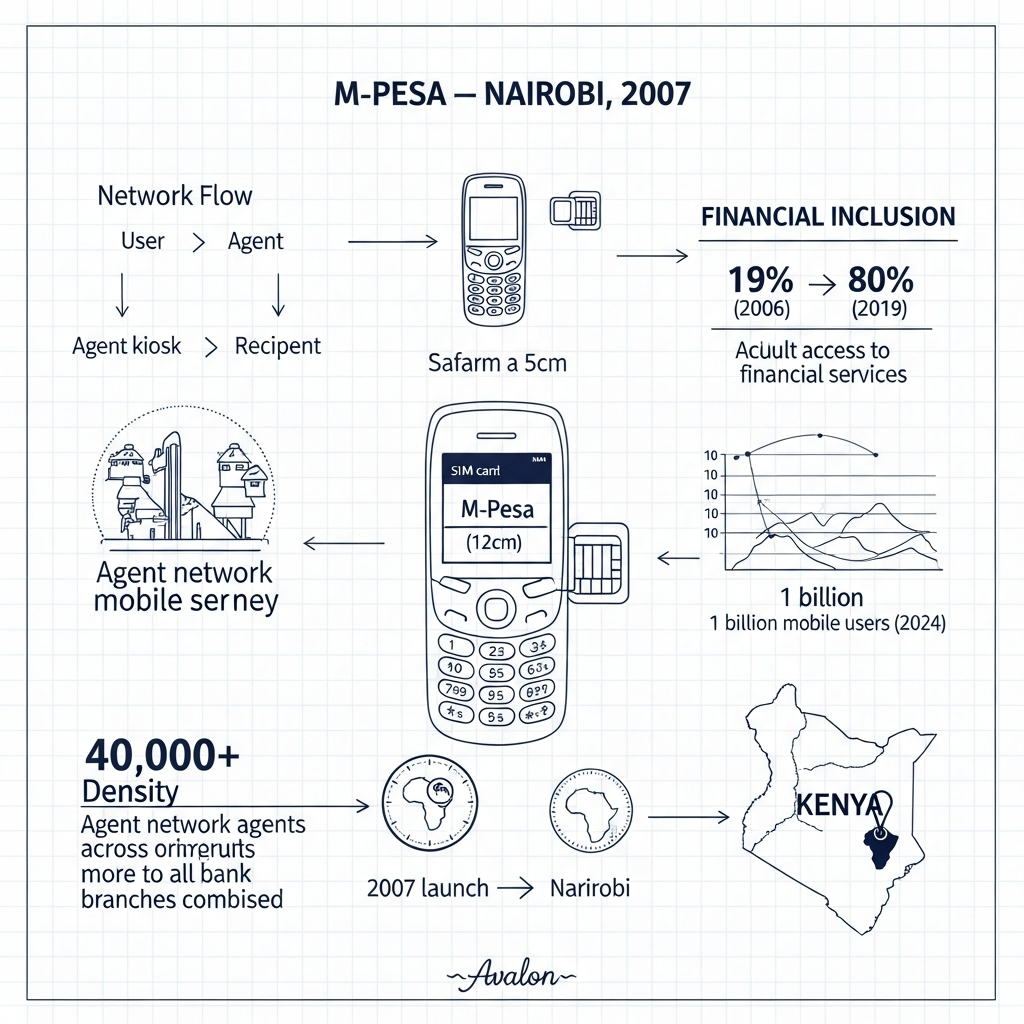
M-Pesa: AI serving financial inclusion for millions of Africans.
Africa — The Quantum Leap
How Africa invented digital inclusion, revealed AI's biases, and built its own models
Yesterday — Leaping Across the Abyss
There exists a physics of impossible leaps. The electron, quantum physicists say, does not cross the space between two orbits — it disappears from one and appears in the other, never occupying the in-between. A quantum leap.
Africa made this leap.
In 2007, fewer than nineteen percent of Kenyans had access to a bank account. Branches were rare, roads sometimes impassable, costs prohibitive. The traditional banking system, inherited from colonization, had never been designed for remote villages or for the informal economies that sustained the majority of the population. Africa seemed condemned to remain on the margins of the global financial system.
Then came M-Pesa.
"M" for mobile. "Pesa" for money, in Swahili. A simple idea: allowing Kenyans to send and receive money by simple text message, without a bank account, without branches, without heavy infrastructure. Safaricom, the telecommunications operator, transformed its phone recharge shops into deposit and withdrawal points. Village kiosks became teller windows. The mobile phone became a wallet.
Within a few years, the financial inclusion rate in Kenya leapt from nineteen to eighty percent. Studies from the Massachusetts Institute of Technology and Georgetown University estimated that M-Pesa had lifted one hundred ninety-four thousand Kenyan households out of extreme poverty — primarily through the economic empowerment of women, who could now save, borrow, and manage their finances without depending on male intermediaries.
The Western world had not yet invented Apple Pay when Africa was already paying by phone.
This was not catching up. It was leapfrogging. Africa had not traversed the space between the traditional banking system and digital finance — it had jumped over it.
In 2010, there were thirteen million mobile payment accounts in the world. By 2023, that number had reached six hundred forty million — and sub-Saharan Africa represented more than half of active accounts. The share of African adults making digital payments rose from twenty-eight percent in 2014 to fifty percent in 2021. By 2024, African digital payment networks had surpassed one billion mobile users, facilitating more than one thousand one hundred billion dollars in transactions.
Africa had demonstrated something that development theorists had not anticipated: latecomers can become pioneers — if they invent their own path rather than copying that of others.
The same logic of the quantum leap applied to artificial intelligence.
Africa did not have the massive data centers of Silicon Valley. It did not have the research budgets of American universities. It did not have the pools of doctoral students trained in the laboratories of Stanford or MIT. By conventional criteria, it should have remained a spectator to the deep learning revolution.
It chose to become an actor.
In 2015, Karim Beguir and Zohra Slim founded InstaDeep in Tunis. Their insight: artificial intelligence was going to transform biology, logistics, industrial design — and Africa could contribute from Africa, without waiting for Western giants to deign to take interest.
Eight years later, in January 2023, BioNTech — the German pharmaceutical company that had co-developed one of the first vaccines against Covid-19 — acquired InstaDeep for six hundred eighty-two million dollars. It was the largest acquisition of an African technology company in history.
InstaDeep had not simply grown. It had proved that excellence in artificial intelligence could be born in Tunisia, export itself to London, Paris, Berlin, Lagos, Cape Town, Boston, and San Francisco, and compete with the best laboratories in the world. Its DeepChain system allowed medical researchers to explore protein sequences in minutes thanks to language models trained on billions of amino acids. DeepPack optimized the filling of shipping containers. DeepPCB designed complex printed circuit boards in under twenty-four hours.
The acquisition by BioNTech produced what analysts call a "validation effect": suddenly, investors, government agencies, and major corporations began to consider African deep tech teams as worthy of investment and ready for export. InstaDeep had "opened the door" for other African founders.
In 2024, more than two thousand four hundred African companies were building artificial intelligence infrastructure or developing their own AI-based systems. South Africa led, followed by Kenya and Nigeria. Egypt, Rwanda, Tunisia, and Mauritius were emerging as regional hubs. This was no longer an exception — it was an ecosystem.
Today — Situated Intelligence
But Africa did not content itself with importing artificial intelligence. It reinvented it for its own needs.
The language problem illustrates this reinvention.
Africa has more than two thousand living languages. The continent harbors the greatest linguistic diversity on the planet. Yet the large language models — ChatGPT, Claude, Gemini — were trained primarily on English-language corpora, with some additions in French, Spanish, German, and Chinese. African languages — Swahili, Hausa, Yoruba, Xhosa, Zulu, Amharic, and hundreds of others — represented an infinitesimal fraction of the training data.
The result was predictable: these models worked poorly, if at all, for the majority of Africans.
The response came from below.
Masakhane — "we build together" in Zulu — emerged as a pan-African research initiative in natural language processing. More than two thousand African researchers, spread across more than thirty countries, coordinated to create translation tools, speech recognition, and text generation for African languages. The MasakhaNER project introduced the first large-scale dataset for named entity recognition covering ten African languages.
This was not charity from outside. It was creation from within.
Awarri, a Nigerian startup, undertook to build the first Nigerian large language model. Silas Adekunle, its co-founder, explained the challenge: "We have so many different accents and languages, and this model will allow many people and developers to create products that leverage AI but are made for the Nigerian market." The scale of the project, with limited resources, forced them to be creative in how they collected, labeled, and processed data.
Intron Health, also in Nigeria, tackled a concrete problem: medical documentation. Western speech recognition systems did not understand African accents. Doctors spent hours transcribing their notes. Intron Health developed a speech recognition platform specifically adapted to African accents, achieving ninety-two percent accuracy where imported systems failed.
The result was spectacular. At the University of Ibadan Teaching Hospital, the turnaround time for radiology reports dropped from forty-eight hours to twenty minutes. More than fifty-six thousand patients benefited from the system across some thirty public and private hospitals. Intron Health had assembled the largest African clinical speech dataset — more than three and a half million audio recordings covering two hundred eighty-eight African accents.
In August 2024, Jacaranda Health expanded its open-source language model, UlizaLlama, to provide AI-based support for pregnant women in five African languages: Swahili, Hausa, Yoruba, Xhosa, and Zulu.
Africa was no longer asking to be included in global AI. It was building its own.
This construction was accompanied by a critical consciousness.
In December 2020, Timnit Gebru was fired from Google. Born in Ethiopia, trained at Stanford, she had been recruited to co-lead the tech giant's artificial intelligence ethics team. Her crime: having co-authored a scientific paper on the risks of large language models — their tendency to reproduce biases present in their training data, their environmental cost, their opacity.
The affair caused a seismic shock. Nearly two thousand seven hundred Google employees and more than four thousand three hundred academics and civil society members signed a letter condemning her dismissal. Nine members of the U.S. Congress wrote to Google demanding explanations. Fortune magazine named her among the fifty greatest leaders in the world in 2021. Nature included her among the ten scientists who had played a major role in the scientific developments of the year. Time designated her among the most influential people of 2022.
But Timnit Gebru did not content herself with denouncing. She founded the Distributed Artificial Intelligence Research Institute (DAIR), a research institute working with researchers around the world, with particular attention to the African continent and the African diaspora in the United States. One of DAIR's first projects used AI to analyze satellite images of South African townships to better understand the legacies of apartheid.
"One of the biggest problems with AI right now is exploitation," Gebru declared. She was pointing to an uncomfortable reality: in an office building on the outskirts of Nairobi, approximately two hundred men and women spent their days moderating violent content on behalf of Meta, paid as little as one dollar fifty an hour. Africa was providing the invisible labor that made the AI of Western giants possible.
Timnit Gebru's story was part of a lineage. A few years earlier, she had co-authored with Joy Buolamwini, an American researcher of Ghanaian origin, the study "Gender Shades" which revealed that facial recognition software erred up to thirty-five percent more often for dark-skinned women than for white men. This discovery — that AI systems saw Black faces less well — forced major tech companies to acknowledge a problem they had long ignored.
Africa and its diaspora were not content to build AI. They were questioning it.
The Infrastructure of the Future
Meanwhile, African states were beginning to develop strategies.
In July 2024, the Executive Council of the African Union, composed of representatives from all fifty-five member states, approved the African Continental Artificial Intelligence Strategy. It was a first: a common framework for AI development and governance at the scale of an entire continent.
The strategy spanned from 2025 to 2030, with a preparatory phase in 2024. The first phase, from 2025 to 2026, would focus on establishing governance structures, creating national strategies, and mobilizing resources.
But Africa was not advancing as a uniform bloc.
Rwanda was the only African country to adopt a comprehensive national artificial intelligence policy. This policy aimed to position Rwanda as "Africa's AI laboratory" and as a champion of responsible AI, to develop skills, to create an open and secure data ecosystem, and to transform the public sector. An investment fund was created to allow the government to co-invest alongside angel investors and venture capital funds in AI companies.
Kenya published its national AI strategy in the first quarter of 2025, after having included substantial references to AI in its Digital Master Plan 2022-2032. In 2024, the United States announced a partnership with Kenya to leverage AI, facilitate data flows, and promote digital training.
South Africa hosted the Centre for Artificial Intelligence Research (CAIR) — a research network — as well as a Centre for the Fourth Industrial Revolution. One of the center's objectives was to transition South Africa to a data-driven digital economy.
Egypt articulated its strategy around four pillars: AI for government, AI for development, capacity building, and international activities.
Yet in 2024, only seven African countries had a formal AI strategy. The continent remained fragmented, with considerable gaps between pioneers and laggards.
Investments followed this fragmentation. In the first quarter of 2025, more than eighty-three percent of funding for African AI startups went to Kenya, Nigeria, South Africa, and Egypt. InstaDeep and Sama, the two largest companies, represented approximately twenty-five percent of all funds raised by African AI companies.
A major announcement was made at the Kigali summit: Cassava Technologies would invest up to seven hundred twenty million dollars in partnership with Nvidia to build the first "African AI Factory," providing AI infrastructure to Egypt, Kenya, Morocco, Nigeria, and South Africa.
According to the United Nations, AI has the potential to generate one thousand two hundred billion dollars in economic activity in Africa, an increase of five point six percent in continental GDP by 2030.
The quantum leap was not over. It was just beginning.
Beyond — Ubuntu Intelligence
The palaver tree still exists.
In every African village, there is a place where people gather to discuss, listen, decide together. No majority vote crushing the minority. An inclusive consensus, where decisions are binding only when all parties agree. Ubuntu: "I am because we are."
This philosophy contained, without knowing it, the principles of distributed intelligence.
Mark Shuttleworth, the South African billionaire who became the second space tourist in history, named his operating system Ubuntu Linux — the palaver tree transformed into computer code. Millions of computers around the world run on Ubuntu today. The African name has become universal.
But beyond the symbol, Ubuntu poses a fundamental question to artificial intelligence: for whom and by whom is it built?
Large language models were trained on corpora where African languages represented a negligible fraction. Facial recognition systems were optimized for faces their designers knew — primarily white and male. Credit algorithms were calibrated on financial histories that did not exist for hundreds of millions of Africans without bank accounts.
Universal AI does not exist. What exists are systems that reflect the data on which they were trained, the values of those who designed them, the priorities of those who funded them.
Africa understood this — and it began to build differently.
Masakhane brings together researchers who create tools for their own languages, with their own data, according to their own priorities. Intron Health develops speech recognition for the accents that Western giants ignore. Awarri builds a language model that understands Nigerian reality. This is not localization — it is situated creation.
Africa teaches us that artificial intelligence cannot be truly universal if it is not truly plural. That inclusion does not consist of translating systems designed elsewhere, but of designing systems from local realities. That the diversity of languages, accents, and contexts is not an obstacle to overcome, but a richness to integrate.
It also teaches us vigilance. Timnit Gebru and Joy Buolamwini revealed that AI biases are not technical accidents, but reflections of political and economic choices. That systems that see Black faces less well are not neutral — they perpetuate inequalities. That the workers in Nairobi who moderate traumatizing content for one dollar fifty an hour are part of the AI value chain, even if we prefer to forget them.
Africa asks the questions that others prefer to ignore. It builds the tools that others do not know how to build. It shows paths that others have not taken.
The quantum leap continues.
In 2007, M-Pesa transformed payments. In 2023, InstaDeep proved that AI excellence could be born in Africa. In 2024, Masakhane was coordinating more than two thousand researchers for African languages. In 2025, Cassava Technologies and Nvidia announced the first African AI Factory.
Each leap prepares the next.
The electron that disappears from one orbit to appear in another does not cross the in-between. It transcends distance. Africa has not caught up with the world. It has surpassed it — in places, at moments, in certain domains. It invented mobile financial inclusion before the West. It asked the first questions about facial recognition biases. It builds language models for languages that tech giants ignore.
The next leap may already be underway.
The palaver tree has never stopped growing. Its branches now extend into the cloud.