Oceania — Archipelago of Innovation
Illustrations
1 / 5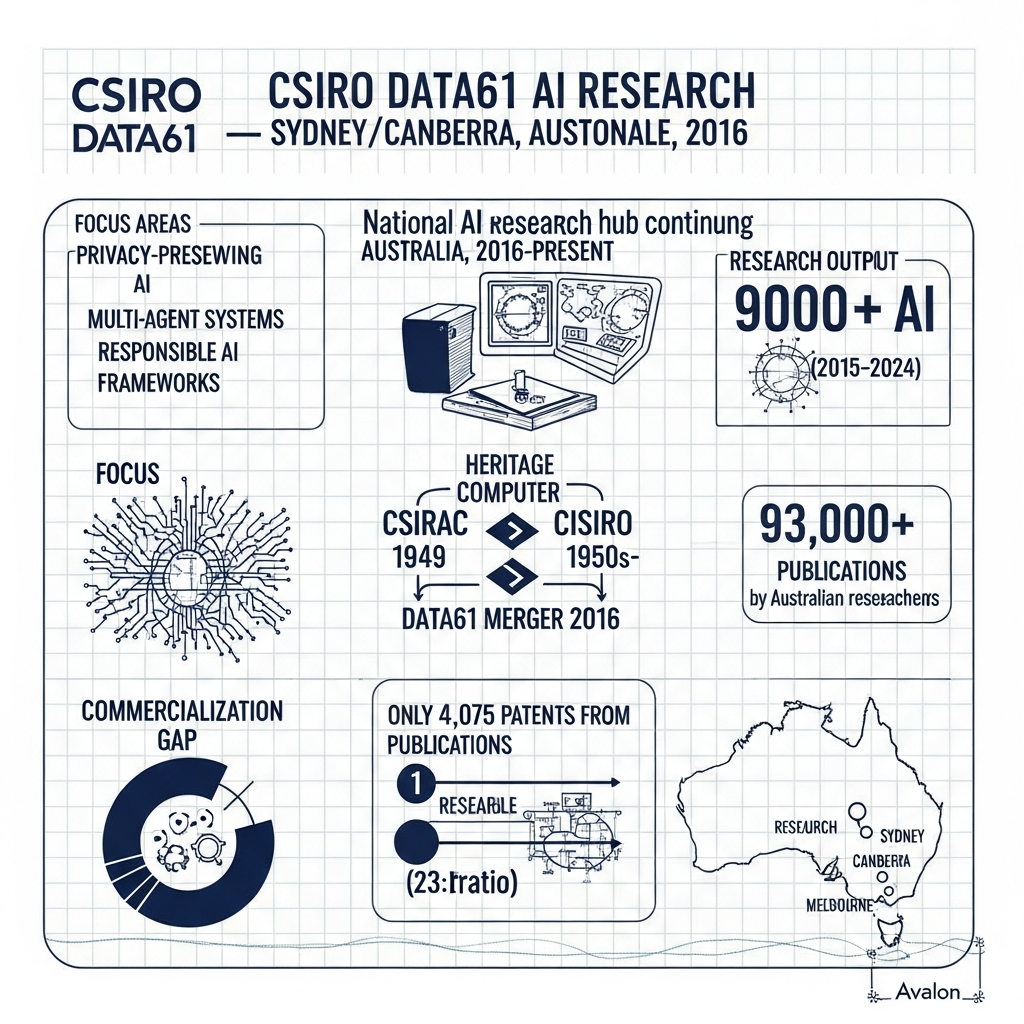
CSIRO Data61: Australia's largest AI research team.
Yesterday — Bridges to the World
There exists a geography of isolation. Australia is the continent farthest from other land masses. For millennia, this isolation shaped a unique biological evolution — kangaroos, koalas, platypuses. For decades, it also shaped a particular technological evolution.
Trevor Pearcey had built CSIRAC in 1949 — the fifth stored-program computer in the world. He had done it "largely independently of European and American efforts." Isolation had forced him to invent everything. In 1948, before his machine even worked, he had predicted the Internet.
This tradition of innovation at the antipodes continued. WiFi. The cochlear implant. Google Maps, born in Sydney. Atlassian, Australia's first tech unicorn. Oceania was building bridges to the world from its distant islands.
But the deep learning revolution posed a new challenge. It required resources that Australia did not possess in sufficient quantity — billions of dollars in investment, thousands of AI researchers, massive server farms, vast quantities of training data. Was the isolation that had been an advantage — forcing creativity — becoming a handicap?
Today — The Australian Paradox
Australian AI presented a paradox.
On one side, research flourished. AI-related scientific publications had more than doubled between 2015 and 2024. AI's share of Australian academic publications had risen from five point three percent to eleven point six percent — a doubling of the priority given to this field. CSIRO Data61, the specialized arm of the national science agency, hosted one of the largest concentrations of AI and data science expertise in the world.
On the other side, commercialization languished. AI-related patents had nearly quadrupled — from one hundred seventy in 2015 to six hundred twenty-nine in 2024. But this figure remained modest. Between 2015 and 2024, Australia had produced more than ninety-three thousand AI-related scientific publications — and only four thousand seventy-five patents. Twenty-three publications for every patent. Research was not being transformed into industry quickly enough.
Venture capital funding for AI startups reached approximately one billion three hundred million Australian dollars in 2024 — AI represented between twenty-five and thirty percent of total investments. More than six hundred fifty AI companies were based in Australia, including one hundred ten new ones founded in 2023-2024.
These figures seemed respectable. But compared to those of the United States, China, or even Israel, they revealed a gap. Australia produced one point six percent of global AI research — but only zero point two percent of patents. Scientific excellence was not converting into economic power.
The "sovereignty gap" illustrated this problem.
Australia did not have a large language model comparable to GPT-4 or Claude. Research institutions and companies depended almost entirely on models developed abroad. This dependence created vulnerabilities — strategic, economic, cultural.
A consortium including Katonic AI, Rack Corp, NEXTDC, Hitachi Vantara, and Hewlett Packard Enterprise was working on "Kangaroo LLM" — Australia's most ambitious attempt at AI independence. But the project remained at an early stage.
"The rise of generative AI and large language models like ChatGPT is rapidly transforming the digital and cyber innovation landscape," noted Dr. Liming Zhu of CSIRO Data61. Australia could not content itself with using others' tools — it had to develop its own.
CSIRO's "Innovate to Grow" program had helped more than six hundred companies in the R&D phase since its launch in 2020. The National AI Centre, led by Data61, was coordinating national efforts. But these initiatives remained modest compared to the scale of American or Chinese investments.
The National Response
In December 2025, the Australian government published the National AI Plan — a roadmap for building an AI-compatible economy.
The plan was organized around three objectives. First, capturing AI opportunities by building smart infrastructure and attracting investment. Second, spreading AI benefits by generalizing adoption, training Australians, and improving public services. Third, protecting Australians by mitigating risks, promoting responsible practices, and collaborating on global standards.
The Australian AI Safety Institute was created, with an investment of thirty million Australian dollars. Its mission: to monitor, test, and share information on emerging AI capabilities, risks, and harms. Australia was joining the international network of AI safety institutes, aligning with comparable efforts in the United States, the United Kingdom, Canada, South Korea, and Japan.
But Australia was making a different choice from Europe. It was not adopting a specific AI law — no equivalent of the European AI Act. It was not making the proposed "guardrails" for high-risk AI mandatory. It was relying on existing laws — privacy protection, consumer protection, copyright, labor law, sector-specific regulations.
This "light" approach aimed to accelerate investment and innovation. It also reflected a different philosophy — fewer ex ante rules, more trust in market mechanisms and general laws. Critics saw it as a delay in protecting citizens. Supporters saw it as a competitive advantage.
Economic projections were ambitious. AI and automation could generate up to six hundred billion dollars per year for Australian GDP by 2030. Foreign investors had contributed seven billion dollars to Australian AI technologies in the five years preceding 2023. Two billion dollars in venture capital had been invested in Australian AI applications in 2023.
The potential existed. The question was whether Australia would be able to realize it.
Beyond — The Laboratory Island
Oceania teaches us the limits of scientific excellence.
Australia produces world-class research. Its universities — Melbourne, Sydney, ANU, UNSW — rank among the best in the world. Its scientists publish in the best journals. Its expertise in computer vision, robotics, and agent systems is internationally recognized.
But research is not enough.
The passage from publication to patent, from patent to product, from product to global market — each stage eliminates candidates. Australia excels at the first stage. It struggles with the following ones. The "commercialization gap" is a structural problem that the National AI Plan acknowledges but does not entirely solve.
This gap reflects deeper realities. The Australian domestic market — twenty-six million inhabitants — is too small to amortize the development costs of a large language model. The pool of AI talent, though growing, remains modest compared to those of the United States, China, or India. Available venture capital, though increasing, does not rival that of Silicon Valley or London.
Oceania also teaches us the value of specialization.
Rather than trying to compete on all fronts, Australia could focus on niches where it has natural advantages. AI for agriculture — in a country that is one of the world's largest agricultural exporters. AI for natural resources — in a country rich in minerals essential to the energy transition. AI for biodiversity — in a country that hosts fauna and flora unique in the world.
CSIRO Data61 is working on privacy-preserving AI and agent systems — areas where Australia can make a distinctive contribution. The RAIR Centre (Responsible AI Research), launched in December 2024 by CSIRO and the University of Adelaide, focuses on responsible AI — an area where Australian values can be expressed.
Oceania finally teaches us the persistence of isolation.
Even in the age of the Internet, even when data crosses oceans at the speed of light, geography still matters. Australia is far from the centers of AI power — from Silicon Valley, from London, from Beijing, from Bangalore. Time zones complicate collaboration. Talent sometimes leaves for opportunities closer to the nerve centers.
But isolation can also be an advantage. It forces creativity — as it had for Trevor Pearcey. It allows experimentation — far from the gaze and pressure of giants. It offers a different perspective — that of one observing the world from the antipodes.
Australia will probably not be the next OpenAI or the next DeepMind. It does not have the resources for that race. But it can be something else — a laboratory for responsible AI, a center of excellence in specific niches, a bridge between Asia and the West.
The archipelago of innovation continues to build its bridges. Some will lead to the world. Others will remain local. All are part of the new geography of artificial intelligence.