Middle East — Silicon Gardens
Illustrations
1 / 5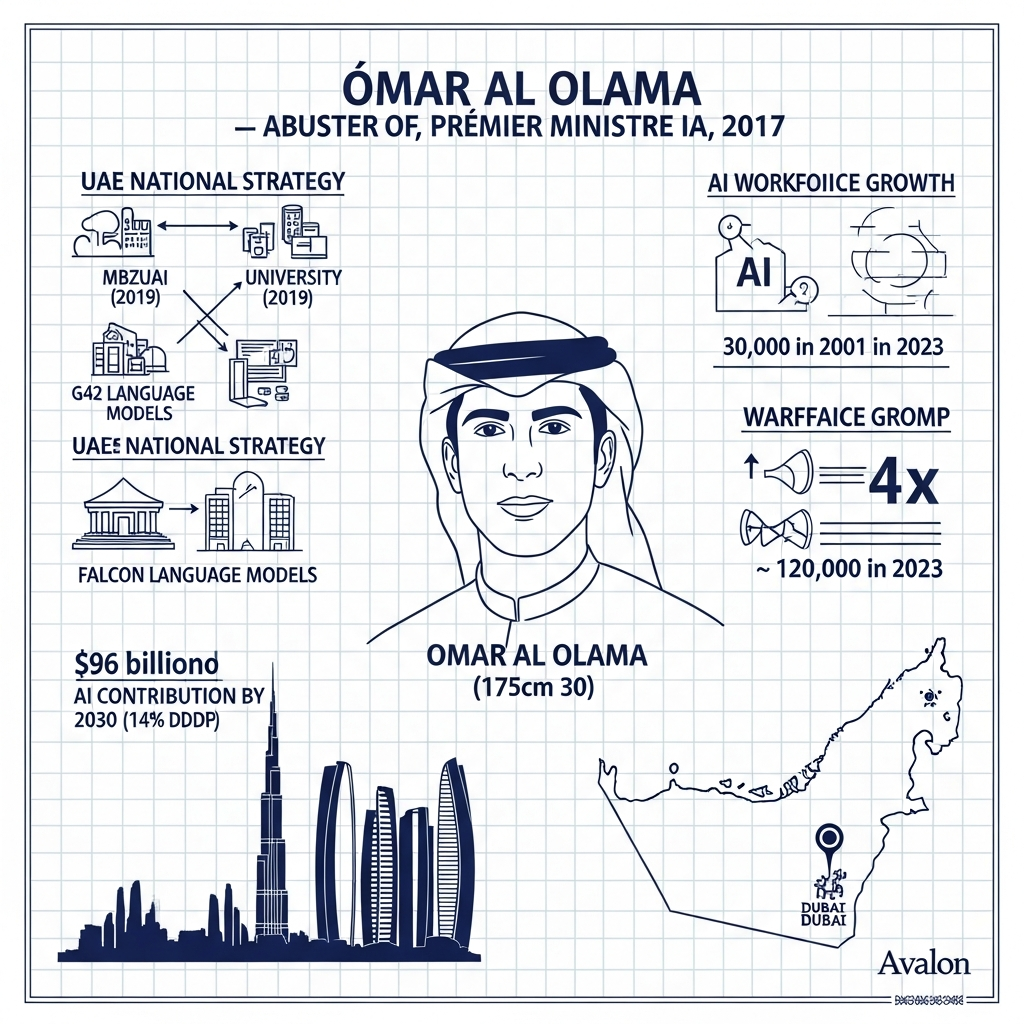
Omar Al Olama: world's first Minister of AI (UAE, 2017).
There are two ways to build a technological future. The first is born of necessity — when survival demands innovation. The second is born of vision — when wealth allows betting on tomorrow.
The Middle East has known both.
Yesterday — Vision and Necessity
In 2017, the United Arab Emirates did something no country had dared to do: they appointed a Minister of Artificial Intelligence. Omar Al Olama was thirty years old. He became the first in the world to hold this title.
This was not a symbolic gesture. It was a declaration of intent.
The Emirates knew what the world sometimes forgot: oil runs out. The reserves that had made the Gulf's fortune would not last forever. The economic model that had transformed fishing villages into metropolises of glass and steel had to be reinvented. Artificial intelligence would be the new oil.
"AI is probably the number one priority for the UAE in terms of investment and focus," Al Olama declared. The country was not doing things by halves.
In 2019, the Emirates created MBZUAI — the Mohamed bin Zayed University of Artificial Intelligence. It was the first university in the world entirely dedicated to artificial intelligence. Not an AI department within an existing university. An AI university — period. The best researchers in the world were recruited. Doctoral students received full scholarships. The objective was to train a generation of Emiratis capable of building AI, not just using it.
In 2022, the Technology Innovation Institute in Abu Dhabi launched Falcon — a large language model named after the UAE's national bird. The following year, Falcon 10B outperformed Google and Meta models on certain performance benchmarks. The Emirates did not just want to buy American AI. They wanted to create their own.
G42, the Emirati AI champion, emerged as a major player. The company, chaired by an influential member of the Abu Dhabi royal family, was developing massive AI infrastructure. In May 2024, G42 unveiled Falcon 2, powered by one of the largest supercomputers in the world. The model was open source — accessible to all, modifiable by all.
In April 2024, Microsoft invested one and a half billion dollars in G42. The deal had been preceded by negotiations between the American and Emirati governments. G42 agreed to distance itself from its Chinese partnerships in exchange for access to American technology. AI was becoming a geopolitical issue — and the Emirates were choosing their camp.
"On the AI front, I think there will be complete alignment between the UAE and the United States," Al Olama declared.
The numbers told a story of accelerated transformation. The Emirati AI workforce had quadrupled between 2001 and 2023, reaching one hundred twenty thousand workers. AI could contribute ninety-six billion dollars to the Emirati economy by 2030 — nearly fourteen percent of GDP. The desert was becoming a silicon garden.
The Startup Nation
Meanwhile, on the eastern coast of the Mediterranean, Israel was cultivating another type of garden.
The country that had built the WEIZAC in 1955 — one of the world's first computers, created by a nation barely six years old — had never stopped innovating. Unit 8200, Israel's equivalent of the NSA, had become, almost by accident, the world's largest startup school. Veterans who emerged from it founded cybersecurity, fintech, and AI companies. Check Point, Wiz, Palo Alto Networks: giants born from this military crucible.
In 2024, Israeli startups collectively raised twelve billion two hundred million dollars — an increase of thirty-one percent from the previous year. AI represented forty-seven percent of all investments and thirty percent of the country's startup ecosystem.
Israeli figures were staggering in their intensity. Since 2018, the share of AI investment in Israel had been three to four times higher than in Europe or the United States. Growth of active AI companies since 2014 reached one hundred seventy-three percent — far exceeding the growth of non-AI startups.
Wiz, a cybersecurity company founded in Tel Aviv, raised nine hundred million dollars in 2024, reaching a valuation of twelve billion dollars. It served more than forty percent of Fortune 100 companies. Island, specializing in secure enterprise browsers, reached a valuation of four billion eight hundred million dollars. Dream, an AI cybersecurity startup, became a unicorn with a valuation of one billion one hundred million dollars.
In December 2024, Nvidia acquired Run:ai, an Israeli AI infrastructure startup, for eight hundred million dollars. Ilya Sutskever, co-founder of OpenAI, established a research laboratory in Tel Aviv for his new company SSI — Safe Superintelligence Inc. Meta launched an AI accelerator in Tel Aviv. The ecosystem was attracting giants.
Hailo, founded in Tel Aviv in 2017, was designing specialized AI processors for edge devices — chips capable of data center performance with low power consumption. It raised three hundred forty-four million dollars and reached a valuation of one billion two hundred million dollars.
Israel was evolving, according to observers, from "startup nation" to "scale-up nation" — companies were demonstrating their ability to grow and compete on the global stage, not just be born and acquired.
The Ambitious Kingdom
Further south, Saudi Arabia was charting its own course.
Vision 2030 — the economic transformation plan launched by Crown Prince Mohammed bin Salman — placed artificial intelligence at the heart of the kingdom's future. The objective was to diversify an economy still dependent on oil, to create millions of jobs in technology sectors, to transform the country into a regional innovation hub.
Investments were massive. More than five hundred billion dollars allocated to megacity and smart infrastructure projects, including NEOM — a five-hundred-billion-dollar futuristic city being built from scratch in the desert, powered by renewable energy and piloted by artificial intelligence.
NEOM was to be a full-scale laboratory. Autonomous vehicles. AI-powered security. Service personalization through machine learning. A city designed not to adapt to AI, but around AI.
Saudi Arabia was targeting twenty billion dollars in AI investment by 2030. The annual contribution of AI to the economy was projected at one hundred thirty-five billion dollars — or twelve point four percent of GDP. The kingdom ranked first in the world for government strategy in Tortoise Media's Global AI Index.
In May 2024, SDAIA — the Saudi Data and Artificial Intelligence Authority — launched ALLaM, a large language model in Arabic, in partnership with IBM. In October, the Saudi sovereign wealth fund (PIF) announced a partnership with Google Cloud to establish an advanced AI hub near Dammam. Wa'ed Ventures, a Saudi venture capital fund, reserved one hundred million dollars for AI startups in the kingdom.
"We are reprioritizing somewhat toward the sectors that need it most, and today that is technology, artificial intelligence," declared Economy Minister Faisal Alibrahim.
Today — The Geopolitics of AI
The Middle East of AI had become a geopolitical chessboard.
The Emirates had chosen America. G42 had severed its Chinese partnerships. Microsoft's investment sealed a technological alliance. Omar Al Olama spoke of "complete alignment" with the United States on AI.
Israel remained anchored in the Western ecosystem. American giants — Nvidia, Meta, Google — were establishing offices there and acquiring startups. Israeli technology was feeding Silicon Valley.
Saudi Arabia was navigating more cautiously. It was working with IBM and Google, but also with Huawei. It was seeking to maintain relationships with all parties, not to close any doors.
This geopolitics of AI reflected deeper tensions. The race between the United States and China for technological dominance was also playing out in the Middle East. The Gulf countries, wealthy but technologically dependent, had to choose their suppliers — and their allies. AI was no longer just a technology. It was a tool of power.
Arabic-language models — Falcon, ALLaM, Jais — also represented an issue of linguistic sovereignty. Western large language models were trained primarily on English-language corpora. They poorly understood Arabic — its dialects, its nuances, its culture. Building Arabic models meant refusing to let the AI revolution happen without the language of four hundred million people.
G42 and MBZUAI were developing Jais, presented as the highest-quality Arabic language model in the world. Google was launching a fifteen-million-dollar fund to help with AI localization in Arabic. The stakes were ensuring that artificial intelligence speaks — and understands — the language of the Middle East.
Beyond — The Two Gardens
The Middle East presents us with two models of AI development.
The first is that of funded vision. The Emirates and Saudi Arabia are investing massively because they can — because oil wealth gives them the means to bet on the future. They are building universities, recruiting researchers, developing models, establishing hubs. They are transforming oil rent into technological capital.
This model has obvious advantages. Money attracts talent. Infrastructure enables experimentation. Political will accelerates decisions. The Emirates have created a significant AI ecosystem in less than a decade.
But this model also has limits. Money can buy researchers — it cannot buy a culture of innovation. Universities can be built — academic traditions take generations to form. Models can be developed — the fundamental research underlying them often comes from elsewhere.
The second model is that of cultivated necessity. Israel innovates because it must innovate — because its geopolitical situation demands permanent technological advantage. Unit 8200 trains engineers who found startups. The constant threat stimulates creativity. The small size of the domestic market pushes companies to target the world from the start.
This model has produced remarkable results. Israel ranks among the most dynamic startup ecosystems on the planet. Its cybersecurity companies dominate the global market. Its expertise in AI is internationally recognized.
But this model is also fragile. It depends on a specific geopolitical context — what would happen if peace were established? It relies on an educated and motivated population — what would happen if talent left? It is concentrated in a few sectors — cybersecurity, defense, fintech — that do not represent the entire field of AI.
---
The Middle East teaches us that AI can be born anywhere — even in the desert, even in regions that the West does not always notice.
It teaches us that wealth can be an accelerator — but not a guarantee. The Emirates have the money. They still need to prove they can produce innovation, not just buy it.
It teaches us that necessity can be a driving force — but not a universal solution. Israel innovates under constraint. Other countries cannot reproduce this constraint — and would not want to.
It finally teaches us that AI has become a geopolitical issue. Technological alliances reflect political alliances. The choice of suppliers is a strategic choice. The Middle East, historic crossroads of civilizations, is becoming a crossroads of the digital revolution.
Silicon gardens are blooming in the desert. They are irrigated by yesterday's oil and tomorrow's data. They produce Arabic-language models, Hebrew-language startups, infrastructure funded by sovereign wealth funds.
The question that remains open is whether these gardens are sustainable — whether they can survive the exhaustion of oil, geopolitical changes, technological evolutions. Whether they are temporary oases or permanent forests.
The desert has bloomed. The future will tell if it stays green.