Asia
Illustrations
1 / 10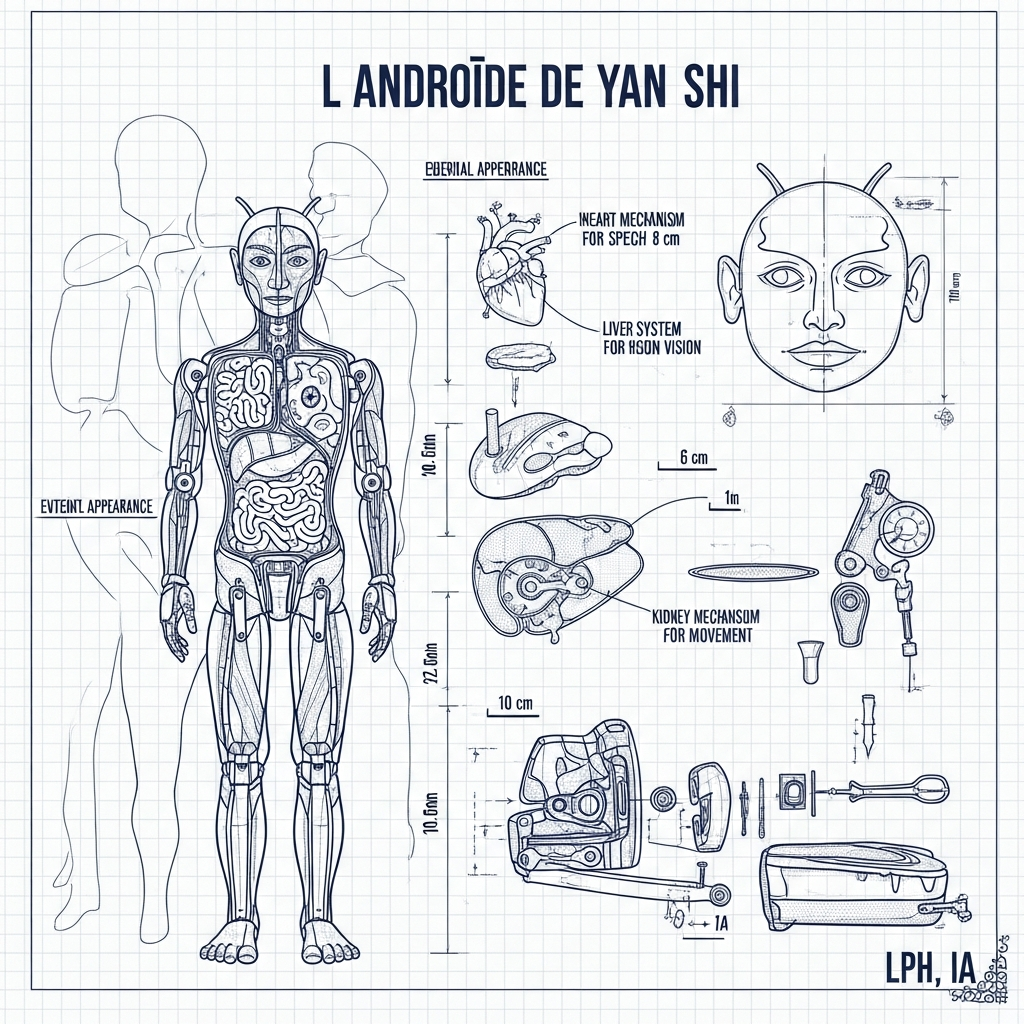
Yan Shi's android: first documented artificial creature, capable of singing and dancing before King Mu of Zhou (10th century BCE).
The Empire of Automata: When Ancient China Invented Thinking Machines
Three thousand years before the word "robot" was invented by a Czech playwright, a Chinese craftsman was dismantling before an astonished king the innards of an artificial creature capable of singing, dancing, and seducing. This scene, reported in a Taoist text from the third century BCE, is not an isolated case. It inaugurates a tradition of mechanical innovation that would span more than a millennium of Chinese history, from the Warring States period to the final centuries of Antiquity. The Middle Kingdom did not wait for the West to dream of thinking machines. It built them.
Yesterday — King Mu's Android
The story begins at the borders of myth and history, in tenth-century BCE China. King Mu of Zhou, fifth sovereign of his dynasty, was traveling through the western regions of his kingdom when a man named Yan Shi presented himself. This craftsman, whom the Liezi text calls an "artificer," wished to offer his talents to the monarch. But what he brought exceeded anything the court had ever seen.
Yan Shi unveiled a life-sized human figure, so perfectly made that the king at first took it for a living being. When its cheeks were pressed, the creature sang. When its hand was held, it danced with movements of exquisite grace. It walked with long rapid strides, moved its head up and down, and "anyone would have taken it for a living human being," the text tells us.
The spectacle ended with an incident that nearly cost its creator his life. At the end of the performance, the automaton winked seductively at the royal concubines. King Mu, furious, ordered Yan Shi's immediate execution. How dare this man present him with a creature capable of desiring his women?
Terrified, the craftsman dismantled his creation piece by piece before the monarch. Beneath the artificial skin appeared engineering marvels: a heart, lungs, a liver, a spleen, kidneys, intestines—all fabricated from leather, wood, glue, and lacquer. On the outside, tendons, bones, skin covered with hair, teeth, hair. A complete anatomy, entirely artificial.
The king, passing from anger to fascination, wanted to understand. He removed the heart: the automaton stopped speaking. He took out the liver: the creature went blind. He removed the kidneys: it could no longer walk. Each organ had a precise function in the general economy of the machine. King Mu left the demonstration convinced he had witnessed a marvel, murmuring that "human skill could equal that of the Creator."
This story, which some consider the first work of Chinese science fiction, poses questions that still resonate today. What distinguishes a machine from a living being? Can an artificial creature experience emotions, desire? And if it can, how should we treat it?
Today — Masters of Movement
Yan Shi was not alone. Through the centuries of Chinese Antiquity, a lineage of inventors pursued this quest for autonomous mechanical creatures, each contributing to an edifice of innovation unparalleled in the ancient world.
In the fifth century BCE, Lu Ban—the "Chinese Leonardo da Vinci"—fabricated a wooden bird capable of gliding for three days before touching the ground. Chronicles of the era report that he also created a wooden horse that walked on its own, and a phoenix so realistic that it "flew away" from its creator's workshop. Legend has it that he even sculpted a wooden immortal whose pointed finger toward the enemy state of Wu caused three years of drought—the first evocation of a machine capable of influencing the world from a distance.
His contemporary Mozi, philosopher and engineer, founded a school whose disciples were considered the "engineers" of ancient China. He himself allegedly invented a flying machine and designed mechanical defense systems so sophisticated that he could, through a simple demonstration on models, dissuade an entire kingdom from launching a war. Nine times, the opposing engineer presented siege tactics. Nine times, Mozi replied with an unprecedented countermeasure. The enemy exhausted his ideas; the philosopher still had strategies in reserve.
The Mohist school did not merely build machines. It developed a theory of optics, a formal logic, and a reflection on the nature of knowledge that rivaled that of the Greeks. The Mohists distinguished different types of knowledge: knowledge through direct experience, knowledge through testimony, and knowledge through reasoning. This classification foreshadows contemporary debates on the different sources of learning for artificial intelligence systems.
But it was with the south-pointing chariot that Chinese engineering reached a summit of abstract sophistication. This vehicle, whose first operational version was built by Ma Jun around the third century CE, bore a figurine whose extended arm always indicated south, regardless of the direction taken by the chariot. No magnet, no magnetic compass: the secret lay in a differential gear system of remarkable complexity.
The differential—that mechanism we find today in every automobile—integrated the differences in rotation between the two wheels to keep the pointer oriented toward the south. The Chinese had invented, fifteen centuries before the automobile industry, the principle that allows our cars to turn without the wheels skidding. They used it not for transportation, but to create an autonomous navigation system, ancestor of our GPS.
Ma Jun did not stop there. He perfected the design of repeating crossbows, created a puppet theater driven by a water wheel, and built war chariots equipped with automated figurines brandishing drums and cymbals. His contemporaries considered him the greatest engineer of his time, capable of "making mountains dance and rivers run."
Beyond — The Breath in the Machine
The history of these automata teaches us something essential about the nature of technical innovation. The Chinese creators of Antiquity did not simply fabricate ingenious mechanisms. They posed, with their own conceptual means, the fundamental questions that still drive artificial intelligence research.
Yan Shi's android possessed organs each of which fulfilled a vital function—a modular vision of behavior that anticipates the architecture of our computer systems. Removing the heart stopped speech; removing the liver suppressed vision; removing the kidneys paralyzed movement. Each component contributed to the whole according to precise rules. Is this not exactly what we do when we design neural networks with their specialized layers?
Lu Ban's birds, capable of flying for three days, embodied the dream of extended autonomy—the same autonomy we seek today in our drones and unmanned vehicles. Mozi's demonstrations, where simulation was enough to dissuade a war, foreshadowed the strategic use of models and simulations in modern decision-making.
The south-pointing chariot perhaps represents the most profound innovation. This device did not measure south directly, as a compass would. It calculated it, by continuously integrating the vehicle's movements. This is what engineers today call an inertial navigation system—the same principle that guides submarines, aircraft, and rockets when GPS signals are unavailable.
But beyond the mechanisms, it is the worldview that strikes us. For the ancient Chinese, the boundary between the living and the artificial was not as impermeable as we often believe. The concept of qi, the vital breath that animates all things, could circulate as well in a body of flesh as in a machine of wood and bronze. Yan Shi's automaton was not merely a mechanism—it was animated, in the literal sense of the term, by a vital principle that the craftsman had known how to capture and organize.
This vision may seem naive to us, pre-scientific. But it poses a question that our artificial intelligences force us to confront: what makes a system "think" rather than merely calculate? Where does true autonomy begin? And above all: what do we owe our creations?
The Chinese of Antiquity had no definitive answer. Neither do we. Perhaps it is precisely this unanswered question that has driven humans, for millennia, to fashion creatures of wood, bronze, silicon—mechanical mirrors in which we seek, tirelessly, our own reflection.
In Yan Shi's workshop as in the data centers of the twenty-first century, the same question remains: can one create a machine that, in some way, lives?
The Bronze Guardians: When Ancient India Created Machines with Spiritual Movement
There is a story told in the ancient texts of the Indian subcontinent, a story so extraordinary that it seems straight out of science fiction. It speaks of robot warriors guarding the sacred relics of the Buddha, of flying vessels crossing the skies at the speed of thought, and of engineer-gods forging mechanical wonders for the inhabitants of the Hindu Olympus. This story is not a modern invention. It is more than two thousand years old.
Yesterday — The Architects of the Sky
Before even the Greek philosophers formalized the rules of logic, Vedic India had already imagined its own creators of artificial beings. At the summit of this technical pantheon sat Vishwakarma, whose name literally means "he who makes everything." Divine architect, cosmic engineer, he was both the builder of the universe and the maker of celestial weapons. From his workshops emerged Indra's thunderbolts, Shiva's trident, Vishnu's spinning discus—and above all, the Pushpaka Vimana.
This celestial vehicle, described in the Ramayana with troubling precision, could travel "at the speed of thought" and transport its passengers thousands of kilometers in a few hours. The texts describe it sometimes as a winged chariot, sometimes as a multi-story flying palace, capable of rising into the clouds with a thunderous roar. Vishwakarma had first fashioned it for Brahma, the creator, before it passed into the hands of Kubera, the god of wealth, then was stolen by the demon-king Ravana.
This genealogy of the Pushpaka Vimana reveals something essential: for the ancient Indians, extraordinary machines were not anomalies but objects that circulated, were transmitted, changed hands. They had a history, a provenance, a lineage—exactly like the technologies we develop today.
Alongside Vishwakarma worked another figure, more ambiguous: Maya, the architect of demons. Do not confuse him with the philosophical concept of cosmic illusion, Māyā. Mayasura was a builder, an engineer versed in magic, astronomy, and military art. It was he who built the fabulous palace of the Pandavas at Indraprastha, a dwelling so sophisticated that its crystal floors resembled water and its water pools resembled solid floors. Visitors drowned believing they were walking, or stumbled believing they were swimming.
Maya's creations were called mâyâyantra—literally "magic machines." This term played on the double meaning of the word mâyâ: both the architect's name and the power to create illusions, deceptive forms that seduce or terrify. In ancient India, the boundary between engineering and enchantment did not exist. Any sufficiently sophisticated machine was, by definition, magical.
Today — The Battle Against the Automata
But the most extraordinary story comes from a Buddhist legend that mingles East and West in a dizzying tale. It begins at the Buddha's death, in the fifth century BCE. King Ajatashatru, sovereign of Magadha, was charged with protecting the precious relics of the awakened sage. Rather than entrust them to human guards, he hid them in an underground chamber near his capital, Pataliputra—and had mechanical guardians built to watch over them.
These automata bore a name that resonates strangely in modern ears: bhuta vahana yanta, which means in Pali "machines with spiritual movement." The terminology itself reveals a conception where the mechanical and the spiritual do not oppose but fuse. These metal warriors, armed with whirling swords, patrolled tirelessly in the darkness of the underground tomb, ready to cut down any intruder who dared approach the sacred relics.
Where did the plans for these extraordinary machines come from? Legend tells that a young man from Pataliputra had heard of the robot makers of Roma-visaya—the Indian name for the Greco-Roman Mediterranean world. These Western engineers, it was said, knew how to create all kinds of automata for commerce, agriculture, and even executions. But they jealously guarded their secrets.
The story then takes a dramatic turn. An engineer from Roma-visaya, knowing he was about to be murdered by his peers for wanting to transmit his knowledge, hid the plans for his machines in his own flesh. He made a deep gash in his thigh, concealed the precious documents there, then ordered his son to bring his body back to India after his death. Thus, supposedly, the secrets of Greek robotics crossed the seas and deserts to reach the Indian subcontinent.
Two centuries later, the powerful Emperor Ashoka—the same one who covered India with pillars engraved in ancient Greek—heard the rumor of the hidden relics. He searched until he found the underground chamber, but when he tried to enter, the mechanical warriors rose against him. A fierce battle ensued between the emperor and the automata. According to one version of the story, the god Vishwakarma himself had to intervene, shooting arrows into the bolts that held the rotating structures of the robots. According to another version, Ashoka had to pay a fortune to the engineer's descendant so he would reveal how to deactivate his creations.
This legend is not mere fantasy. It reflects a documented historical reality: in the third century BCE, two Greek ambassadors, Megasthenes and Deimachus, actually resided at Pataliputra. Ashoka corresponded with Ptolemy II of Egypt, each king sending emissaries to the other. The great pillars erected by Ashoka bear inscriptions in ancient Greek and mention Hellenistic rulers by name. The exchange of knowledge between Greece and India was not a myth—only the exact nature of this knowledge escapes us.
Beyond — Machines with Spiritual Movement
What does this plunge into the technical imagination of ancient India reveal? First, that the fundamental concepts of artificial intelligence—autonomy, decision, programmed action—are not Western inventions. Vedic and Buddhist India had already formulated these ideas with its own words, within its own conceptual frameworks. The bhuta vahana yanta of Pataliputra are the direct ancestors of our security robots, our patrol drones, our autonomous surveillance systems.
Second, that the circulation of technical knowledge between civilizations is as old as civilizations themselves. The legend of the engineer who hides his plans in his flesh testifies to an acute awareness of the value of technical knowledge and the dangers of its transmission. We speak today of technology transfer, intellectual property, industrial secrets—the ancient Indians were already telling these stories, in their own way.
Finally, that the expression bhuta vahana yanta—machines with spiritual movement—perhaps contains a wisdom we have lost. For the ancient Indians, there was no contradiction between the mechanical and the spiritual. A machine could be animated by a breath, an intention, a form of soul. This vision seems naive to us, pre-scientific. But perhaps it poses a question that our artificial intelligences force us to confront: what truly animates a machine that seems to think?
Today, in the laboratories of Bangalore and Hyderabad, Indian engineers develop some of the most advanced artificial intelligence systems in the world. They are part, perhaps without knowing it, of a millennial tradition. The thread connecting Vishwakarma forging the Pushpaka Vimana to developers training neural networks is not broken. It crosses centuries, empires, technical revolutions.
The bronze guardians still sleep in some underground chamber of our collective memory. They remind us that the dream of creating intelligent artificial beings belongs to no culture, no era. It is a human dream, universal, as old as our capacity to shape matter and ask ourselves what distinguishes the living from the inert. The ancient Indians called it yanta—the machine. We call it artificial intelligence. The word changes, the question remains.
And perhaps, deep down, we are still seeking what the kings of Pataliputra sought: not merely mechanical servants, but guardians capable of watching over what we hold most precious—our knowledge, our memory, our humanity.