Africa
Illustrations
1 / 5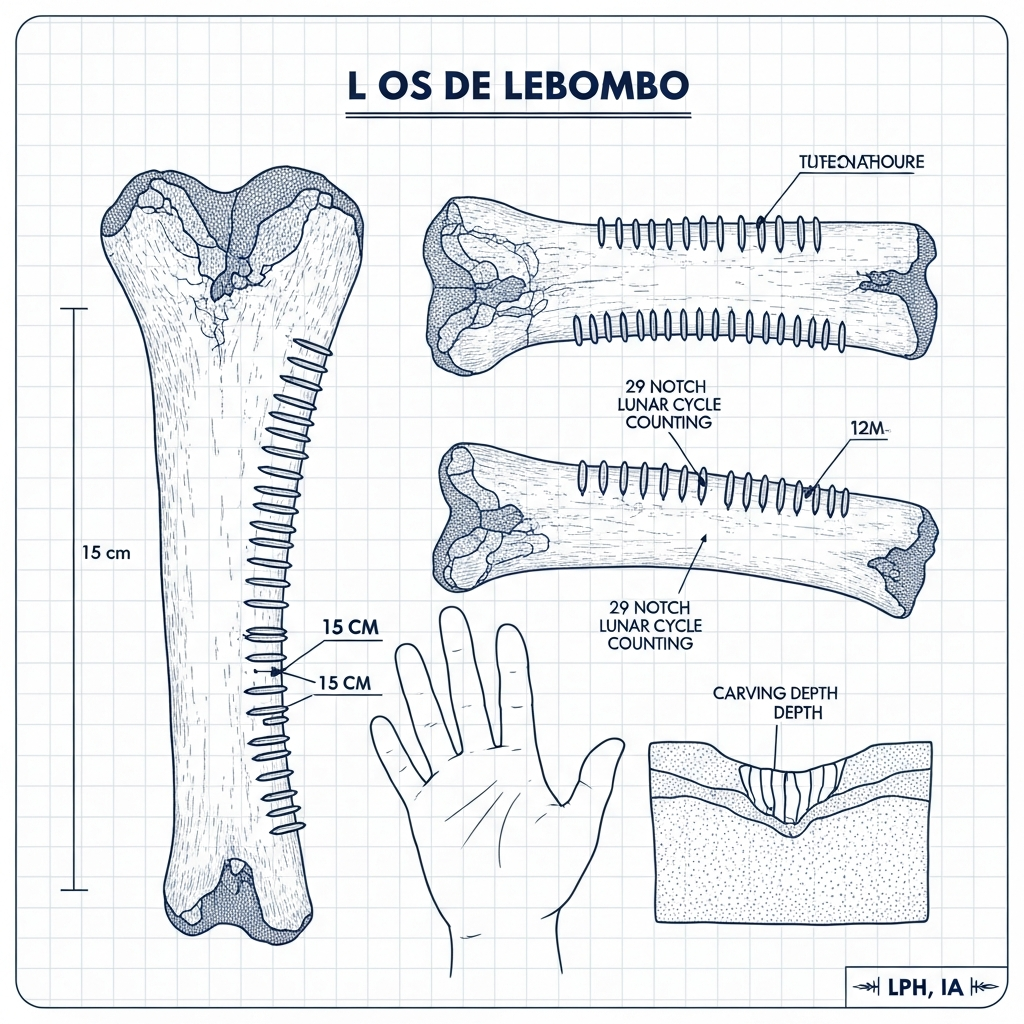
The Lebombo bone (43,000-35,000 years ago): 29 notches corresponding to the lunar cycle, discovered at Border Cave in South Africa.
Notches and Stars: How Africa Invented the Languages of Calculation
This article covers an extended period, from Prehistory to Antiquity, to demonstrate the continuity of mathematical and computational knowledge developed on the African continent.
Before writing, there was counting. Before temples, there were stone circles. Before computers, there were binary systems engraved in the memory of priests. The story we are about to tell does not begin in European universities or Silicon Valley laboratories. It begins in the caves of the Lebombo Mountains, in the plains of the Nubian desert, in Yoruba sanctuaries—at the heart of Africa, forgotten cradle of mathematical thought.
For it was there, forty thousand years ago, that human hands traced the first deliberate notches on a baboon bone. And it was there, millennia later, that a sophisticated divination system used binary code long before the West dreamed of inventing it.
Yesterday — Humanity's First Notches
In the 1970s, archaeologists excavating Border Cave, at the edge of South Africa and Eswatini, unearthed a baboon fibula fragment. The object, only a few centimeters long, bore twenty-nine distinct notches, regularly spaced. Radiocarbon dating revealed its staggering age: between forty-three thousand and thirty-five thousand years. The Lebombo bone had just dethroned all other known mathematical artifacts. It is, to this day, the oldest evidence of numerical thought ever discovered.
Twenty-nine notches. The number is not random. It corresponds almost exactly to the duration of a lunar cycle. Archaeologist Claudia Zaslavsky suggested that the creator of this tool—who may well have been a woman—was perhaps tracking the phases of the moon in relation to her menstrual cycle. If this hypothesis is correct, the first mathematicians in history would have been African, and their arithmetic would have been born from an intimate need to understand the passage of time.
Twenty thousand years later, at the other end of the continent, on the shores of Lake Edward in what is now the Democratic Republic of Congo, another bone was carved with manifest intention. The Ishango bone, discovered in 1950 by Belgian geologist Jean de Heinzelin de Braucourt, presents groupings of notches far more complex than simple tally marks. Mathematicians Dirk Huylebrouck and Vladimir Pletser recognized in it a base-twelve numeration system, with sub-bases of three and four—a sort of primitive slide rule.
Even more remarkable: the left column of the bone contains all the prime numbers between ten and twenty. Coincidence? Researchers doubt it. If these groupings are intentional, then the inhabitants of Ishango, twenty millennia ago, would have discovered prime numbers long before the Greeks formalized them. Abstract mathematical thought would not have been born on Mediterranean shores, but in the heart of equatorial Africa.
These bones were not isolated curiosities. They testify to a tradition of systematic thought that traversed the continent. Seven thousand years before our era, in the Nubian desert, one hundred kilometers west of Abu Simbel, nomadic peoples erected the oldest astronomical observatory ever built. Nabta Playa—a circle of standing stones oriented toward the summer solstice—predates Stonehenge by nearly two millennia.
Astronomers who have studied the site have identified alignments with Arcturus, Sirius, Alpha Centauri, and the constellation Orion. Astrophysicist Thomas Brophy proposed that three interior stones represented the three stars of Orion's Belt as they appeared in the sky seven thousand years ago. These cattle-worshipping nomads, who came from afar to perform their rituals when the monsoon rains arrived, had developed a sophisticated understanding of celestial movements.
From notches on a bone to stellar alignments, a single impulse runs through these innovations: the will to capture time, to predict cycles, to transform observation into reproducible knowledge. This is the very foundation of what we today call algorithmic thinking.
Today — Binary Code Before Code
If the Lebombo bone represents the prehistory of calculation, the Ifá system of the Yoruba perhaps represents its first maturity. Practiced for at least two thousand five hundred years in what is now southwestern Nigeria, this system of divination and knowledge uses a structure that any computer scientist would immediately recognize: binary code.
The system rests on two hundred fifty-six configurations called Odu, obtained through the combination of sixteen principal signs. Each Odu is represented by eight marks organized into four vertical pairs. A single line means "open"; a double line means "closed." Translated into modern language: one corresponds to open, zero corresponds to closed. Two to the eighth power equals two hundred fifty-six. We are looking at an eight-bit coding system, structurally identical to the EBCDIC code used in the first IBM computers.
The babalawo, the priest of Ifá, does not divine randomly. He calculates. Using his divination chain or sixteen sacred palm nuts, he generates a binary sequence that he then interprets by consulting a vast corpus of poetic verses—hundreds of texts associated with each Odu, memorized during training that begins in childhood and can last decades.
Ethnomathematician Ron Eglash, who studied sand divination systems in Senegal, recognized in these practices a "pseudo-random number generator" and a "digital feedback loop"—the same principles that drive modern algorithms. "Here is this absolutely astonishing digital feedback loop, which is indigenous," he noted with wonder.
Gottfried Wilhelm Leibniz, the German philosopher and mathematician who formalized the binary system in the West at the turn of the eighteenth century, knew of the existence of the Ifá system. He had discovered it through Jesuit missionaries who had traveled to Africa and China. In his correspondence, Leibniz expressed his admiration for "the profound philosophical binary logic" he perceived there. The West was rediscovering, two millennia later, what West Africa had codified for centuries.
But Ifá is not merely a calculation system. It is a living database. Each of the two hundred fifty-six Odu is associated with hundreds of verses—mythological narratives, ritual prescriptions, practical advice. The total corpus probably exceeds a million verses. And all of this is preserved in the memory of babalawos, transmitted from generation to generation through rigorous training that rivals the most demanding disciplines of the modern academic world.
Researchers in African science and technology have emphasized that these knowledge systems must be recognized for what they are: intelligent indigenous technologies. Not superstitions to be folklorized, but cognitive innovations to be studied. UNESCO understood this, inscribing the Ifá system on the Intangible Cultural Heritage of Humanity list in 2005.
Beyond — Another Path to Intelligence
Africa did not only invent binary calculation. It also developed a form of geometry that the West would not theorize until the twentieth century: fractals.
In 1988, American engineer Ron Eglash, studying aerial photographs of a Tanzanian village, was struck by a familiar pattern. The thatch-roofed huts were organized in circles of circles of circles—a recursive structure where the same pattern repeats at different scales. Eglash immediately recognized what he was seeing. He had worked in Silicon Valley. He knew what fractals were. And he was seeing them, not on a computer screen, but in the architecture of an African village.
His subsequent research revealed that this fractal geometry was not accidental. It was present in urban planning, hairstyling, textiles, sculpture, painting, metalwork, and even in divination systems. Sahel artisans made windscreens using a scale design that maximized efficiency for minimal material—an optimization algorithm before the letter.
These discoveries force us to rethink the history of mathematics. Recursion, self-similarity, scaling—these concepts we associate with modern geometry and computer science—were integrated into the daily practices of societies that Western historiography long labeled "primitive."
And then there is memory. In African oral societies, knowledge is not stored in books or hard drives. It is preserved in human minds, maintained by decades of training. The "men of memory"—oral historians, keepers of traditions—can recite genealogies spanning dozens of generations, historical narratives covering centuries, poetic corpora of thousands of verses.
Recent research has shown that these memory systems can preserve information with remarkable fidelity over millennia. Australian Aboriginal oral traditions contain precise descriptions of coastal landscapes submerged by rising waters at the end of the last ice age—more than seven thousand years ago. Human memory, properly trained and socially organized, constitutes a storage technology of extraordinary robustness.
We live in an era fascinated by the memorization capabilities of machines. Our artificial intelligences are trained on billions of texts, capable of regurgitating information with impressive precision. But they remain fragile—dependent on electricity, maintenance, technical infrastructure. African memory systems have survived invasions, migrations, political upheavals. They function without electricity, without servers, without software updates.
The history of artificial intelligence, as it is usually told, begins with Turing, with Shannon, with the Dartmouth conference in 1956. It is a story of air-conditioned laboratories, printed circuits, programming languages. It is true, but it is incomplete.
For before silicon, there was bone. Before computer code, there was Ifá code. Before the algorithms of our machines, there were the algorithms of our ancestors. And many of these ancestors lived in Africa, carving notches on baboon fibulas, aligning stones with the stars, transmitting from generation to generation calculation systems of a sophistication we are only beginning to recognize.
Artificial intelligence is not a break with the human past. It is its continuation. And to understand where we are going, we must first understand where we come from—from the caves of Lebombo to the circles of Nabta Playa, from Ifá sanctuaries to the fractal villages of Tanzania.
Binary is not a Western invention. It is an African heritage.