The Americas
Illustrations
1 / 5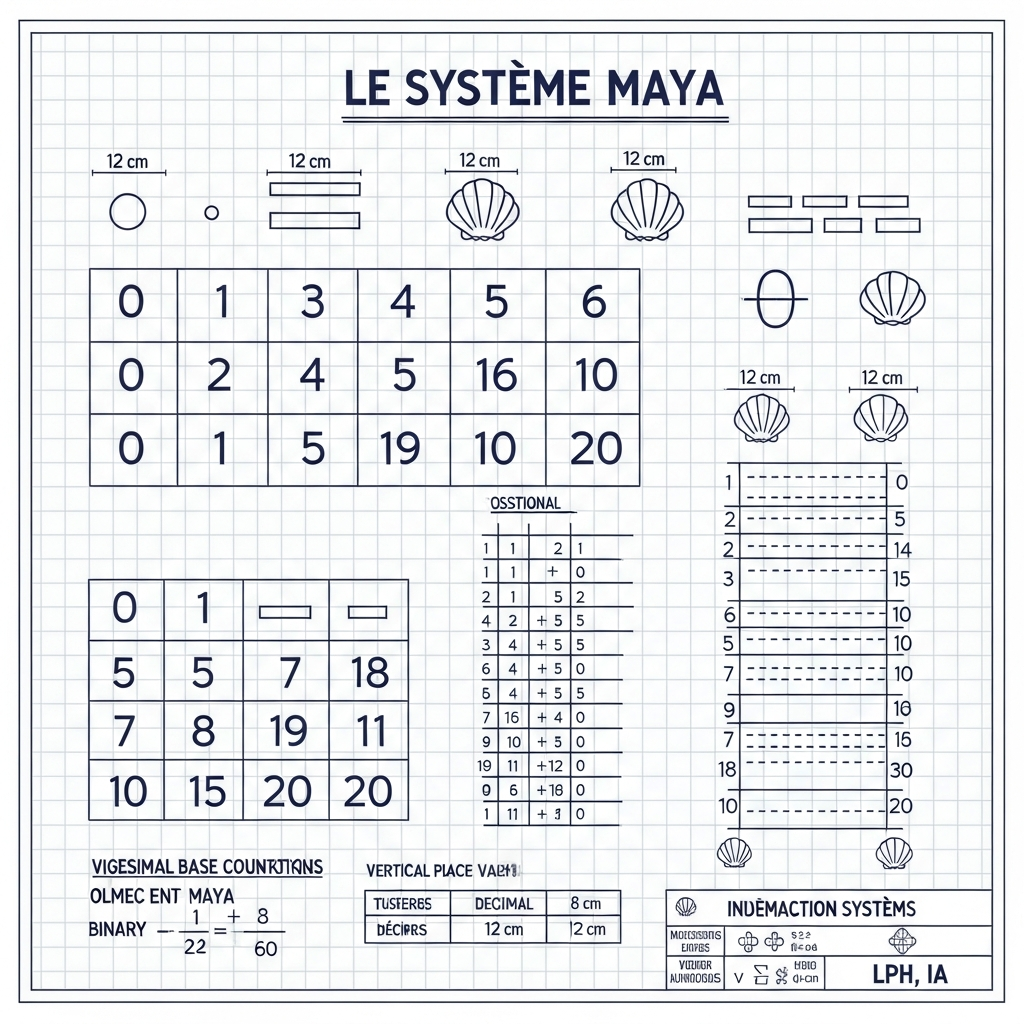
The Maya base-20 numeral system: dots (1), bars (5), and shell (0).
Zero and the Stars: How Ancient Mesoamerica Invented the Language of Time
There is a concept without which no computer could function, without which no algorithm could execute, without which modern mathematical thought would be unthinkable. This concept is zero—the revolutionary idea that an absence can be represented, that a void can have value, that nothing can count. And this concept, more than a millennium before it reached Europe, was invented in the tropical forests of Mesoamerica.
The civilizations of ancient America did not build automata in the manner of the Greeks or Chinese. They did not fabricate speaking statues like the Egyptians. Their contribution to the history of artificial intelligence is of another order—more fundamental, more abstract, more enduring. They invented the languages of calculation and time. Without these languages, our thinking machines simply would not exist.
Yesterday — The Revolution of the Void
Somewhere between 300 and 400 BCE, in the humid heart of what we now call Mexico, the Olmecs—that civilization archaeologists call the "mother culture" of Mesoamerica—developed a numeration system that required a symbol to represent absence. This symbol, drawn in the form of a shell evoking emptiness, was positional zero.
The invention may seem trivial to modern minds accustomed to manipulating zeros since childhood. It is not. Most of the great civilizations of Antiquity—the Romans, the Greeks, the Egyptians—never developed a true concept of zero. Their numeration systems, however sophisticated, did not allow them to represent nothingness as a quantity. The Babylonians sometimes used an empty space as a position marker, but without attributing any value to it. It took until the fifth century CE for zero to appear in India, and several more centuries for it to reach Europe through Arab mathematicians.
The Olmecs, then the Maya who inherited their knowledge, had solved the problem long before. Their vigesimal system—in base twenty, probably because the ancients counted on their fingers and toes—used only three symbols: a dot for one, a bar for five, and a shell for zero. With these three elements, they could represent any number, write dates spanning millions of years, calculate planetary trajectories.
Stela C of Tres Zapotes, dated to 32 BCE, bears one of the oldest inscriptions using this system. Other Olmec monuments, like the La Mojarra stela, confirm the antiquity of this invention. The Maya only inherited and perfected a system their predecessors had developed centuries earlier.
Today — The Architects of Time
The Long Count calendar, used from the first centuries of our era and probably developed from older traditions, allowed events to be dated over astronomical periods. Inscriptions found on stelae calculate dates situated more than four hundred million years in the past or future. Maya astronomers of Antiquity had determined the synodic period of Venus—the time between two returns of the planet to the same apparent position—at 584 days, with a precision that would not be matched in Europe for centuries.
But the Maya calendar was not merely a measurement tool. It was a system for integrating multiple temporal cycles. The Tzolk'in, sacred calendar of 260 days, intertwined with the Haab', solar calendar of 365 days, to form the Calendar Round—a 52-year cycle at the end of which the same date combinations repeated. This superposition of cycles, this capacity to think of time as an interweaving of different rhythms, strikingly foreshadows the data structures we use today in our computer systems.
Maya priest-astronomers observed the sky from observatories like Uaxactún, where aligned temples allowed equinoxes and solstices to be marked with precision. At Copán, stelae recorded the cycles of the moon and planets with remarkable accuracy. These observations were not mere curiosities. They served to predict eclipses, determine propitious dates for planting and harvest, rhythm the religious and political life of the cities.
The Dresden Codex, though copied at a later period, preserves astronomical tables whose origin dates back to Maya Antiquity. These tables made it possible to calculate the positions of Venus centuries in advance. They testify to a tradition of systematic observation that extended over generations, accumulating data and refining models.
Astronomy, here as elsewhere, was the mother of computation. To observe the stars is to measure time. To measure time is to calculate. To calculate is to abstract. And to abstract is to think.
Beyond — The Universal Language of Calculation
The contributions of ancient Mesoamerica to the history of artificial intelligence are both fundamental and underappreciated. Fundamental because without zero, without the concept of positional notation, without the idea that a system of symbols can represent any quantity, computers would not exist. Underappreciated because Western historiography long minimized the intellectual achievements of pre-Columbian civilizations.
This history teaches us something essential about the nature of intelligence—artificial or otherwise. The Olmecs and Maya had no electricity, no conductive metals, no semiconductors. Yet they solved computational problems of stunning complexity. Their astronomical tables predicted eclipses with a precision that European astronomers would not achieve until much later. Their calendars integrated cycles of different temporal scales into a coherent system. Their concept of zero—philosophical as much as mathematical—allowed them to think the infinite and the void.
These achievements invite us to rethink what we mean by "information technology." We tend to imagine computing as necessarily linked to electronics, integrated circuits, luminous screens. But computing, in its essence, is nothing other than the systematic processing of information according to defined rules. And this processing can be done with glyphs carved in stone as well as with transistors, with bars and dots as well as with ones and zeros.
The priest-astronomers of Copán and Tikal, calculating the position of Venus centuries in advance, practiced a form of computation. They had encoded in their codices algorithms that, methodically applied, produced predictable and reproducible results. These are not metaphors. These are information processing systems, as legitimate and sophisticated as those we use today—simply different in their material substrate.
We live in a world saturated with numbers, calculations, data. Our lives are rhythmed by algorithms that decide what we see, what we buy, what we think we know. We think of this digital revolution as something radically new, unprecedented in human history.
But in the ruins of Tikal, on the stelae of Copán, in the inscriptions of Tres Zapotes, another story is told. The story of civilizations that, without electricity or silicon, had understood that time could be measured, that information could be encoded, that calculation could be systematized.
Zero was not born in Silicon Valley laboratories. It was born in the tropical forests of Mesoamerica, invented by astronomers who scrutinized Venus and scribes who counted the days. Artificial intelligence, in its modern form, is the heir of these ancient inventions. It rests on foundations laid more than two millennia ago, on a continent that Europe did not yet know.
The glyphs and stars still speak. One need only know how to listen.